| Author |
 Replies: 6 / Views: 1,452 Replies: 6 / Views: 1,452 |
|
|
Pillar of the Community
Australia
653 Posts |
I recently picked up this fragmented (cut?) Venetian Grosso as a curiosity and because I like the powerful expressions of the Doge and the Lion on the LHS and Christ on the RHS. I believe it is an Alvise Contarini coin dated between 1684 and 1688. Sorry for the different colours of the coin on each side but I took the photo under electric light. I wonder why the coin was mutilated in this way? I suspect that it may have been cut as the missing part of the coin has near linear boundaries. Was the coin used as "small change" when this was not available and was it cut for this reason? Squire 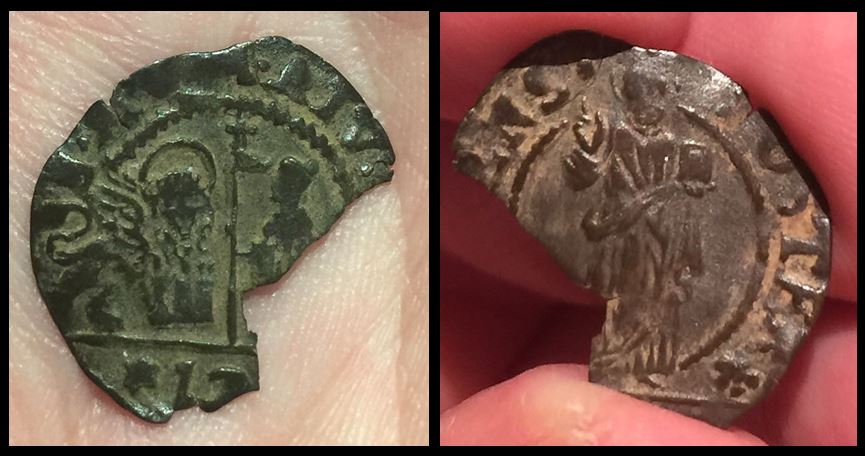 |
|
|
|
Moderator
 United States
34538 Posts |
SW, I'm happy to provide you with an opinion, but please note that this is a little outside my specialty. Alvise Contarini also issued a copper Soldo contemporaneously with your coin. That suggests to me that other options for "small change" existed in this time and place. That coupled with the non-straight and non-equal portioning of your coin suggest to me that this is just a broken flan. However, I will be very interested to hear what others think about your coin.
"If you climb a good tree, you get a push."
-----Ghanaian proverb
"The danger we all now face is distinguishing between what is authentic and what is performed."
-----King Adz
|
|
Bedrock of the Community
Australia
21789 Posts |
The coin wasn't mutilated.
It has fallen apart.
Two reasons for this:
internal silver crystallisation, or horn silver.
Either can make hammered and ancient silver coins very fragile.
Google 'horn silver', and 'silver crystallisation' to find more on these subjects.
|
|
Moderator
Australia
16967 Posts |
It would have been really tricky to deliberately cut the coin like this. Far easier would have been to cut it in a straight line, into halves and quarters, if cutting-for-change was required.
Conclusion: the coin is not cut, but torn apart.
These coins are quite thin, and of quite dilute silver. So it would have been brittle to start with. It would have gotten more brittle with age. At some point in the past (either not long after the coin was made, or more recently, during or after it was dug up out of the ground) it has been bent, and rather than simply folding along the bend (as a fresh, purer silver coin would have done) the coin has snapped.
Don't say "infinitely" when you mean "very"; otherwise, you'll have no word left when you want to talk about something really infinite. - C. S. Lewis
|
|
Pillar of the Community
 Australia
653 Posts |
Thanks for the response Sap, sel_69I and Spence  Some very interesting information about "horn silver / silver crystallisation" and coin fragmentation. Much appreciated  Squire Edited by Squire Wilson
03/04/2019 02:22 am
|
|
Pillar of the Community
2087 Posts |
I don't think it is a Grosso. I think it is a Solidino. Grosso was, for the time, pure silver (96-97%). You don't normally see such corrosion with Grosso. The solidino( which the design on your coin, matches) was 67% silver and was much more likely to corrode in the manner of your coin.
Edited by austrokiwi
03/07/2019 1:07 pm
|
|
Pillar of the Community
Australia
653 Posts |
Thanks for the useful feedback austrokiwi
Indeed the coin is a Solidino and not a Grosso
These coins are so thin it is no surprise that they can break when they deteriorate with age
Squire
|
| |
Replies: 6 / Views: 1,452 |
|










 Posted 03/03/2019 06:13 am


