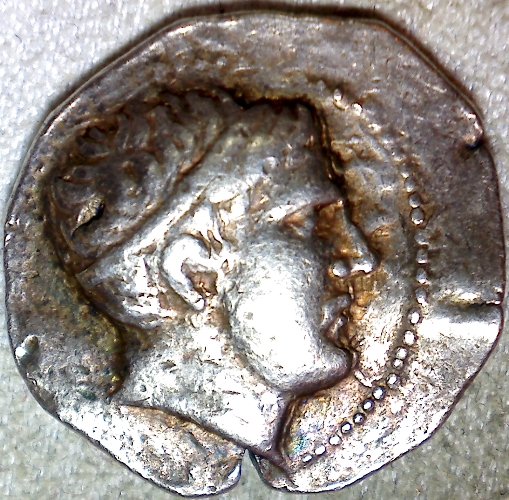
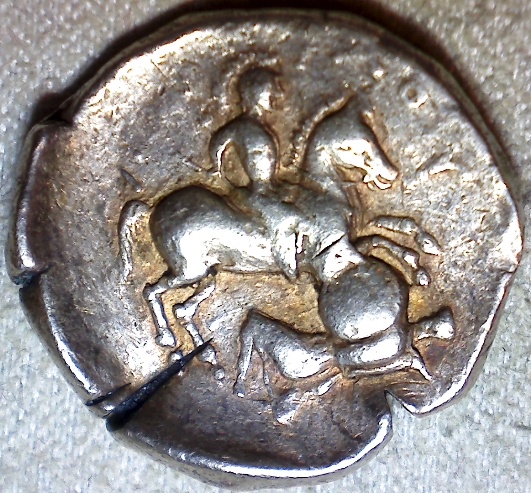
Here is another recent pick-up for me. With multiple test cuts, flan cracks, and a bit of resulting flan wave, this tet can surely tell a few stories. However, my favorite aspect is the design on the rev showing the horseman spearing a fallen warrior who is lying there just trying to protect himself with a shield. The rev inscription reads ΠATPAOY. This coin dates to between 335 and 315 BC and is attributed as S 1520 and SNG Oxford 3359. As mentioned in the title, it came entombed by NGC. Similar coins of King Patraos have shown up a couple other times on CCF:
http://goccf.com/t/171770http://goccf.com/t/138823&whichpage=2@ben, since your photobucket images are no longer loading on CCF, any chance of you posting your coin to this thread? For that matter, I'd be happy if all others posted their Paeonian coins here too.
A short history lesson about Paeonian taken directly from wikipedia:
Quote:
In the Iliad, the Paeonians are said to have been allies of the Trojans. During the Persian invasion of Greece the conquered Paeonians as far as the Lake Prasias, including the Paeoplae and Siropaiones, were deported from Paeonia to Asia.[1] In 355-354 BC, Philip II of Macedon took advantage of the death of King Agi of Paeonia and campaigned against them in order to conquer them. So the southern part of ancient Paeonia was annexed by the ancient kingdom of Macedon and was named "Macedonian Paeonia"; this section included the cities Astraion (later Stromnitsa) Stenae (near modern Demir Kapija), Antigoneia (near modern Negotino) etc.
The exact original boundaries of Paeonia, like the early history of its inhabitants, are obscure, but it is known that it was located immediately north of ancient Macedonia (which corresponded roughly to the modern Greek region of Macedonia), and to the south-east of Dardania (which was similar to modern-day Kosovo); in the east were the Thracian mountains, and in the west, the Illyrians.[2] It was separated from Dardania by the mountains through which the Vardar river passes from the field of Scupi (modern Skopje) to the valley of Bylazora (near modern Sveti Nikole).







 Posted 03/10/2019 3:02 pm





