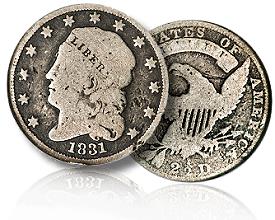
 Newly Discovered 1831 Quarter Eagle Struck on a Dime Planchet
In the earliest years of the Mint, dime and quarter eagle reverse dies were used on each denomination--apparently a conscious decision. The planchet sizes were close, 19 mm for the dimes and 20 mm for the quarter eagles.
The diameter of each denomination was later reduced when new machinery was introduced. The dime's diameter was reduced to 18.5 mm beginning in 1809, and the quarter eagle to 18.2 mm in 1829.
It is not a stretch to imagine the Mint striking a batch of dimes with a few unstruck planchets remaining in the hopper, then striking a run of quarter eagles, a couple of which were struck on leftover dime planchets. Only 0.3 mm separated the size of the two planchets, an imperceptible difference to the casual inspector.
What happened next is fairly obvious: nothing. This piece entered the channels of commerce and circulated as a dime for many years. Only recently and after 54 points of wear did someone notice that the design was inconsistent with that of an 1831 dime. This piece was found in a bag of silver in North Texas, in May of this year.
It is always interesting to scan the "Found in Rolls" column in
Coin World. Foreign coins, tokens, silver coins are constantly found in rolls. But an 1831 quarter eagle struck on a dime planchet in a bag of silver?
This is the second example of this off-metal striking that is known. The other piece is high-grade and has a distinguished pedigree including Brand, Opezzo, Farouk, Judd, and Sloss. It has been off the market since 1974, when it was traded privately, then it was withdrawn from the 1979
ANA Sale. Over the years that piece has been listed and delisted as a possible pattern.
Read Full Story |
Read More: Error Highlight Series 






 I guess I should have read the whole thing. I was too busy studying the error.

 Posted 08/18/2008 2:48 pm





