| Author |
 Replies: 14 / Views: 1,726 Replies: 14 / Views: 1,726 |
|
|
Valued Member
United States
182 Posts |
I purchased this lot as a lot of reproduction ancient coins. That being said, I have no expectations for ANY of these being authentic (I am guessing the seller knows, or has a reason to believe they are all reproductions). I purchased them so I could actually look at, and hold reproduction coins in my hand, so I can hopefully learn more about authentic vs reproduction ancient coins. The attached images appear to be black and white scans of the coins laid on a flatbed scanner. I do not have them in hand yet as I just purchased them a couple of hours ago online. This being said, do any of these stand out as possibly being authentic? I recognize many of them as known reproductions. Some of these coins are totally new to me though and coins I have never seen (real or fake). Is purchasing these on the pretense of learning from the fakes a good way of learning, or did I just waste a few bucks? Thank you for your time and input. Doug 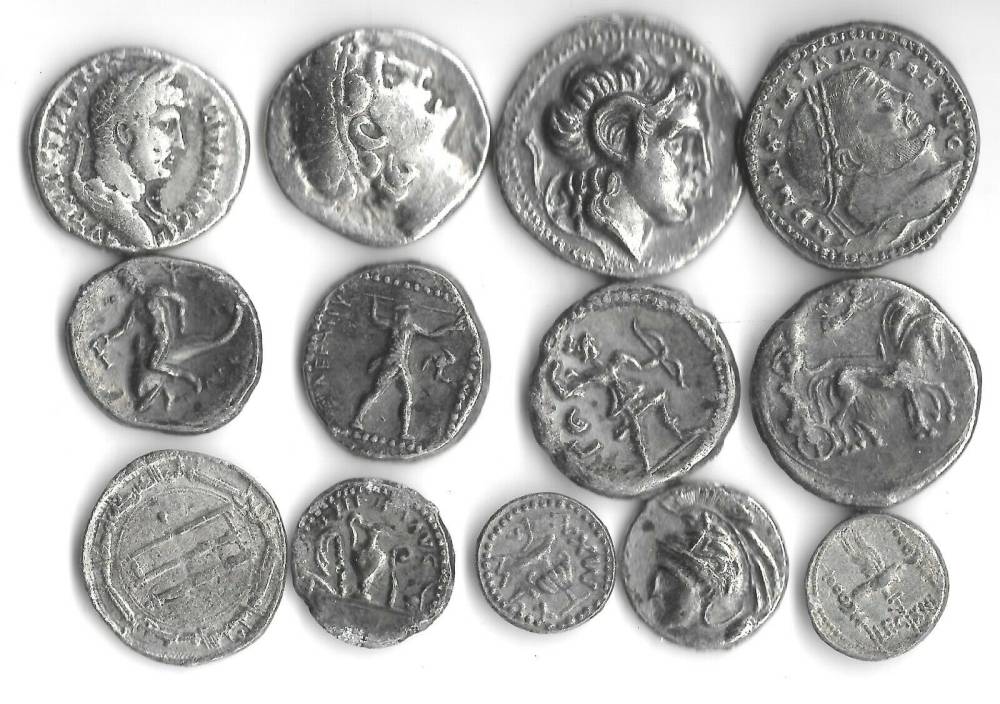 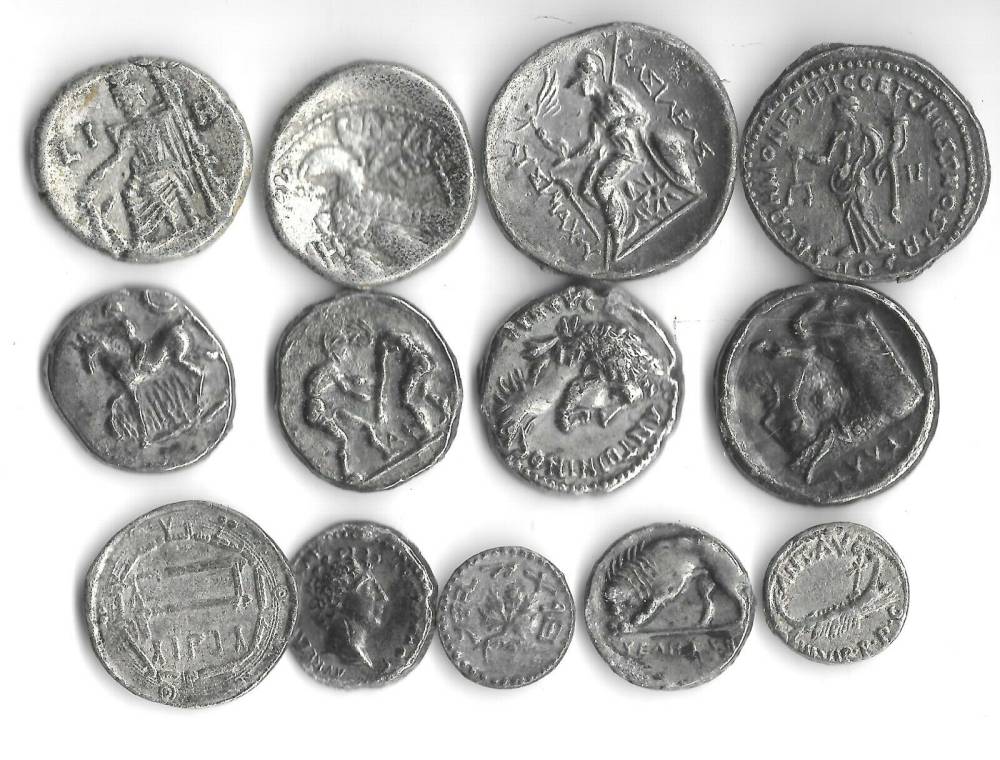 |
|
|
|
CCF Advertiser
 United States
1318 Posts |
Well they have no sign of being in the ground at all, and sadly they took the famous Bronze Jewish Roman War coin and made it "silver" (or whatever that metal is) which is kind of lazy of the reproduction company in my opinion. They could have purchased a different metal one would think for that coin.
|
|
Bedrock of the Community
United States
94367 Posts |
Guessing all are reproductions, but close-up pics needed to confirm. Start with those you feel have a chance.
Edited by Coinfrog
06/08/2019 9:17 pm
|
|
Valued Member
 United States
182 Posts |
That is the first one that absolutely stuck out as being very, very wrong. I have a couple authentic "First Revolt" bronze coins in my collection. I was just hoping that it looked "silver" because of being a B&W image from a flatbed scanner.
|
|
Pillar of the Community
United States
979 Posts |
Quote:
Is purchasing these on the pretense of learning from the fakes a good way of learning You learn what fake coins look like by knowing authentic coins. Having a reproduction coin will not benefit you, especially as you said you have never even seen authentic examples of some. Edited by Victor
06/08/2019 9:31 pm
|
|
Valued Member
United States
182 Posts |
@coinfrog, when I get them in hand, I will do that.
Does anyone know what the coin on the bottom left is a reproduction of?
|
|
Valued Member
United States
182 Posts |
Quote:
You learn what fakes coins look like by knowing authentic coins. Having a reproduction coin will not benefit you, especially as you said you have never even seen authentic examples of some. That makes a lot of sense. I am only out $5.00, so it isn't a big loss. I am hoping that at least one has some real silver in it... :) |
|
Pillar of the Community
United States
1005 Posts |
None of the color can be used as info here since it's a black and white scan
|
|
Pillar of the Community
United States
1554 Posts |
Quote:
Does anyone know what the coin on the bottom left is a reproduction of? The coin at lower left is intended as an 'Abbasid silver dirham, temp. Harun al-Rashid, AD 786-809, Madinat al-Salam (Baghdad) mint, dated AH 189. https://www.zeno.ru/showgallery.php?cat=12286Edited by Kushanshah
06/08/2019 11:54 pm
|
|
Moderator
United States
23731 Posts |
They all appear to be fake.
|
|
Bedrock of the Community
Australia
21789 Posts |
All look to be reasonably good fakes, but they may not be so deceiving when inspected in hand.
Here is a classic case as to why I maintain a large collection of fake ancient coins, for my own education.
Cheaper fakes tend to be cast, so one should look for edge joins, or evidence of them being removed. Cast coins tend to have a greasier feel to them, and the design detail tends to be less distinct.
Edge splits show no signs of tensile metal distress.
Pressure cast coins are a bit harder to detect, but the surface texture although much finer, still tends to betray them under high magnification.
Die struck fakes are often betrayed by style.
All fakes are susceptible to detection by weight and suspicious alloys.
High quality fakes in good quality gold or silver are often betrayed by lack of a verifiable provenance, XRF analysis, and comparison of types and styles against pictures on published data bases.
If you don't know or are unsure, take the suspected coins to a museum, a professional coin dealer who knows what what he is talking about, or submit them for slabbing.
After all of this, if you are still not completely happy, then walk away.
|
|
Valued Member
United States
182 Posts |
I really appreciate all of the great advice on these coins. When I actually get them in hand, I will as questions, if I have them, about what gives them away as reproductions. Thank you.
|
|
Moderator
Australia
16985 Posts |
The only one that isn't a "really good fake" is the brass replica of a Gela tetadrachm, centre row, far right. That particular replica coin has been seen on the fourm many, many times - it was mass-produced by Readers Digest some time in the 20th century and distributed glued to a card advertising a book on ancient Greece; the large crater on the man-faced-bull's neck was put there onthe replicas to provide a pit for the glue to stick to. They are supposed to have the word "COPY" stamped on them, below the chariot; perhaps not surprisingly, I have seen several where someone has attempted to erase that word off the coin. This example shows it nicely. This coin, plus a couple of your other replicas can also be seen in this old thread. The "Ferengi-ear" Lysimachus tetradrachm and the follis of Maximianus are noted. Fake coins have differnt origins and reasons why they were made. The Gela tetradrachm was made in the West for advertising purposes and was not really intended to fool anyone. The Aspendos coin (middle row, centre left) looks suspiciously like one that I bought from the museum souvenir shop in Aspendos, Turkey - these "museum replicas" are sold to tourists, again clearly marked as replicas. Others, like the Romano-Egyptian tetradrachm (top row far left) have the "tourist copy" look to them; such coins are sold in the street markets of touristy places (like Egypt) and are not clearly labelled as replicas; they hope that gullible tourists will assume they are real. As for "what gives them away", there are numerous answers, as these appear to be sourced from different origins. Some are matches to well-known fake coins, easily found on databases of fake coins such as the FORVM fakes database or the fake and fantasy sections of zeno.ru. Others, it's the general appearance - the "style" of lettering is wrong, or the artwork is badly copied and/or wrong for the time period, or the surface is "porous" from being crudely cast. Owning fake coins as a "reference" or "education" is fine (and many of us have such pieces, for that reason), but you really do need to know what the genuine ones look like, as a comparison. Just like with modern money: owning a bunch of play money or other counterfeits will not help you identify genuine banknotes. What you need to do is get real familiar with the real, and learn all the distinguishing features of real money, so that when a fake comes along, you can spot it at once. Don't say "infinitely" when you mean "very"; otherwise, you'll have no word left when you want to talk about something really infinite. - C. S. Lewis
|
|
Valued Member
United States
182 Posts |
Generally speaking, on reproductions (or fakes) or silver coins, are the reproductions usually a silver plated base metal coin or actually silver? I understand the higher the quality of the reproduction, the better chance of being silver. Is water displacement the most reliable (non destructive) way to know...after the magnet test?
|
|
Bedrock of the Community
Australia
21789 Posts |
The quickest way to get a good determination for fake or otherwise, it to take the suspect coin to an experienced professional.
There are many tests and examinations that can back up such an opinion,
however posting a picture here on the CCF is a good place to start.
There some very good opinions that can be asked for here in the CCF. The opinion of Sap is one of those.
|
| |
Replies: 14 / Views: 1,726 |
|







 Posted 06/08/2019 9:16 pm





