To participate in the forum you must log in or register. | Author |
 Replies: 156 / Views: 23,429 Replies: 156 / Views: 23,429 |
|
|
|
Pillar of the Community
 United States
6130 Posts |
Caligula, 37 - 41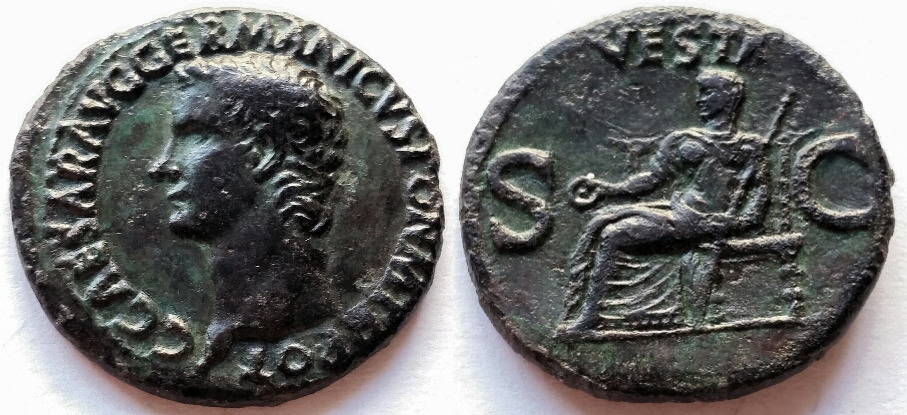 Caligula AE As C CAESAR AVG GERMANICVS PON M TR POT, Bare head left VESTA / S-C, Vesta seated left, holding patera and scepter Born in AD 12, Gaius Caesar was the son of the famed general Germanicus and Agrippina the Elder; thus he was the grandson of Augustus. In his youth, he spent much of his time on campaign with his father, where he was the nickname Caligula (Latin for Little Soldier's Boot) from the troops, as his father had a miniature soldier's uniform made for him as a toddler. Following the death of his father in 19, nearly his entire family was purged by Tiberius, though Caligula was spared and in 31, brought to Tiberius' retirement estate at Capri, where it is alleged he was sexually abused. Caligula was named heir jointly with Tiberius Gemellus in Tiberius' will, and some historians claim that the sick and elderly emperor was smothered by Caligula or his agents. Caligula quickly outmaneuvered Gemellus to have the will nullified and himself proclaimed sole inheritor, and adopted Gemellus as his son and heir to prevent any retaliation. His return to Rome was universally celebrated out of fond memories of Germanicus. He spent his first six months generously attempting to right the wrongs dealt upon the Romans by his predecessor. In October 37, Caligula fell seriously ill; some contemporaries suspected an attempted assasination by an unknown party, possibly Tiberius Gemellus, who was blamed and executed for treason. Caligula recovered, but quickly descended into a depraved madness. He executed or assassinated most of those close to him who occupied a position to challenge his rule, and succeeded in blowing through Tiberius' enormous 2.7 billion sestertii treasury surplus in his first year. Caligula did initiate some building projects for the good of Rome, including expanded sea ports and new aqueducts, although these are usually overshadowed by his elaborate and wasteful personal projects, including at least two floating palace-ships and a two-mile pontoon bridge erected for no reason other than to prove a soothsayer wrong (who said he had no more chance of becoming an emperor than riding his horse across the Bay of Baiae.) Caligula is perhaps best remembered for his erratic, irresponsible, and depraved personal behavior. In addition to the wasteful and paranoid behaviors mentioned above, he famously seems to have attempted an invasion of the British Isles; perhaps rough seas thwarted his plans--he declared war on Neptune and had his soldiers stab the water and then collect seashells as plunder. He declared himself to be a living god, and demanded to be worshiped in Rome, which was appalling to Roman religious and moral sensibilities. Additionally, he was overly fond of his favorite horse, Incitatus, to the point that had a marble house built just for this horse, and attempted to make him a Consul in the Senate. Unsurprisingly, his relationship soured with both the Senate and the public, culminating in 41 when members of the Praetorian guard succeeded in overwhelming and stabbing their emperor to death on January 22 or 24, AD 41, when he was 28 years old. The Senate responded to the news by attempting to re-institute the Republic, but the army and public called for a successor. In the chaos, Caligula's wife and infant daughter were murdered.
|
|
Pillar of the Community
United States
6130 Posts |
Claudius, 41 - 54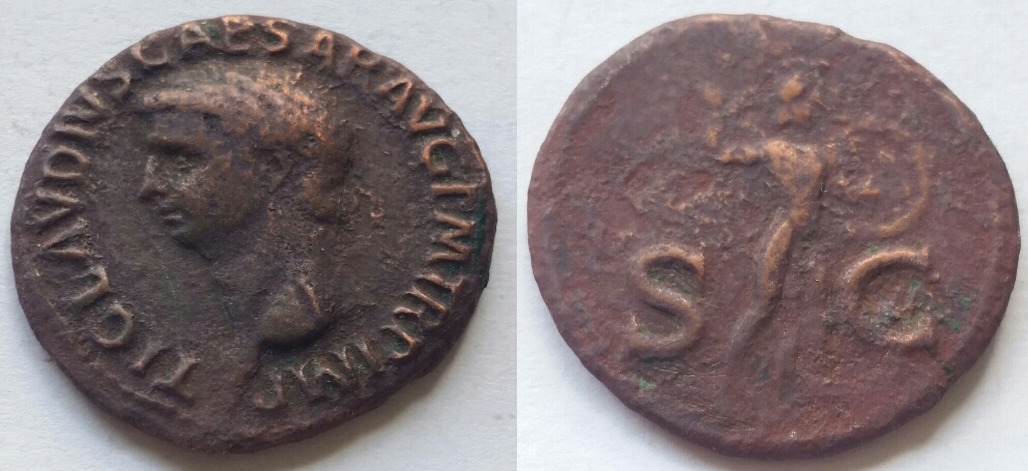 Claudius AE As TI CLAVDIVS CAESAR AVG PM TRP IMP, bare head left S-C, Minerva standing right, raising javelin Unlike his illustrious brother Germanicus, Claudius was an outcast from a young age, due to an unknown affliction (cerebral palsy and Tourette's have been suggested) that caused him to limp, stammer, drool, and have periodic seizures. Kept from the public eye, Claudius contented himself with scholarly pursuits, focusing on history and language. While his family was initially impressed with his studies, he crossed the line when he wrote a history of the Civil Wars that rubbed Augustus the wrong way, and Claudius was again pushed to the background. When Tiberius died in 37, Claudius, now middle aged, caught his lucky break and was nominated as co-consul with the new emperor. Claudius was used as little more than the object of Caligula's cruel humor, but he was nevertheless at the forefront of public and political thought when Caligula was assassinated in 41. According to legend, Claudius, fearing for his life, fled and hid behind a curtain and was declared Princeps upon being discovered. Initially hesitant to accept the nomination, Claudius appeared before the Senate, who ratified the appointment after some considerable debate. To everyone's surprise, many of the new emperor's ailments seemed to rectify themselves once he found himself in a position of absolute power; leading some to suspect that he had exaggerated his condition for most of his life to avoid the attention of potential assassins. Although some historians paint him as a man of weak character - a gambler, quick to anger, easily swayed by emotion, and dominated by the women in his life - Claudius was an efficient administrator. He undertook the largest campaigns of conquest since Augustus, most famously conquering much of Britannia. He built and restored aqueducts and roads and shifted a great deal of power back to the Senate while placing pressure on them to perform up to his standards. The women of his life were ultimately his downfall. Following two divorces early in his life, his third wife Messalina engaged in an excessive number of very public and damaging sexual affairs. This culminated in 48 AD when she married her lover Gaius Silius in a public ceremony while Claudius was away at Ostia. Ostensibly she did this because she thought Claudius incapable of safeguarding the future of their son Britannicus. Enraged, Claudius had his wife, her lover, and their entire political circle executed. Realizing the need to consolidate his position, he married his niece Agrippina the Younger and adopted her teenaged son, the future emperor Nero. Nero and Britannacus were then made joint heirs, although Britannacus was far too young to be considered a potential candidate for the Purple. Over the next few years, as Nero asserted himself as the heir of Claudius, Agrippina began clearing the field for her son to assume the purple. Claudius fell suddenly and violently ill and died on 13 October 54; nearly all ancient sources agree that he was murdered by Agrippina by way of poison, probably by sneaking toxic mushrooms into his food.
|
|
Pillar of the Community
United States
6130 Posts |
Britannicus Caesar, d. 55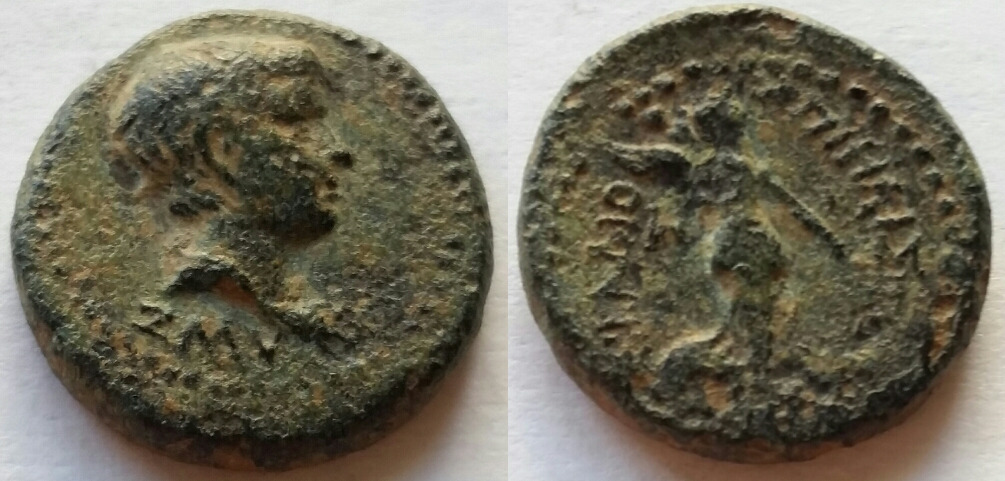 Britannicus Caesar AE 17 of Ionia, Smyrna Bare head right, ZMYP below #1028;ΠI ΦIΛIΣTOY - #1028;IKAΔIOΣ, Nike advancing right, trophy over shoulder Born in 41 AD to Claudius and Messalina, Britannicus was the first Roman Caesar to be born in the purple, although he would never live to rise to the Principate. In his youth, Britannicus was tutored under Sosibus, and was a close childhood friend of the future emperor Titus. Upon his mother's death in 48, public opinion shifted toward Lucius Domitius, the future emperor Nero. After being pressured into marrying his niece Agrippina, Claudius adopted Domitius and made him joint heir with Britannicus, although Nero used his age and influence of his mother to outmaneuver Britannicus and ultimately inherit the purple alone in 54 upon the death of Claudius. Early in the reign of Nero, the new emperor began to butt heads wit his mother, who ultimately threatened to support Britannicus to keep her son in line. Britannicus' 14th birthday was on 11 February 55, which would mark his transition into manhood under Roman law and thus make him a potential threat to the emperor Nero. At an uncertain date before that date, Nero poisoned Britannicus at a banquet to end his potential claim to the purple.
Edited by Finn235
06/12/2019 02:43 am
|
|
Pillar of the Community
United States
6130 Posts |
Agrippina the Younger, wife of Claudius, mother of Nero, died AD 59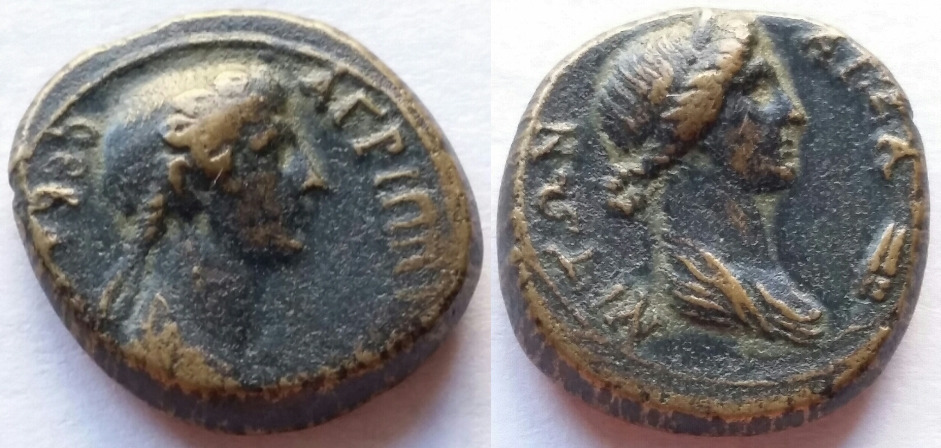 Agrippina II AE16 of Aezanis, Phrygia AΓΡIΠΠINAN CEBACTHN, draped bust right AIZANITΩN, draped bust of Persephone right, ear of corn before Born 6 November 15, Agrippina was the daughter of Agrippina Major and Germanicus, thus the great-granddaughter of Augustus and of Mark Antony, the granddaughter of Agrippa, the sister of Caligula, and the niece of Claudius. Initially travelling with her father and siblings, she was sent to Rome to be raised by her grandmother Antonia. Her mother returned to assist in raising her after the death of her father in 19, and she began aspiring to greatness under the influence of her powerful female relatives. She married her cousin Gnaeus Domitius Ahenobarbus at the age of thirteen in 28, although the marriage was unhappy and remained childless for nine years - historians describe Ahenobarbus as a despicable and dishonest man. Along with her sisters, Agrippina was given high honors when her brother Caligula came to power. Already pregnant, she gave birth to Lucius Domitius Ahenobarbus, the future emperor Nero, on December 15, 37. Caligula became increasingly unhinged throughout 38, and after the death of their sister Drusilla, Agrippina and Livilla conspired to murder their brother to replace him with Lepidus, Drusilla's widower. The plot was thwarted, and the sisters were stripped of all of their belongings and exiled. Lucius (Nero) was allowed to remain in Rome. Agrippina was able to return from exile upon the death of Caligula in 41 and the rise of her uncle, Claudius. She tried in vain to seduce and win over the future emperor Galba around this time. She married Gaius Sallustius Crispus Passienus later that year, under the urging of Claudius. During this time, Claudius' wife Messalina attempted to assassinate Lucius (Nero) but failed. Agrippina was widowed a second time in 47 - by this time, her popularity with the public had grown, which was sympathetic to the numerous hardships she had endured. Messalina was executed on charges of conspiracy in 48, and Agrippina began tugging at political strings to get advisors to urge Claudius to marry his niece and unite the Julian and Claudian family trees. Claudius relented and they were married on the first day of 49, despite the immorality of the incestuous (but not strictly illegal) marriage. Her position now secure as Empress of Rome, Agrippina began systematically and ruthlessly clearing the field of everyone who could challenge her or her son. Accusations of black magic and incest saw many opponents exiled, while she had others assassinated. A year later, she received the title of Augusta, being the third to hold this most prestigious honor. She persuaded Claudius to adopt her own son, despite having his own heir in Britannicus. Lucius was then renamed Nero, who was married to his step-sister Octavia in 53. Around this time, Claudius reportedly came to his senses and realized that his empire and bloodline were being wrestled from his control, but before he could outmaneuver his wife, Agrippina poisoned him with deadly mushrooms, killing him on October 13, 54. Claudius out of the way and Britannicus too young to assume office, Agrippina now controlled the empire through her son, who initially did her bidding without question. She soon had a falling out with Nero over her son's illicit love affair, and threatened to support Britannicus and have him elevated to the Principate. Nero then had Britannicus killed, sparking a deadly power feud. Nero had his mother expelled from the palace, and then in 57 exiled her to Misenium, where they both tried to be as much of a headache as possible to each other. Tensions boiled over until Nero finally resolved to kill his mother in early 59. Ancient historians are contradictory on the actual method or motive behind the matricide, but all describe an elaborately-designed boat that collapsed or sank itself with Agrippina on board. All accounts recall that she survived the self-sinking boat, only to be assassinated soon after. She died on March 23, 59, aged 43. Despite years of hostility between them, Nero was reportedly consumed with regret over the death of his mother, and haunted by nightmares and reportedly her ghost.
|
|
Pillar of the Community
United States
6130 Posts |
Nero, 54 - 68 Nero AR Denarius IMP NERO CAESAR AVGVSTVS, Laureate head right IVPPITER CVSTOS, Jupiter seated left, holding scepter and thunderbolt Born on 15 December 37, Nero was the last of the Julio-Claudian line; the first emperor who did not live during the lifetime of either Augustus or Tiberius. His biological father died when he was two or three years old; he became Claudius' adoptive son when he was twelve. Being several years older than Britannicus, Nero fast-tracked around his adoptive brother to become Claudius' primary heir, and succeeded him at the age of 16 in 54. Just months later in February 55, Nero succeeded in having Britannicus poisoned at a banquet. Initially a pawn for his mother Agrippina, Nero began to try to rid himself of her influence, leading to a power struggle that culminated in matricide in 59 AD, an action that haunted Nero for the rest of his life. From that point, Nero became increasingly unhinged, seeking personal pleasure above all else. Although much of the general public enjoyed a "pretty boy" emperor who was an accomplished poet, musician, and patron of the arts, opinion soured following the Great Fire of 64, propelled by the rumor that Nero played the lute and sang while he watched his city burn. That same year, he "married" his freedman Pythagoras while assuming the role of the wife in a Roman marriage. In 65, he reportedly kicked his pregnant wife, Poppaea Sabina to death following a domestic argument. The following year he married Statilia Messalina, and also took a young eunuch named Sporus as a second "wife" - It is said that Sporus looked much like Poppaea. By this time, Nero's reputation both among the public and the Senate had soured. Vindex, a general in Gaul, rebelled in 68, supported by the future emperor Galba, who was the governor of Hispania. Although Vindex was defeated, the legions began to declare their loyalty to Galba. Nero's inner circle evaporated, and in the summer of 68 he learned that he had been tried in absentia, named an enemy of the state, and sentenced to death. Although the Senate wished to preserve Nero's life at least until he could produce a legitimate heir to carry on the Julio-Claudian bloodline, on 9 June 68, Nero committed suicide, surrounded by his last few loyal supporters. He was 30 years old.
|
|
Pillar of the Community
United States
6130 Posts |
Poppaea Sabina, Second wife of Nero, d. 65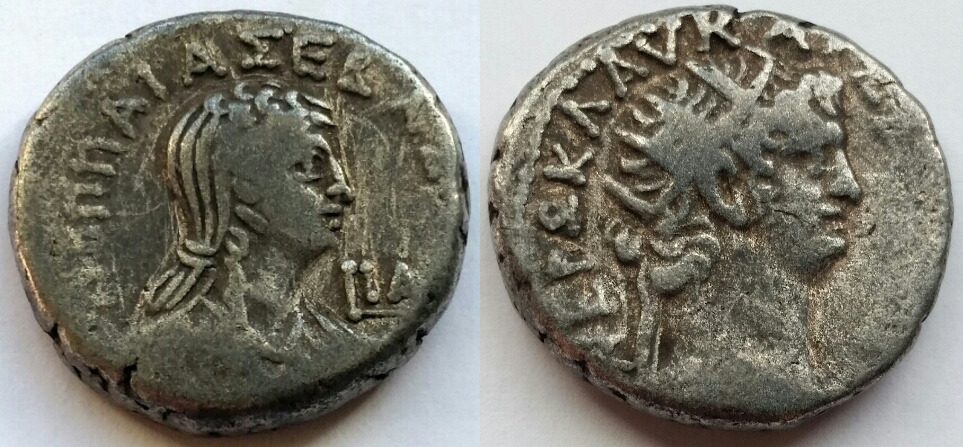 Poppaea BI Tetradrachm Alexandria, Egypt ΠOΠΠAIA ΣEBAΣTH, draped bust of Poppaea right, LIA to right NEΡΩ KΛAY KAIΣ ΣEB ΓEΡ AV, radiate head of Nero right Year 11 of Nero = 64-65 AD Born in 30 to an aristocratic family in or near Pompeii, Poppaea Sabina's family was ruined when her father's career was ended by his friendship with Tiberius' second in command, Sejanus. Her mother fell victim of the intrigues of Claudius' wife Messalina in 47. When she was 14 years old, Poppaea married Rufrius Crispinus, the Praetorian Prefect under Claudius. Around the time that he was removed from his command by Agrippina, Poppaea divorced her first husband in favor of Otho, who would himself become emperor. Ancient historians have suspected that Otho was seen by Poppaea as little more than a stepping stone to get the attention of the emperor Nero, who fell in love with her and divorced his first wife Claudia for her. Poppaea divorced Otho in 58, who was sent away to govern Lusitania, the Western frontier of the Roman world. The histories are confused and contradictory, but some claim that Poppaea pressured Nero into matricide to clear the path to her assuming the title of Augusta, although she did not actually marry Nero until 62. Nero was reportedly infatuated with Poppaea, and the two had a daughter, Claudia, who died in infancy. According to the hsitorians, she was pregnant with their second child in mid-65 when she and Nero became embroiled in a domestic dispute. Depending on which historian is to believed, Nero either kicked her to death, or else her death was an accident in the heat of the moment. She lost the child and died of her injuries, aged about 35.
Edited by Finn235
06/15/2019 4:51 pm
|
|
Pillar of the Community
United States
6130 Posts |
Chapter II - Civil War, "The Year of Four Emperors" 68-69Galba June 68 - 15 January 69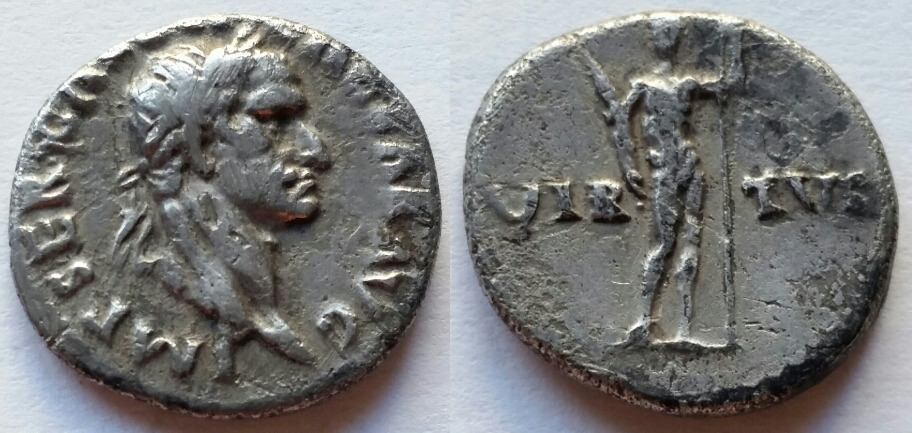 Galba AR Denarius IMP SER GALBA CAESAR AVG, Laureate head right VIRTVS, Virtus standing, leaning on spear, holding palm frond or sheathed sword Born in 3 BC, Galba was the last Roman emperor to have been born in the first century BC, and was the oldest man to ascend to the Princiapte until Gordian I. The first Emperor to come from a family other than the Julio-Claudians, he nevertheless hailed from an old and wealthy family, his father serving as a lawyer in the time of Augustus. As a young man he showed remarkable skill, and both Augustus and Tiberius predicted that he was destined for great offices. He served as Consul in 33 amid a celebrated military career that ended around the time of Claudius' death. He had two male children, both of whom died young. He retired early in the reign of Nero, but was recalled to serve as the governor of Hispania Tarraconensis in 61. In early 68, he learned that Nero intended to have him put to death, and so threw his support behind the failed rebellion of Vindex. When that pretender died, Galba found that support for him was growing, and Nero's supporters were nearly nonexistent. Upon Nero's death that year, Galba assumed the titles of Caesar, marched to Rome, and was met as the new Emperor. His reign immediately got off on the wrong foot. The financial situation of Rome was dire following Nero's later extravagances, and it was now up to Galba to fix it. His first act was to deny the Praetorians their customary accession bonus, and his second was to increase taxes, especially upon areas that did not accept his claim until it was ratified by the Senate. He earned a reputation as a cruel and ruthless emperor, sentencing many to death, and it also became apparent that his advanced age and health problems were impacting his ability to function as head of state. Discontent boiled over and on 1 January 69, the German legions rebelled and declared their governor, Vitellius, emperor. Galba refused to back down, and adopted Calpurnius Piso as his heir, scorning Otho who had been hoping for the nomination. On 15 January 69, the Praetorians declared for Otho in competition to Galba. The emperor went out (carried on a litter as he was unable to walk) to meet the rebels; a short fight ensued and Galba was summarily sentenced to death by the mob. Plutarch records that Galba merely remarked, "Then strike! If it be for the good of the Romans." and was beheaded. He was 71 years old.
|
|
Pillar of the Community
 Spain
2752 Posts |
Super coins Steve!...Love the Galba portrait  Very interesting coin of Poppaea coupled with a sad ending! Really enjoying your ability to summarize...Thanks for sharing.. |
|
Pillar of the Community
United States
7067 Posts |
Great thread, as one would expect from Steve. I'm really pleased to see that Provincials are included here. I think they get a bum rap sometimes - particularly the tets from Alexandria. (I like that Nero/Poppaea tet) They may not always exhibit refined aesthetics, but I find them very appealing.
|
|
Pillar of the Community
United States
8056 Posts |
Super thread for a non-collector of ancients, though we share the appreciation for fine portraits.
Learning a lot. Thanks!
Edited by tdziemia
06/19/2019 01:34 am
|
|
Pillar of the Community
United States
6130 Posts |
Otho 15 January - 16 April 69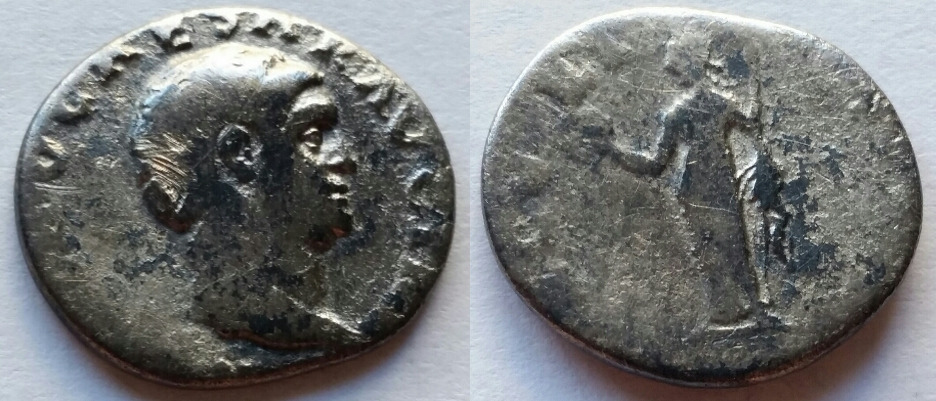 Otho AR Denarius IMP OTHO CAESAR AVG TRP, Bare head right SECURITAS P R, Securitas standing left with wreath and palm branch (Don't laugh at my ultra-budget example!) Born to an Etruscan family, Otho was one of the many in Nero's decadent entourage. This came to an end in 58 when he introduced his wife, Poppaea Sabina, to emperor Nero; she divorced Otho to marry Nero, and had her former husband sent away to be the governor of Lusitania. Otho jumped at the occasion to support Galba's rebellion, and accompanied him back to Rome. Astrologers predicted that he would one day become emperor, so Otho conspired with Galba's inner circle to ensure that he would be next in line to succeed the elderly emperor. He was indignant following the adoption of Piso, and scraped together enough money to buy the loyalty of 23 of the Praetorian guard. On the morning of his accession, he met with his conspirators, and was surprised when the rest of the Praetorian guard followed suit and proclaimed him Imperator. He marched on the Palatine with his new supporters, and found almost no resistance as Galba and his few supporters were effortlessly cut down. The public, already longing for a new Nero, were happy to have a young pretty boy emperor again. Otho wasted no time in appeasing them; minting coins for his accession bonus (likely the only reason his coins are not exceedingly rare), and reinstating the toppled statues of Nero. Not long after, he learned of the rebellion in Germania by Vitellius, and after failed peace negotiations, prepared for war. The empire was barely aware of his accession, let alone willing to support him, but he found support from the troops in Pannonia, Dalmatia, and Moesia, who were all too far away to reinforce his position before Vitellius arrived. He marched north with the inferior forces at his disposal, hoping to stall long enough to meet his reinforcements. Against the advice of most of his generals, he sent some of his force to meet that of Vitellius at the Battle of Bedriacum, which was defeated. In a move that still baffles historians to this day, Otho, remorseful of his actions and unwilling to shed any further blood in his civil war, took his own life by stabbing himself in the chest in the early hours of 16 April 69. He was 36 years old.
|
|
Pillar of the Community
United States
6130 Posts |
Vitellius 16 April - 20 December 69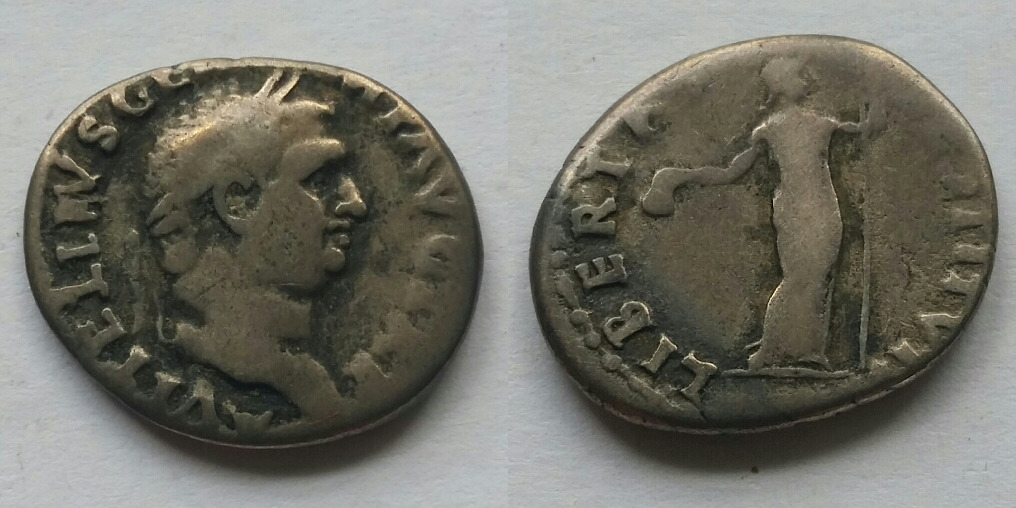 Vitellius AR Denarius A VITELLIVS GERM IMP AVG TR P, Laureate head right LIBERTAS RESTITVTA, Libertas standing right, holding pileus (freedman's cap) and scepter RIC 105 Vitellius was born in AD 15, the son of a prestigious senator. Rumor has it that as a boy he was subjected to the abusive "whims" of emperor Tiberius so that his father could more quickly ascend through the ranks of public office. He spent his teenage years in the Near East, probably coming in close proximity to a particular Jewish prophet during a stop at Judaea. He returned to Rome as a young man, and followed in his father's footsteps, rising through the ranks quickly and maintaining close relationships with several emperors. He was nearly crippled while engaging in a chariot race against Caligula, and was a close personal friend of Nero. Whatever his personal nature, he loved but two things: gluttony and gambling. Upon the death of Nero in 68, he was sent by Galba to be the governor-general of the troops in Germania. He had no military experience, so historians think this may have been Galba's attempt to disable any effective resistance from the legions he had scorned by refusing the usual donatives. Unrest boiled over, and on 2 January the troops declared for Vitellius against Galba. The inexperienced Vitellius was left behind while his top generals led the legions. En route, it was discovered that Galba was already dead and replaced by Otho, who had recalled the superior Danbuan legions to reinforce his position against Vitellius. Otho's troops were not fast enough, and after several days of defeats, Otho opted for the more noble death and ended his own life to end the civil war. Unchallenged, Vitellius was ratified by the Senate, and he set off at once for his triumph. Passing through the battlefields where Otho's dead still lay, he is said to have infamously remarked "How sweet is the death of an enemy, but sweeter still is that of a fellow Roman." His tenure as Emperor was nothing but a perpetual party; he ate and drank himself into a stupor around the clock, and he executed people for the crime of being a buzzkill. He killed everyone to whom he owed a gambling debt, and banished astrologers for warning him of divine retribution for his sins. The astrologers responded by predicting his downfall and death by the end of the year. Meanwhile, the armies in the East had declared for Vespasian by the end of the summer, and the new rival marched for Rome. By the autumn, Vitellius was universally loathed, protected only by those who stood to profit from his extravagances. Despite numerous warnings and defecting generals, Vitellius remained in Rome until Vespasian was knocking at his door. He attempted to resign his office to spare his life, but was forced to remain by the Praetorian guard. On 20 December, in a panic Vitellius dressed himself in commoners' clothing, stashed a retirement's worth of Aureii into a girdle, and barricaded himself in his doorkeeper's quarters. The legions broke in, identified him as the emperor, then stripped him half-naked and paraded him through the streets to the Forum. There he was tortured in what historians only describe as a horrific manner. Turning to his captors, his final words were "Yet I was once your Emperor..." and he was struck dead by a Gallic soldier, fulfilling the prophesies set against him. He was 54 years old. His body was dragged through the streets and thrown into the Tiber, then his family (except for his wife, apparently) was executed, leaving Vespasian unopposed and the civil war concluded.
|
|
Pillar of the Community
United States
6130 Posts |
Chapter III - The Flavian Dynasty, 69 - 96 ADVespasian, 69-79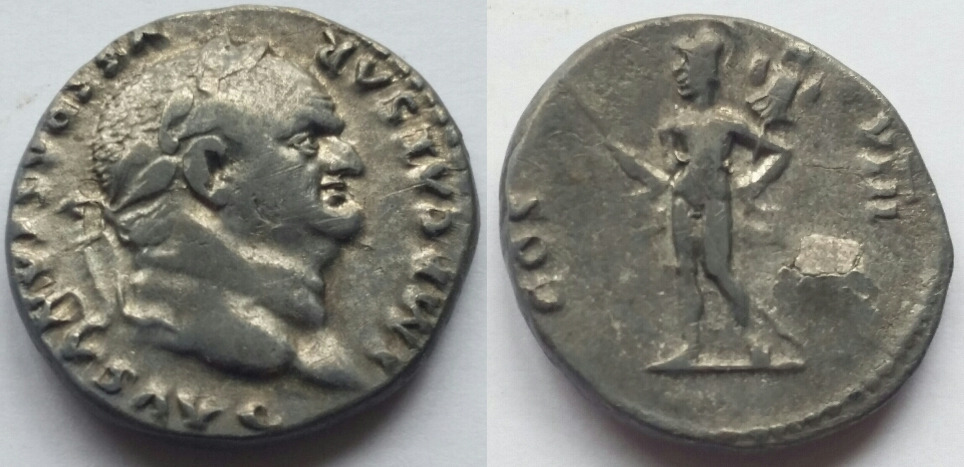 Vespasian AR denarius IMP CAESAR VESPASIANVS AVG, Laureate head right COS VIII, Mars standing left, holding spear and trophy Born in 9 AD, Vespasian was the last emperor to have lived during the lifetime of Augustus. Hailing from an Equestrian family, Vespasian and his family rose to prominence during the early half of the first century, and Vespasian rose through the ranks of office, commanding Legio II Augusta in the invasion of Britain in 43, and holding his first consulship in 51. He was dispatched to deal with the First Jewish Revolt in 66, laying siege to Jerusalem. He received news of Nero's suicide in the summer of 69, and his legions declared him emperor in competition to Vitellius. Leaving his elder son Titus in charge of the war, he stationed himself in Alexandria to secure her grain supply and sent his generals to march on Rome, where they encountered some resistance from Vitellius' largely demoralized troops. As his troops arrived in Rome, Vitellius was dragged through the streets and put to death, and the Senate confirmed Vespasian in the Principate the following day, December 21, 69; he was the fourth person to hold that honor since January of that year. Vespasian's first act (before even departing for Rome) was to send an emergency supply of grain to the city that had been ravaged by mob-violence. He physically arrived in Rome in the summer of 70, tasked with scrounging the money to repair the city that had gone largely unrepaired since the Great fire more than half a decade earlier. He was forced to adopt a number of unpopular taxes, but despite some resistance, the general public seems to have accepted his rule, sparing him the fate that befell his three predecessors. In particular, it is notable that Vespasian gave particular emphasis on propaganda early in his reign, absolutely convicted that he was both predestined to rule the Roman world, and that his apotheosis after death was virtually guaranteed. History is unusually quiet on the details of his decade-long reign, but we know he undertook massive building projects, most famously including the Colosseum, the Temple of Pax, and the Temple of Divus Claudius. He reportedly endured constant conspiracies against him, but was praised by contemporary historians as a patient and level-headed emperor. He enjoyed peace on the frontiers as the Dacians and Germans supported him, and his general Agricola succeeded in stabilizing the Roman hold on Britain, expanding into southern Caledonia. In his tenth year as emperor, Vespasian fell ill (apparently dysentery or food poisoning) while travelling. He continued to conduct official business from his bed, but his condition worsened. On June 24, 79, feeling the end approaching, he called out to his entourage, "Vae, puto deus fio!" , "Dear me, I feel I am becoming a God!". Then stating, "An Emperor ought to die on his feet!" he died while being helped from his bed. He was 69 years old.
|
|
Pillar of the Community
United States
6130 Posts |
Titus, 79-81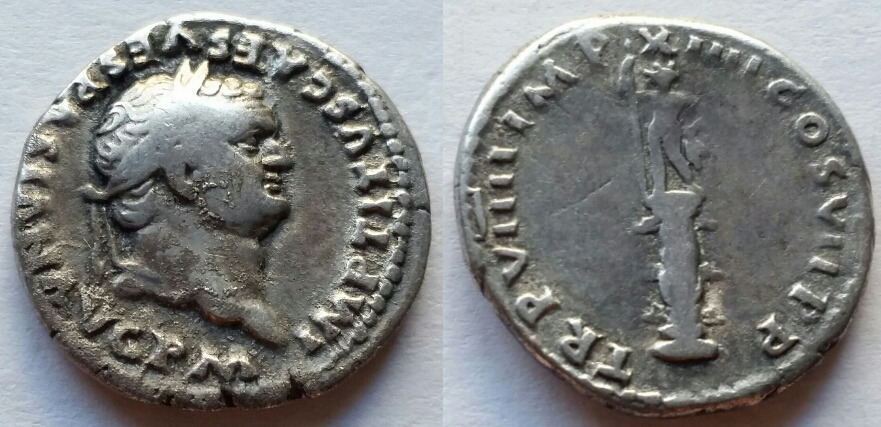 Titus AR Denarius IMP TITVS CAES VESPASIAN AVG P M, Laureate head right TR P VIIII IMP XIIII COS VII, Sol(?) standing on rostral column Born in 39 AD, Titus came of age during his father's rise to prominence under Claudius and then Nero. He was close to Britannicus, and was reportedly next to him when Nero had him poisoned. His early career is obscure, but he rose quickly through the military ranks thanks to the influence of his father, and distinguished himself as a capable general, serving at least in Germania and Britannia. After he was widowed from his first wife in 65, he married Marcia Furnilla, and although they had a daughter together, he was quickly forced to divorce his wife due to her family's dangerous involvement in a conspiracy against Nero. Titus was summoned to assist his father in quelling the Jewish Revolt, and there distinguished himself as a brilliant general. He was left in charge of the campaign when Vespasian headed west to claim the office of Princeps for himself, and Titus whittled the resistance down to the city of Jerusalem. After a long and bloody siege, he succeeded in breaching through the three walls of the city, looted it of its treasure, burned it to the ground, and then demolished much of the ruins, intent to wipe all memory of that city from existence. According to Josephus (a Jewish commander who was pressed to serve as an intelligence officer for the Romans, and later wrote a detailed history of the rebellion), more than a million perished in the sack of Jerusalem. Titus returned to Rome in 71, and was awarded a triumph for his victory in Judaea. The Senate confirmed him and his younger brother Domitian as Caesares under their father. During his decade serving as Caesar, he achieved notoriety both for his ruthless investigations and quelling of conspiracies against his father, and also for a controversial love affair with Berenice, the exiled Jewish princess who had been living in Rome. He did break off this relationship, but the public was deeply troubled over the prospect that Titus would become the next Caligula or Nero upon his ascent to office. When his father did die in 79, Titus immediately distinguished himself as one of the most compassionate and rational men ever to hold the Principate. His first act was to put an end to all treason trials based on slander or libel, which had been used by all previous emperors to keep their opposition in line. Two months in, he was faced with the eruption of Mount Vesuvius, which leveled Pompeii and Herculaneum. Just a few months later, Rome was again ravaged by a great fire that burned for three days and nights. He was universally commended for his organized and effective relief efforts, personally contributing from his own fortune. In 80, he oversaw the completion of the Colosseum and initiated the inaugural games, which spanned a hundred days of festivities and drew immense crowds. He faced only one major opponent, a rebel by the name of Terentius Maximus in the Eastern provinces, who claimed to fulfill the prophesy of Nero Redivivus, that Nero either had never died or would return from death to re-establish the Julio-Claudians to the Principate. The rebellion was quelled shortly before Parthia threw its backing behind the rebel and sparked a war with Rome. Titus' successful and promising reign came to an abrupt halt in September of 81 when he fell suddenly ill and died while travelling. There were persistent rumors of foul play from Domitian, but not enough evidence exists to judge one way or another. He was 41 years old.
|
|
Pillar of the Community
United States
7067 Posts |
The mug on that Vespasian...wow. Awesome.
|
| |
Replies: 156 / Views: 23,429 |
To participate in the forum you must log in or register.
Disclaimer: While a tremendous amount of effort goes into ensuring the accuracy of the information contained in this site, Coin Community assumes no liability for errors. Copyright 2005 - 2026 Coin Community Family- all rights reserved worldwide. Use of any images or content on this website without prior written permission of Coin Community or the original lender is strictly prohibited.
Contact Us | Advertise Here | Privacy Policy / Terms of Use
|
| Coin Community Forum |
© 2005 - 2026 Coin Community Forums |
| It took 0.49 seconds to rattle this change. |
 |
|
| |
|








 First Page


 Posted 06/12/2019 02:13 am


