|
This page may contain links that result in small commissions to keep this free site up and running.

Welcome Guest! Registering and/or logging in will remove the anchor (bottom) ads and the security checks. It's Free!
To participate in the forum you must log in or register. | Author |
 Replies: 156 / Views: 23,443 Replies: 156 / Views: 23,443 |
|
|
|
Pillar of the Community
 United States
6130 Posts |
Domitian, 81-96 As Caesar under Vespasian  CAESAR AVG F DOMITIANVS, Laureate head right COS V, She-wolf suckling Romulus and Remus, boat below Holed in antiquity for a bracelet or necklace pendant (I swear I'm planning to add and upgrade some of these Flavians once @Orfew stops outbidding me on them!  ) As Augustus 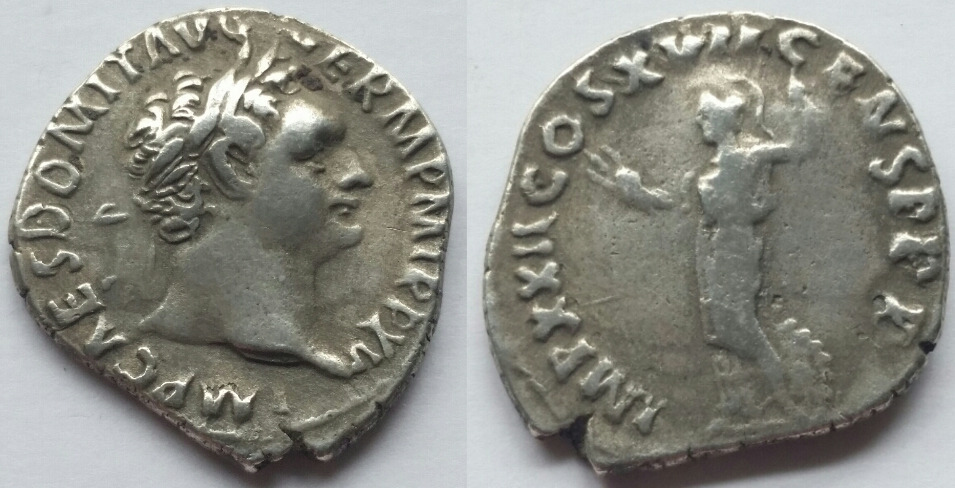 IMP CAES DOMIT AVG GERM PM TR P XV, Laureate head right IMP XXII COS XVII CENS P P P, Minerva standing left, holding thunderbolt and scepter, shield at foot Born in 51 AD, more than 12 years after his brother, Domitian was the youngest child of Vespasian, and grew up in his brother's shadow. He was too young to partake in the glorious campaigns of his father and brother, and led a quiet childhood of scholarly learning. He was described by his contemporaries as intelligent but odd and increasingly isolated, lacking the charisma of the other males of his family. He was eighteen years old when his father became emperor, and although he was granted titles and honors, he performed almost no actual functions of state as Titus was groomed as Vespasian's successor. Early in his reign, it was suggested by both Vespasian and Titus that Domitian should marry his niece, Julia Titi. Domitian turned down this offer, professing his love for and eventually marrying Domitia. Later during his rule, he would engage in a lengthy affair with Julia as his mistress. Domitian became emperor suddenly and (reportedly) unexpectedly in 81 following the untimely death of his brother Titus. His first act was to deify his brother, and then moved swiftly to concentrate all power on himself, being the first emperor to openly challenge the notion that the emperor was merely the "first citizen" entrusted with special powers to ensure the efficient administration of the Republic. He was more or less openly resented by the Senatorial class whose powers and influence he publicly snubbed, so an unbiased interpretation of his character is nearly impossible from the existing sources which were written by historians of the Senatorial class. What is certain is that, at least at the beginning of his reign, Domitian was dedicated to both beautifying the city of Rome, and eradicating corruption and misconduct throughout the Empire. He was a meticulous micromanager, a firm believer in a sound fiscal policy, and convicted in his belief that the populace needed a Censor, or officer of morality--an office he entrusted to himself. This rubbed many the wrong way, and attempts on his life fueled his already deep paranoia. After putting down the rebellion of his governor Lucius Antonius Saturnius in 89, his rule seems to have taken a turn toward the more paranoid, and Domitian ordered numerous executions even for perceived threats to his power. Domitian met his end on 18 September 96 in a conspiracy orchestrated by his chamberlain Parthenius, whose close friend Domitian had executed. A court official, Stephanus, who had been feigning an injury for several days in order to conceal a dagger in the bandages, informed the Emperor of a plot on his life, and was granted audience. While Domitian read over the report, Stephanus stabbed the emperor, and was joined by the other conspirators, killing the emperor before his guard could be summoned. He was 44 years old. |
|
Pillar of the Community
United States
6130 Posts |
<b>Domitia, Wife of Domitian, d. Late 120s</b> 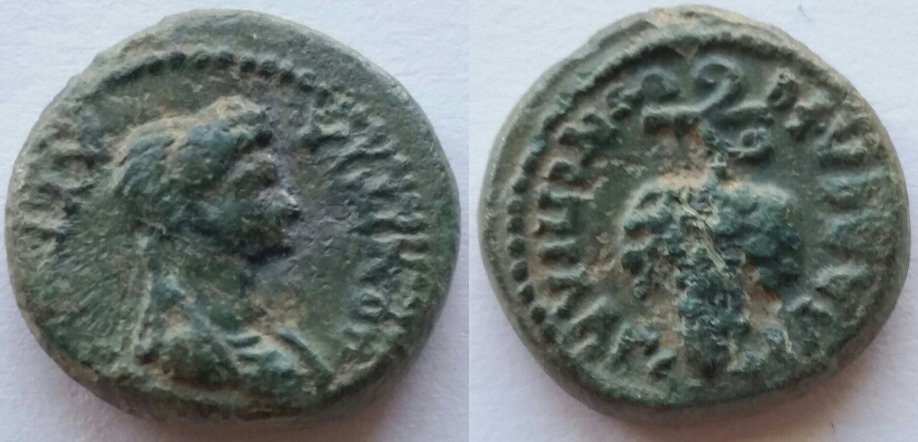 Domitia AE14 of Philadelphia, Lydia ΔOMITIA AYΓOYCTA, draped bust right EΠI ΛAΓE ΦIΛAΔEΛΦEωN, bunch of grapes on stem Born in the early 50s to an old and distinguished Patrician family, Domitia was the great-great-great-great-granddaughter of Augustus, and the niece by marriage of Caligula. Sometime before the rise of Vespasian, she was married to a senator named Aelius Lamia, who would eventually be executed on orders of her future husband. Little is known of her first marriage except that the couple divorced, probably due to a budding romance between Domitia and Domitian. The couple wed in 71, and had a son in 80, who died in infancy and whose name was lost to history. Domitia became Empress upon the ascent of her husband in 81, although the details of her reign are clouded by the slander of her husband's political enemies. Their marriage was reportedly rocky, with Domitian being reported as exiling Domitia in 83 for infidelity while he actively carried on an affair with his niece Julia Titi (whom both Vespasian and Titus had insisted that he marry). Domitia was brought back into the imperial household in 84, although little else is recorded of her. Ancient historians have implicated her in the plot to assassinate her husband, however these accounts are dubious at best. She was allowed to retire to a private life after relinquishing the title of Augusta, and she survived at least until 126 AD. Contemporary historians state that, even decades later, she still introduced herself as Domitia, wife of Domitian." She died peacefully of old age, well into her 70s. |
|
Pillar of the Community
United States
6130 Posts |
Before I continue on, I would like to say thank you to everyone who has been keeping up so far!
re: Bob, I agree that Provincial Roman coins do get a bad rap, although admittedly my collection is heavily leaning toward Imperial, especially from here on out. Provincials are especially nice for the 12 Caesars through the Severans, depicting many more fascinating reverses than the typical Roman "God/goddess standing + boasting about titles" format. I may someday expand into provincials, but for now, they allow me to spend $100 or less on folks who would otherwise set me back $1,000+!
Anyway, the next few installments are some of my favorites are some of my favorites, so I hope you enjoy them as much as I do!
|
|
Pillar of the Community
United States
6130 Posts |
Chapter IV: The Nerva-Antonine Dynasty, 96-193Nerva, 96-98 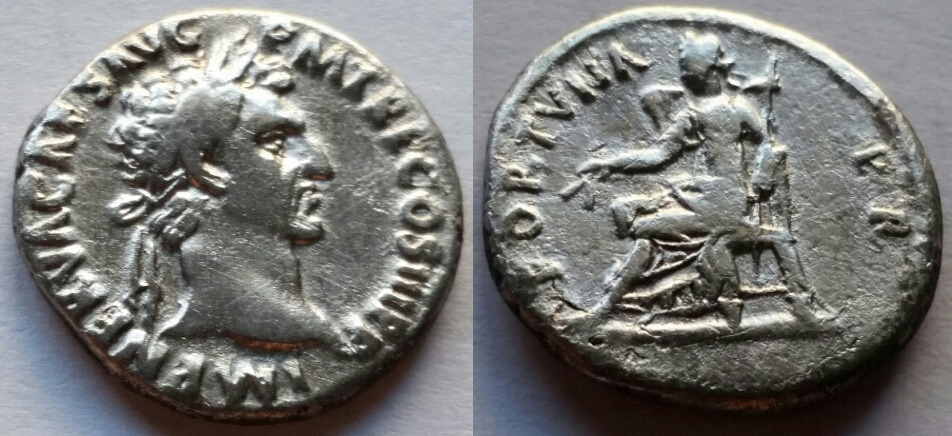 Nerva AR Denarius IMP NERVA CAES AVG PM TR P COS III P P, Laureate head right FORTVNA PR, Fortuna seated left Born in 30 AD to an illustrious and powerful family, Nerva would be the last emperor to have lived during the reign of Tiberius. His father was a close friend of Tiberius, and served as consul under Caligula. Nerva's early life is obscure, but he served as Praetor in 65 during the reign of Nero, and was instrumental in uncovering the Pisonian Conspiracy against that emperor. He was an early and enthusiastic supporter of the Flavian dynasty, and was awarded a consulship in 71. He disappears from history until his second consulship in 90, suggesting that he had played a role in the suppression of the revolt of Saturnius against Domitian. When Domitian was assassinated in 96, the Senate held an emergency session, and selected Nerva from their ranks to take over the office of the Princeps. His first acts were to grant sweeping amnesty to those who had been convicted of treason against Domitian, and to return all confiscated properties to their owners. This destabilized the economy, but Nerva was able to avoid disaster by reducing the expenditures of the imperial office, and through the auctioning off of Domitian's estates and possessions. At the time of his accession, Nerva was 65 and childless, and could not command the respect or loyalty of the armies. In late 97, he elevated the up-and-coming general Trajan as his successor, and died of an aneurysm just a few months later in January 98, aged 67 and having ruled just 15 months.
|
|
Pillar of the Community
United States
6130 Posts |
Trajan, 98-117 Trajan (Early reign) AR Denarius IMP CAES NERVA TRAIAN AVG GERM, Laureate head right P M TR P COS II P P, Victory seated left, holding patera and palm branch  Trajan (Later reign) AR Denarius IMP TRAIANO AVG GER DAC P M TR P COS VI P P, Laureate head right SPQR OPTIMO PRINCIPI / ARAB ADQ, Arabia standing left, holding fasces(?) and branch over camel Minted to commemorate annexation of Nabatea to the Empire Born in 53 AD in Hispania to members of the ancient Gens Marcia, Trajan was the nephew of Marcia Furnilla, the first wife of emperor Titus, and was thus related by marriage to the Flavian dynasty. Serving with his father in the army, Trajan distinguished himself as a capable commander, and was granted his first consulship in 91. Around this time he married his wife Pompia Plotina, ostensibly for political motives as most historians agree that Trajan was most likely homosexual; their marriage was stable, but emotionally distant and remained childless. Historians mention further military feats in passing, and Trajan again enters the forefront of politics upon his adoption by Nerva in late 97. Outwardly, the succession was peaceful, although some modern historians have suggested that Trajan's succession would be better characterized as a coup than a peaceful transition of power. However, there is no evidence of any foul play in Nerva's death. Trajan lingered for a time at his post in Germania before finally arriving in Rome in 99 and holding his third consulship the following year. Although Trajan's rule was characterized by the increased autocracy exercised by the Princeps, all historians--ancient and modern--describe his reign as that of an enlightened despot. During his reign Rome enjoyed her greatest territorial expansions, most notably including the conquest of Dacia in two campaigns from 101-102 and 105-106, the bloodless annexation of Nabatea in 106, and a (fleetingly) victorious war against Parthia in 115-117. Securing booty, captives and the mines of Dacia brought unprecedented wealth to the Roman Empire, and in 105 the senate bestowed the unprecedented title SPQR OPTIMO PRINCIPI, "Best Princeps of the Senate and People of Rome." During his nearly two decades in office, he undertook massive building projects in the city of Rome, many of which still stand to this day. With the full weight of the reputation of Rome backing her currency, he reduced the silver purity of the denarius from 90% to 80%, and ordered the recall of all old (pre-Neronic reform) denarii in circulation to be recoined at the new reduced standard; this effect is visible today in the comparative scarcity of all pre-Nero denarii. Unlike his predecessors, any subsequent increases to the fineness of the coinage was at best fleeting--this trend of increasing debasement would lead to the virtual disappearance of all silver from Roman coinage 150 years after Trajan's death. But, for the time being, his policies allowed him to stretch the limited money supply to keep up with Rome's booming economy, and the citizens enjoyed nearly a century of peace and prosperity under Trajan and his successors. Between his campaigns, Trajan contributed substantially to the culture and leisure of Rome, hosting lavish games and festivals to keep the common citizen happy, upon which the orator and commentator Fronto remarked, "Neglect of serious matters can cause greater damage, but neglect of amusements greater discontent." Additionally, in a move that generated great praise, Trajan set up a financial pool from the state budget to offer relief and assistance to orphans and the poor of the city. In early 117, and before he had appointed a successor, Trajan's health began to fail him. He set out for Italy from the East, but became increasingly weaker as the year wore on, and died of edema in Cilicia on August 8 of that year, aged 63. It was at this time that Hadrian emerged as the successor of Trajan, although ancient sources conflict on whether Trajan made the appointment himself, or if the succession was engineered by his widow Plotina - Cassius Dio states, via secondhand sources, that Plotina hid her husband's death from the public and hired a voice impersonator to give orders from behind a curtain until she could secure a successor.
|
|
Pillar of the Community
United States
7067 Posts |
Fine examples. There seem to have been some really great die engravers during Trajan's reign. Such outstanding portraiture on so many of his coins, across denominations. (Although I suppose I have seen some clunky Trajan Provincials.)
|
|
Pillar of the Community
United States
6130 Posts |
Plotina, wife of Trajan, d. 121 Plotina AE17 of Gordos-Julia, Lydia ΠΛΩTEINA CEBACTH, draped bust right EΠI ΠOΠΛIOY ΓOΡΔHNΩ, Zeus seated left, holding patera and sceptre. Pompeia Plotina was born in Hispania, probably in the 60s AD, and hailed from an aristocratic Roman family. She was wed to Trajan at an unknown date prior to his rise to prominence. Their marriage was stable, but remained childless, as many modern and contemporary historians suspect that Trajan was homosexual or asexual. As empress, Plotina strove to be the silent embodiment of virtue; very little is mentioned of her in the surviving histories, save that, approaching the imperial residence, she addressed the crowd, "I enter here the kind of woman I would like to be when I depart." Although she did not directly take part in her husband's politics, Plotina served to shape the remainder of the second century AD as she played the matchmaker to set up Trajan's nephew once removed, Hadrian, with Trajan's grand-niece Sabina. When Trajan died without officially naming an heir, it is said that Plotina conspired to not only forge her late husband's will to adopt and name Hadrian as his successor, but also to cover up his death for at least several days while preparations were being made. After being widowed, Plotina is known to have had a hand in selecting the new head of the Epicurean school at Athens. She died of illness probably soon after, around 121. Like the majority of the Julio-Claudian women, all coins of Plotina are rare, but Imperial coins are particularly so; hence why I've selected a provincial coin, which, while still not easy on the budget, didn't set me back $1,000+
|
|
Pillar of the Community
United States
6130 Posts |
Hadrian, 117-138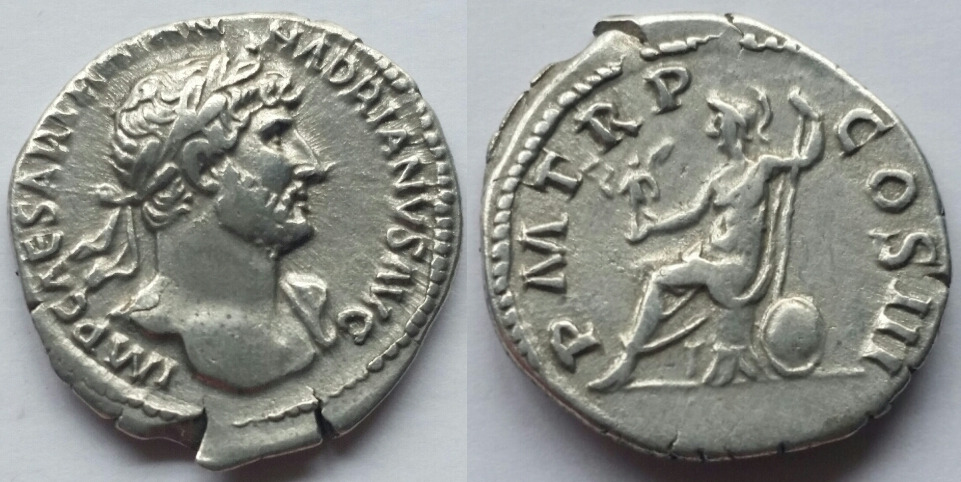 Hadrian AR Denarius IMP CAESAR TRAIAN HADRIANVS AVG, Laureate bust right, drapery over left shoulder P M TR P COS III, Roma seated left, holding victory and scepter resting on shield Born in 76 to a distinguished senatorial family, Hadrian's father was the first cousin of Trajan, and thus placed Hadrian very close to the family that would come to rule Rome in 98. Hadrian was orphaned in 86, and was raised in Trajan's household, and enjoyed an accelerated political career. He served as a tribune of the army in 95, and continued to distinguish himself in the military throughout Trajan's reign. He was elected Quaestor in 101, and was entrusted to deliver Trajan's speeches to the Senate. Around this time, Hadrian married Vibia Sabina, the daughter of Trajan's beloved niece Matidia--an arrangement apparently opposed by Trajan but ultimately pushed through by Plotina. The relationship between Hadrian and Trajan seems to have been strained, with Hadrian continuing to make further political advancements, but with Trajan's actions seeming to indicate he wanted to distance himself from Hadrian; dismissing him from service twice during the Dacian wars to fill other political offices. When Trajan died on August 8 117, the official adoption document had not been procured nor signed until the following day, and Hadrian was not present as required by law. Despite the enthusiastic approval of the emperor's widow, Hadrian was in a precarious situation, as his support was far from widespread, let alone unanimous. He was opposed to Trajan's aggressive expansion policies, and struck a peace accord with Parthia to return the provinces Hadrian deemed indefensible in exchange for a cessation of hostilities. The Senate affirmed his accession and granted his request to deify Trajan, but Hadrian soon after ordered the summary trial and execution of four senators, believed to be his chief political rivals and possible contenders for the throne. He was successful in consolidating his position, although executions of perceived rivals would be a hallmark of his reign. A lifelong Hellenophile, Hadrian's mission as emperor was not to extend the expansionist campaigns of his predecessor, but rather to fortify and strengthen the Empire under an integrated Romano-Hellenic culture. He was a celebrated patron of the arts, actively encouraged the study and use of the Greek language, and became the first emperor since Nero to sport a beard, which would become a universal feature of Roman emperors (save those too young to grow whiskers) until the time of Constantine, two centuries later. Hadrian spent as much as half of his reign away from the capital city of Rome, embarking on a famous tour to every Roman province to establish his presence there. He also famously ordered the construction of what today is called Hadrian's Wall, a fortified wall running from coast to coast across the northern border of Roman Britannia to guard it against the maurauding Caledonians. During a tour of Africa he put down a small local rebellion and there met his "boy toy" favorite Antinous, who would become the focus of his romantic affections, at the expense of his wife Sabina. Hadrian then toured Greece to much local celebration, defused a potential conflict with Parthia, and then returned to Italy before returning to Africa in 128. Returning to Egypt in 130, Antinous drowned, causing the emperor immense grief and distress. Around 132 Hadrian seems to have attempted to reorganize Judaea to better integrate it into the Empire; this caused nationalistic sentiment to surge, culminating in the Bar Kokhba revolt which raged until 135. Roman losses included an entire legion of roughly 4,000 plus heavy losses in other legions, as they were initially ill-prepared for such a large scale revolt. Retribution was swift and crushing as Hadrian recalled his Danbue legions for a punitive campaign that ultimately left over half a million Jews dead, and razed 50 cities and nearly a thousand villages to the ground. Jerusalem was renamed Aelia Captiolina, and a majority of the surviving Jews were forcibly expelled from the area, which they did not again inhabit in significant numbers until the conclusion of World War II. Advancing in age, Hadrian returned to Rome in 134 and did not resume his travels. His wife Sabina died in about 136, and after nearly succumbing to a hemorrhage, Hadrian decided to adopt Lucius Aelius Caesar as his heir. Aelius however died just a year later of illness in early 138, so Hadrian adopted the future emperor Antoninus Pius, on the condition that Antoninus in turn adopt the future emperors Marcus Aurelius and Lucius Verus, who were both far too young to hold office themselves. Hadrian died of illness later that year, on 10 October 138, aged 62.
|
|
Pillar of the Community
United States
6130 Posts |
Sabina, Wife of Hadrian, d. 136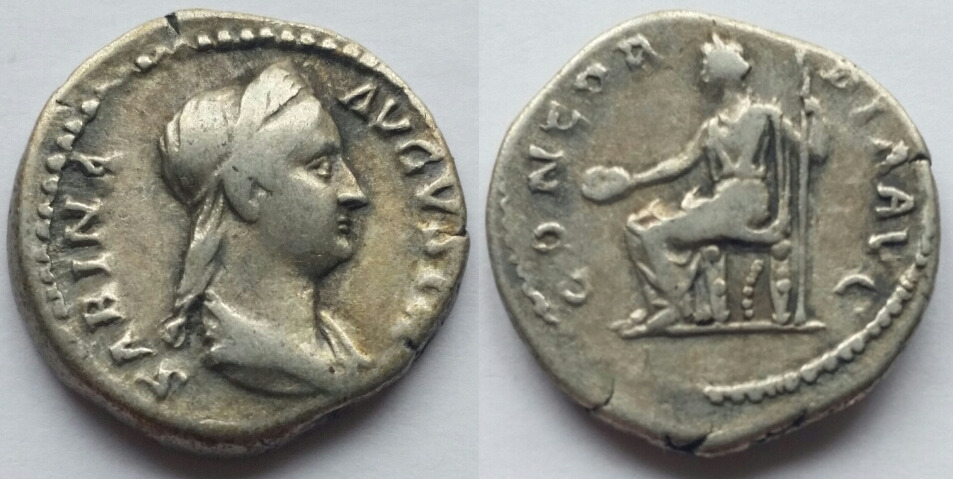 Sabina AR Denarius SABINA AVGVSTA, Draped bust right CONCORDIA AVG, Concordia seated left, holding scepter and patera Born in 83 to Trajan's beloved niece Matidia, she was arranged to marry the future emperor Hadrian in about 100 in a move engineered by the empress Plotina and approved of by her mother. Her marriage to Hadrian, however, was deeply unhappy as her husband was more or less openly homosexual, and denied her virtually any affection. Early in Hadrian's reign, she engaged in an affair with her husband's secretary, the renowned historian Suetonius. The affair was discovered, Suetonius dismissed, and Sabina's husband grew ever distant. She was however granted the title of Augusta in 128. Hadrian is recorded as remarking of his wife that her ill-temper and irritability would have been grounds for divorce, were he not the Emperor. She died of unspecified causes in 136, and was deified in a public ceremony by Hadrian.
|
|
Pillar of the Community
United States
6130 Posts |
Aelius Caesar, d. 138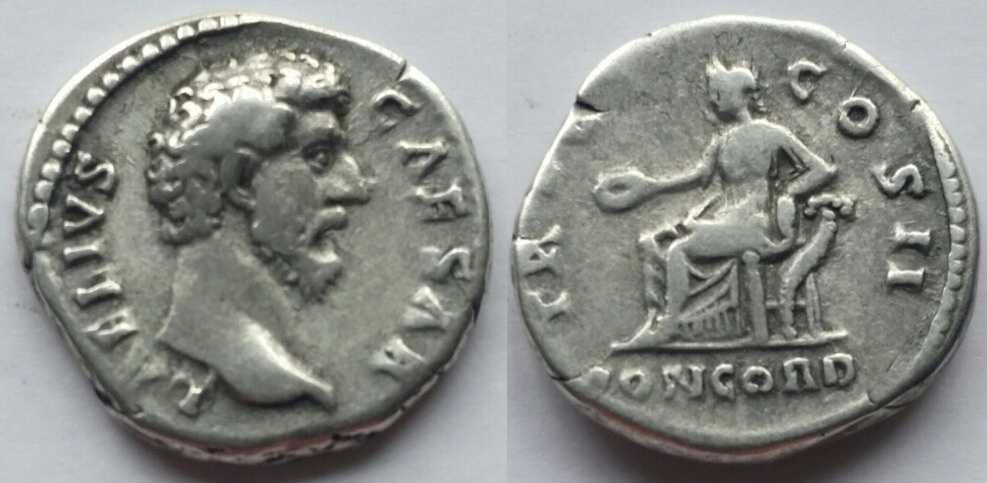 Aelius Caesar AR Denarius L AELIVS CAESAR, Bare head right TR POT COS II / CONCORD, Concordia seated left, holding patera and resting arm on cornucopiae Born in 101, Aelius Caesar was the son of Lucius Ceionius Commodus, one of the senators executed upon Hadrian's accession in 117. Aelius married his wife, Avidia Plautia, sometime before 130. The couple had four children, Gaius Commodus (died young), the future emperor Lucius Verus, and Ceionia Fabia and Ceionia Plautia, who would both play significant roles in Roman politics during the reign of Aurelius and Verus. Through Ceionia Plautia, Aelius was (allegedly) the great-great grandfather of the future emperor Gordian III. Not much is known of Aelius' early life. Hadrian had originally been grooming his great-nephew Salinator, but unexpectedly changed his mind and selected Aelius seemingly out of the blue. Historians believe this act may have been engineered to atone for his rash of executions early in his reign, although some rumors circulated that Aelius was Hadrian's new favorite boy-toy after the death of Antinous. Aelius was granted the consulship in 136 and 137, and sent to the Danbue frontier to train in the military, although it quickly became apparent that he was in extremely fragile health. He returned to Rome at the end of 137, gave a speech before the Senate on January 1 138, but fell ill and later died on January 24, aged 36.
Edited by Finn235
07/05/2019 4:50 pm
|
|
Pillar of the Community
United States
7067 Posts |
All are great but that Hadrian portrait, in particular, is exceptional.
|
|
Pillar of the Community
United States
6130 Posts |
Thanks Bob on both accounts! The Hadrian was actually one of the earlier Roman coins I had purchased. Nerva-Antonine coins may not be quite as artistically impressive as the zenith under the Twelve Caesars, but IMO Hadrian and Trajan both come close. Someday I do hope to supplement all these denarii with nice, big, sestertii, after I brush up on how to identify the warning signs of tooling, which seems to be epidemic on their bronzes.
|
|
Pillar of the Community
United States
6130 Posts |
Antoninus Pius, 138-161As Caesar under Hadrian  Titus Aelius Antoninus Caesar AR Denarius IMP T AEL CAES ANTONINVS, Bare head right TRIB POT COS, Diana standing right, holding arrow and bow As Augustus  Antoninus Pius AR Denarius ANTONINVS AVG PIVS P P TR P COS III, Laureate head right IMPERATOR II, Victory standing left, holding patera and palm Minted to commemorate completion of the Antonine Wall  Antoninus Pius AE Sestertius ANTONINVS AVG PIVS P P TR P COS III, Laureate head right SALVS AVG S C, Salus standing left, feeding snake rising from altar with patera Posthumous 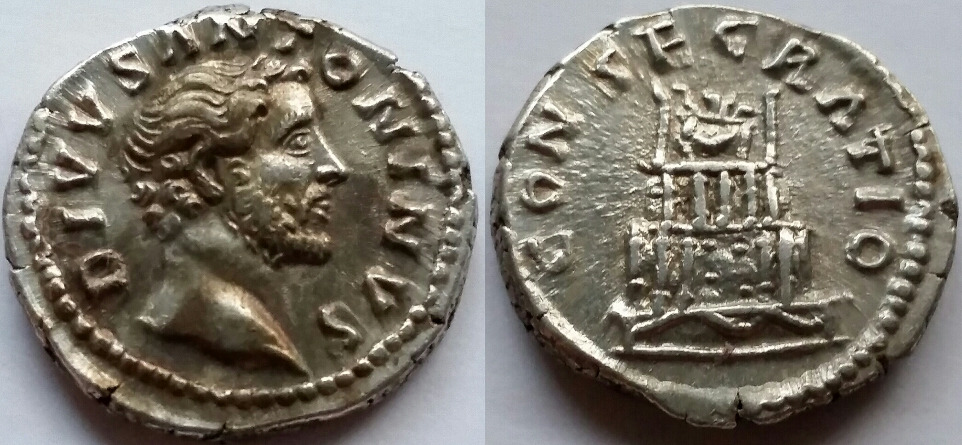 DIVVS ANTONINVS, Bare head right CONSECRATIO, Wedding cake Funeral pyre Born in 86, Antoninus Pius was the last emperor to have lived during the Flavian period. His family was of new prominence, having been granted honors and privileges for being loyal and early supporters of Vespasian. He entered public life at a young age, and was said to have been a close friend of Pliny the Younger. He married his wife Annia Galeria Faustina sometime between 110-115 and the couple had four children, of which only his daughters Aurelia Fadilla and the future empress Faustina the Younger seems to have survived to marriageable age (Aurelia Fadilla was married, but died in her teenage years). Antoninus served as consul in 120, and was appointed as one of the four proconsuls to administer Italy by Hadrian. Impressed with his performance, Antoninus was made proconsul of Asia from 134-135. Antoninus was adopted by Hadrian in early 138, on the condition that he adopt Lucius Verus, son of Aelius Caesar, and Marcus Aurelius, nephew of Faustina the Elder. After a brief stint as Caesar under Hadrian, the emperor died and the 52 year old Antoninus became emperor. One of his first acts was to pardon most of those whom he felt had been wrongly sentenced to imprisonment or death by Hadrian. He also asked the Senate to deify Hadrian, but facing resistance from the Senate (who had never warmed up to Antoninus' predecessor), he threatened to step down from the Principate. Impressed by this show of dedication, the Senate granted his request and bestowed the honorific Pius ("The Faithful") to Antoninus. Antoninus Pius ruled over one of the most placid stretches of Roman history, and never left Italy for the duration of his more than 22 1/2 year reign. He is widely celebrated for his just, rational rule, and the worst insult his detractors could find was to call him a big softie; overly lenient on criminals and especially tolerant toward Christians. His beloved wife Faustina died in 141, which caused Pius a great deal of distress. He had the Senate deify her memory and erect a temple to the Divine Faustina (which still stands to this day) as well as an unprecedented array of deification coinage, arguably the largest in mintage, variety, and length of any Roman deification coinage; these coins are nearly as common as Pius' issues. Although he did take on a mistress later in life, Pius refused to remarry, even though he was permitted to do so under Roman law. A few minor rebellions or incursions occurred during Pius' reign, none of them significant enough to require him to do any more than give orders to the provincial governors. Possibly the largest military event was a raid on Hadrian's Wall from the Caledonians which prompted a reactionary campaign that captured further territory and led to the construction of the secondary "Antonine Wall" that was abandoned a few decades later. Without major military expenses to consider, Pius spent most of his time focusing on building projects within the city of Rome, and also instituting public welfare programs and rewriting Roman law to mitigate some injustices he saw. Notably, he improved the conditions under which slaves could be subjected to by their masters, required trials before punishments for slaves, and instituted the principle that all citizens and slaves alike be considered innocent until proven guilty. Pius was also the last Roman emperor to actively engage in diplomatic relations directly with the far-off kingdoms in India (e.g. the Kushans) and is said to have been the only Roman emperor to successfully send and envoy to China (although they did not arrive until 166), which to the Romans was a fantastical land (Serica) well beyond the borders of the known world from which the finest of their coveted silks came; to the Chinese, Rome was "Da Qin," a balancing force to China's hegemony in the East. Despite Hadrian's apparent assumptions that Pius would be dead within a few years of taking the Principate, clearing the way for youthful Aurelius and Verus to rule, Pius' reign ultimately became the second-longest in Roman history up to that point, and Aurelius and Verus spent the majority of their adult lives as his Caesares. In March of 161, while staying at his private estate outside of Rome, historians note that Pius ate a large amount of cheese, had a fit of vomiting, and died a day or two later, on March 7, 161 at the age of 74. He was buried with his wife Faustina in Hadrian's mausoleum, and Faustina's temple was rededicated to her now divine husband as well.
Edited by Finn235
07/05/2019 4:50 pm
|
|
Pillar of the Community
 Spain
2752 Posts |
Great coins Steve and super write ups as always...
Love the AP under Hadrian portrait...And Plotina I've been looking for a while now a difficult lady to acquire..Lovely little coin!...Paul
|
|
Pillar of the Community
United States
6130 Posts |
Annia Galeria Faustina the Elder, Wife of Antoninus Pius d. 141Lifetime  AR Denarius FAVSTINA AVGVSTA, Draped bust right CONCORDIA AVG, Concordia standing left, holding patera and cornucopiae Posthumous  DIVA FASTINA, Draped bust right AVGVSTA, (Faustina as?) Juno seated right, holding long scepter Born around 100 AD, Faustina the Elder was the granddaughter of Matidia and niece of empress Sabina. She was the daughter of the influential Marcus Annius Verus, and sister of Marcus Aurelius' biological father, also named Marcus Annius Verus. She married future emperor Antoninus Pius when she was young, sometime between 110-115 AD. She bore two sons, Marcus Aurelius Fulvius Antoninus, and Marcus Galerius Aurelius Antoninus, both of whom died young, although the latter appears on a provincial coin, indicating that he may have died around the time his father became emperor. Her two daughters by Antoninus were Aurelia Fadilla, who reached marriageable age but died in her teenage years, and Annia Galeria Faustina Minor, future wife of Marcus Aurelius. Somewhat unusual for imperial marriages, Faustina and Pius seem to have been deeply infatuated with each other, and Faustina received universal praise for her beauty, wisdom, and charitable spirit. She received the title of Augusta in 138 upon her husband's accession, but died soon afterward in early 141. Pius was devastated by her death, and had her deified and sponsored a temple to her memory, in addition to erecting numerous statues, establishing charities in her honor, and minting an immense number of posthumous coins; nearly as many as he had minted for himself.
Edited by Finn235
07/11/2019 11:52 am
|
| |
Replies: 156 / Views: 23,443 |
To participate in the forum you must log in or register.
Disclaimer: While a tremendous amount of effort goes into ensuring the accuracy of the information contained in this site, Coin Community assumes no liability for errors. Copyright 2005 - 2026 Coin Community Family- all rights reserved worldwide. Use of any images or content on this website without prior written permission of Coin Community or the original lender is strictly prohibited.
Contact Us | Advertise Here | Privacy Policy / Terms of Use
|
| Coin Community Forum |
© 2005 - 2026 Coin Community Forums |
| It took 0.6 seconds to rattle this change. |
 |
|
| |
| |







 First Page
 Previous Page


 Posted 07/02/2019 1:19 pm


