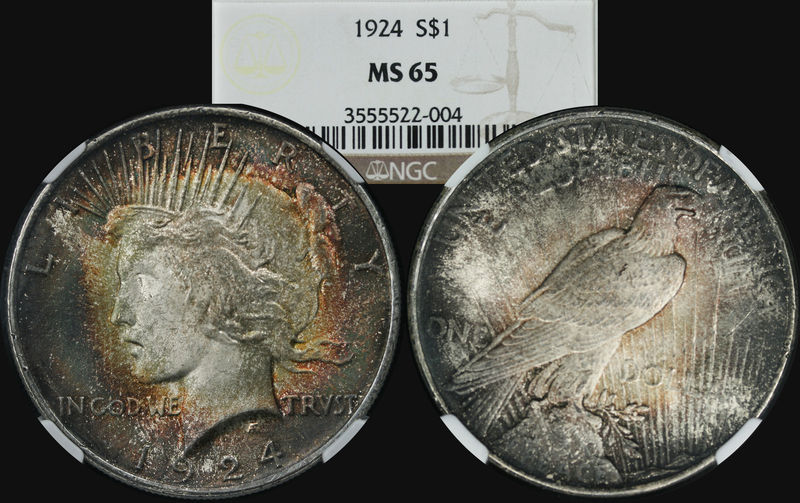
Just a horrible at job, but could be a good piece to learn from.
Looking at the reverse, let's start with that blue to orange color transition. It's wrong, it should be red to orange.
Notice the abrupt color transitions on the lower leg and base of the neck? There should be some blending as the thickness of the oxide layer gradually changes across the coins surface. Think of a rainbow, the colors do not transition abruptly but rather gradually.
Now lets look for any sign of elevation chromatics. Nope, not on this piece. A uniform color washes over the of America, and the relief of the feathers.
This comment is the toughest to explain. The color on this piece appears to be on top of the coin, as opposed to being part of the coins surface.....like it's painted on.
For many reasons (planchet preparation and wash, type of bags used and length of storage),
Peace dollars often come with a crackled appearance when toned. No evidence of that on the piece in question.
Here is an example of a naturally toned piece, that has all the elements in the toning that I have mentioned above.
Hope this helps.


At'd coin from OP










 Posted 06/14/2019 7:06 pm