| Author |
 Replies: 149 / Views: 16,044 Replies: 149 / Views: 16,044 |
|
|
|
Pillar of the Community
 Spain
2752 Posts |
Wow Bob! Very nice.....Must be a strange feeling to hold something in the real that has probably seen battle and blood!
Congrats on your impressive ever increasing collection and look forward to seeing all your new additions in your gallery...Paul
|
|
Pillar of the Community
 United States
7067 Posts |
|
|
Pillar of the Community
United States
7067 Posts |
Thought I'd update this thread with an interesting item I won today. For some context: One of the various types of dagger and sword hilts used in ancient (late 2nd to early 1st millennium BC) Iran consisted of a bronze cylindrical grip topped by a double disk pommel, with an iron core - like these: 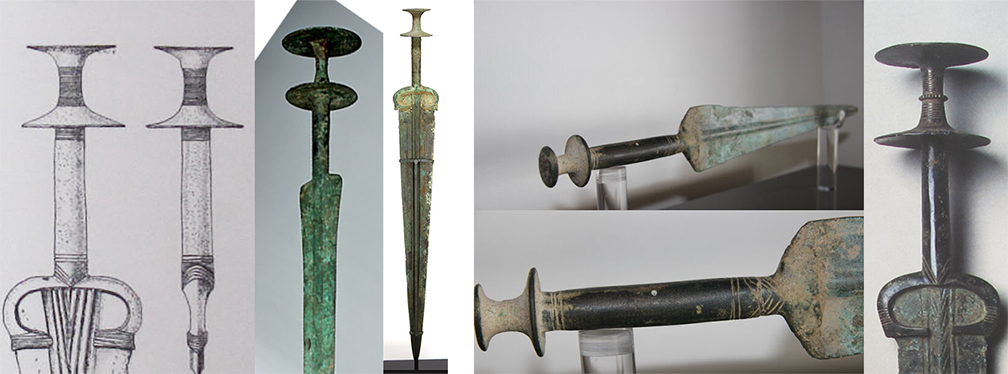 Fully intact specimens are rare and, in any event, are way out of my price range. However, today I won a hilt sans blade. Although it's just a fragment of what was probably an impressive weapon, I'm happy to own it and look forward to its arrival. It's especially nice for the the incised patterns on the grip. Size is 11.1cm (4.4") 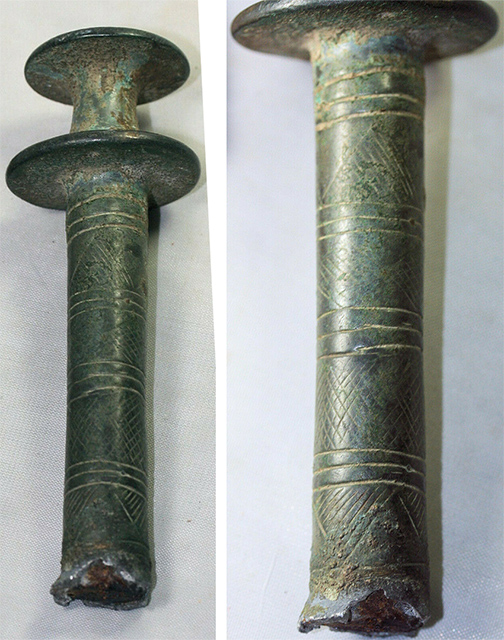 |
|
Valued Member
United States
272 Posts |
Could a period correct blade not be purchased and affixed professionally to this hilt. looks pretty impressive complete the age of some of your blades is incredible tho not my area of expertise seems like a hilt such as yours would be akin to purchasing an authentic slab only from a 1894s dime. Can not imagine what you paid for that hilt but it makes you happy like coins make me and others here happy. We miss you wayward brother but keep with what makes you happy for sure.
|
|
Pillar of the Community
United States
7067 Posts |
It was actually part of a two-item lot (below), accompanied by an unidentified iron, socketed spearhead. I have not had success in my very cursory attempt to attribute the spearhead. I suspect it's medieval - maybe from Europe or Central Asia but, really, I have no idea. I may flip it or give it away. With shipping from UK, the two-item lot totals 70 bucks. I certainly can't complain about that. 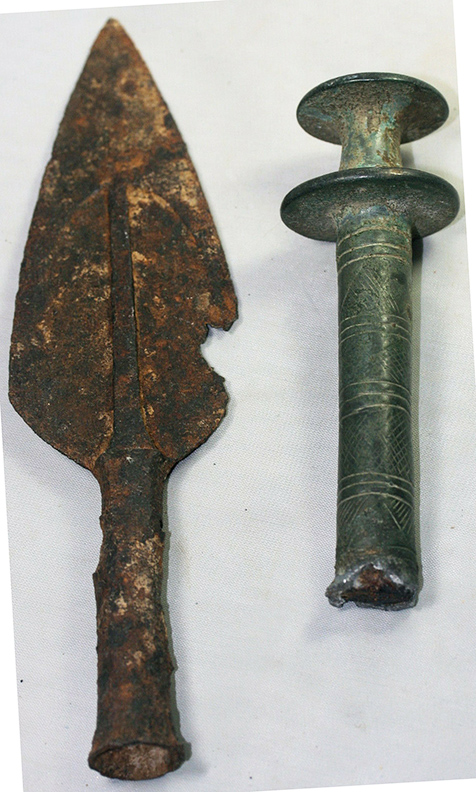 |
|
Valued Member
United States
272 Posts |
you are right there $70 is a good deal there I am sure the spear head is cool and I was under the ASSumption that you had a lot more into that hilt not my area of expertise for sure as I said but cool collection you have bob looking forward to seeing some new additions.
|
|
Pillar of the Community
Spain
2752 Posts |
Nice pick ups Bob!....Lovely patina on the hilt and the style with the double pommel end is really appealing also the decorative engraving is beautiful...Stops those sweaty hands from slipping and stabbing yourself in the foot!
The spearhead could well be medieval with the ridge running down the centre of the blade?
Congrats Paul
|
|
Pillar of the Community
United States
7067 Posts |
Thanks, Paul. Quote:
The spearhead could well be medieval with the ridge running down the centre of the blade? Not so sure. "Midribs" - which serve to strengthen the blades - go back thousands of years. I'm guessing it's medieval since iron spearheads seem to have been less common in antiquity. Also basing the guess on the execution - the preciseness of the symmetry. In any event, iron weaponry hasn't been on my radar, so I know not of what I speak here.  |
|
Pillar of the Community
United States
7067 Posts |
Slow day on the board, so figured I'd share my latest auction win. Quite excited about this one. Just won it today. This is a hilt from a long sword. (The blade is, presumably, long gone) It measures 9.7" long by 3.125" wide. It features a so-called "double-ear" pommel. Such pommels were a distinctive feature of swords in ancient (late 2nd to early 1st millennium) Iran. The hilt has a square cross-section through the grip, with two lattice-patterned bands enclosing a horizontally-oriented linear band which comprise the hand guard. As mentioned above, the pommel exhibits a distinctive (usually identified as Luristani) "double-ear" motif comprised of two decorated semi-circular "ears" which extend outward from the grip at sharp angles. Remnants of the original iron blade are still visible below the guard. Dealer's pics below - followed by some context. 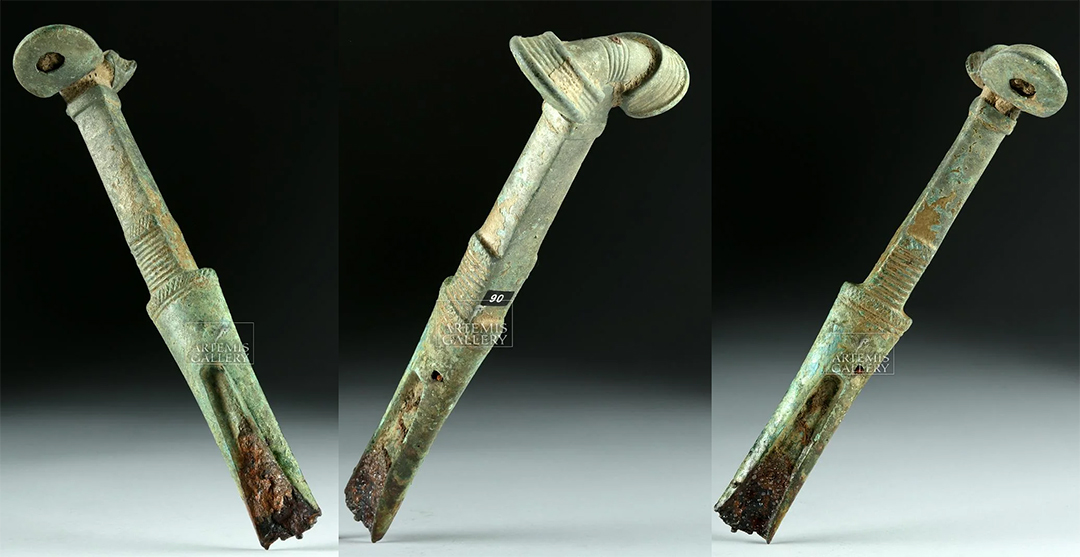 For comparison, here are scans from P.R.S. Moorey's Catalogue of the Ancient Persian Bronzes in the Ashmolean Museum (the illustrated sword also had a bronze hilt and iron blade, like mine), and a group shot of swords, most with double-ear pommels, from Houshang Mahboubian's Art of Ancient Iran: Copper and Bronze. 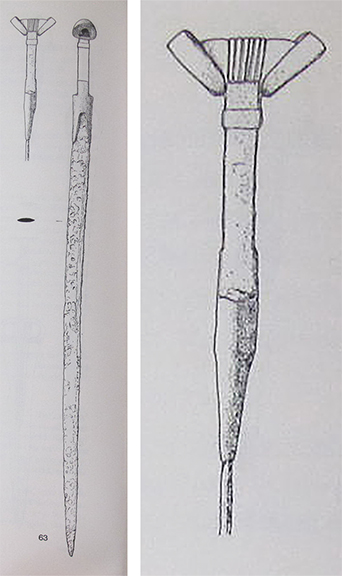 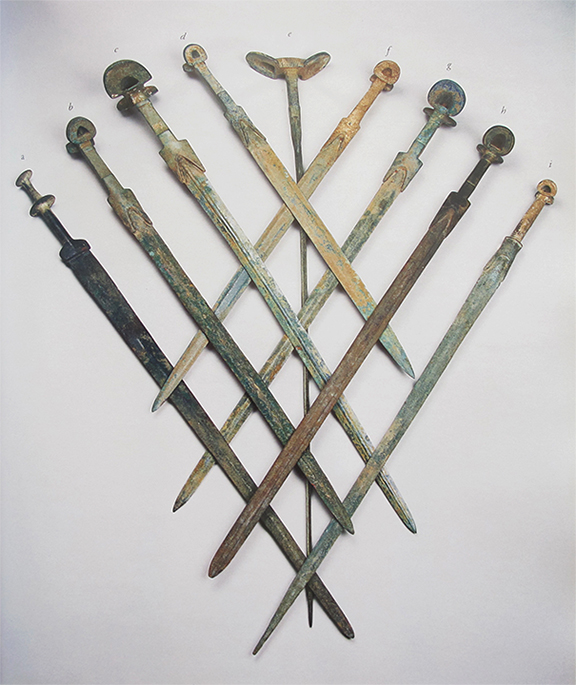 |
|
Moderator
 United States
34564 Posts |
That is pretty cool Bob--thx for posting. It looks to me like each ear has a hemi-circular orifice. Is this a remnant of manufacturing, an easy spot for bejewling, or was there something attached that was even more easily disintegrated than the iron blade?
"If you climb a good tree, you get a push."
-----Ghanaian proverb
"The danger we all now face is distinguishing between what is authentic and what is performed."
-----King Adz
|
|
Pillar of the Community
United States
7067 Posts |
Quote:
It looks to me like each ear has a hemi-circular orifice. That was to get the Q-Tip in, Dave.  Seriously, according to the one at the following link, "The distinctive shape of the pommel has hollow sections which would once have contained inlays of bone or wood." https://archaicwonder.tumblr.com/po...near-eastern |
|
Moderator
United States
34564 Posts |
Ah ok yes bejeweling it is!
"If you climb a good tree, you get a push."
-----Ghanaian proverb
"The danger we all now face is distinguishing between what is authentic and what is performed."
-----King Adz
|
|
Pillar of the Community
Spain
2752 Posts |
Great looking hilt Bob, looks to be in lovely condition..  Have a question and excuse my ignorance here...When you look at sword styles over the centuries one of the features that always strikes me, (no pun intended), is the hand guard. In general there always seems to be a secure hand guard 90 degs to the blade which would stop your combatants sword dead in its track, or at least a severe angular change to deflect the slide of your opponents sword away from the hand area. The Iranian swords and daggers, although still having a deflection angle, seems so slight as to not really protect the hand.....Was there some sort of hand guard built into the hand grip? Great addition to your amazing and very interesting collection.... PS...Ikea cabinet?.....Paul 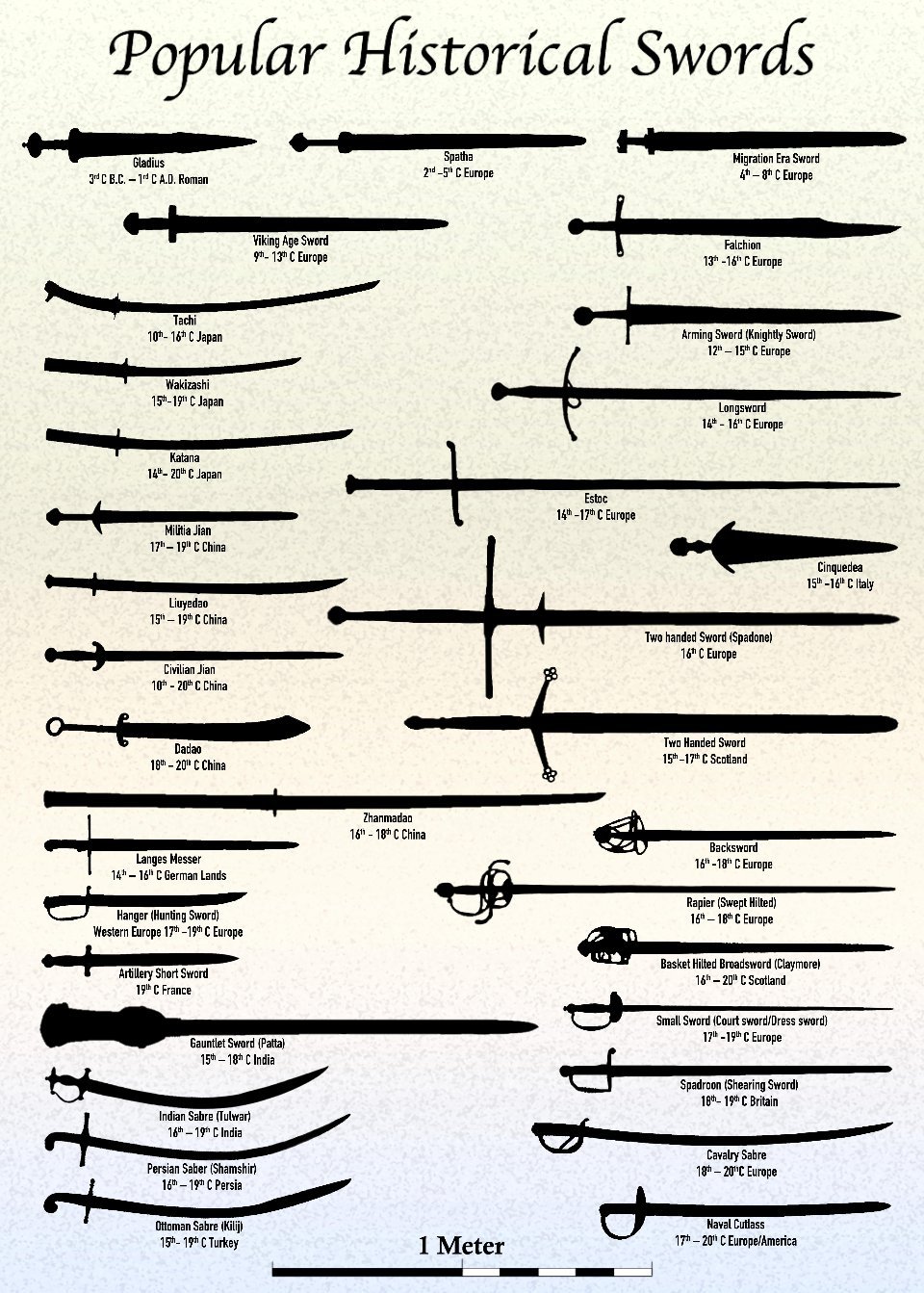 |
|
Pillar of the Community
United States
7067 Posts |
Not sure of the answer, Paul. It's true that many of the very early Western Asian - and also Greek - daggers and swords did not have substantial guards. I don't think that there were any external/attached devices for hand protection - I suspect that, if there were, many would be extant and we would know about them. By medieval times, of course, cross guards could be large, extending out at substantial lengths from the grips. Maybe it simply took the net effect of several thousand years of accumulated bloody hands to figure it all out?
|
|
Moderator
United States
23731 Posts |
With hilt like that the blade most have been impressive. Beautiful addition Bob.
|
| |
Replies: 149 / Views: 16,044 |






 First Page


 Posted 10/14/2019 07:11 am





