| Author |
 Replies: 149 / Views: 16,048 Replies: 149 / Views: 16,048 |
|
|
|
Pillar of the Community
 United States
7067 Posts |
Thanks, Ron. Perhaps, though, not as impressive as some of the elaborately wrapped grips of Echizen swords.
|
|
Moderator
 United States
23731 Posts |
I think a 3000 year old hilt would beat a 600 year old Japans sword hilt hands down. Especially if it was used in combat, there is so much more history there.
|
|
Pillar of the Community
United Kingdom
1168 Posts |
I hope this thread continues to grow, as I find the subject fascinating. The essay is clear and very informative, and the gallery of bronze weaponry is awesome. I have never seen the like of some of these blades and hilts before.
I have a few arrowheads, and tried to identify them from the images in the gallery, but some are either outwith the time period and region, or they are possibly fake.
Just a thought, but it has already been mentioned that a warrior's sword would be buried with him for use in the afterlife. In the making of a blade for a mighty warrior (which would take months) it took on it's own spirit, so man and blade could become one. In some cultures when the warrior was buried, the blade was purposely bent and buried with him, so that no one else could use it. They would be reunited intact in the afterlife.
A brilliant piece of work Bob. Thanks for sharing.
Jim
|
|
Pillar of the Community
United States
7067 Posts |
Thanks, Jim. Interesting comments.
Feel welcome to post the arrowheads, either here in this thread or in a new one. I'd love to see them.
|
|
Pillar of the Community
United Kingdom
1168 Posts |
Hi Bob, if it's OK with the Mods I'd rather put the arrowheads in another thread, and leave this one for your work. It would be a shame to spoil this thread.
Jim
|
|
Pillar of the Community
United States
7067 Posts |
Sounds good to me, Jim. The mods have been pretty patient with the posting of some antiquities, especially since they do provide some context for the coins. Hopefully that allowance will continue. Looking forward to seeing your arrowheads.
|
|
Pillar of the Community
United States
7067 Posts |
|
|
Moderator
United States
34564 Posts |
Fascinating!
"If you climb a good tree, you get a push."
-----Ghanaian proverb
"The danger we all now face is distinguishing between what is authentic and what is performed."
-----King Adz
|
|
Pillar of the Community
 Spain
2752 Posts |
Very nice Bob....I found it really interesting reading through your gallery. I also noticed that a large number of your pieces have excellent provenance as well. Your photographic skills are pretty impressive too....  An outstanding collection Bob! Congratulations Paul |
|
Pillar of the Community
United States
7067 Posts |
Thanks, guys. Yes, Paul, I look for items with strong provenance when possible. Thanks especially for the nice comment about the photography. I am certainly trying my best, despite using a pretty old camera with limited capability. It's a process - and is particularly challenging when I try to collage images that include some close up details, as with the hilts and that recent sword purchase. I'm hoping that, after going to one of the pages in the gallery, people will realize they can again click on the image pic for a larger version to pop up. I've probably been pushing the Forum mods' patience to the limit with image sizes (they're not gigantic, but some are over 400 kb, which is large for the site). I have been wanting to show the details of the patinas, which can be interesting and, I think, attractive.
|
|
Moderator
United States
23731 Posts |
Bob, I always enjoy seeing you blades. It is a wonderful collection with a lot of history behind it.
|
|
Pillar of the Community
United States
7067 Posts |
|
|
Pillar of the Community
United Kingdom
1168 Posts |
An impressive work - even more impressive with round two.
As others have previously mentioned, your photographic skills are second to none Bob.
Jim
|
|
Pillar of the Community
United States
7067 Posts |
Thanks, Jim. Naw, my photo work is at best adequate given the old camera I'm using. That's not false modesty. My shots are better than some, I suppose, but quite inferior to so many I see posted. I do what I can.
|
|
Pillar of the Community
United States
7067 Posts |
Here's an interesting and mysterious item. Recently picked up a decent sized lot of ancient Iranian arrowheads, and have more goodies on the way. The following was included in the lot. This hilt, with broken blade, would have been part of a tiny pseudo-weapon, an imitation of a Luristani dagger. It's about three thousand years old. With the broken blade, it measures 2 3/4". I would imagine that, with blade intact, it would have measured about 3 1/4". These miniature imitation daggers are very rare. I've only seen two for sale since I started collecting the weaponry a couple years back. (This being one of the two - the other is described later in this post) It's remarkable that it was, basically, just an "extra" in the arrowheads lot. 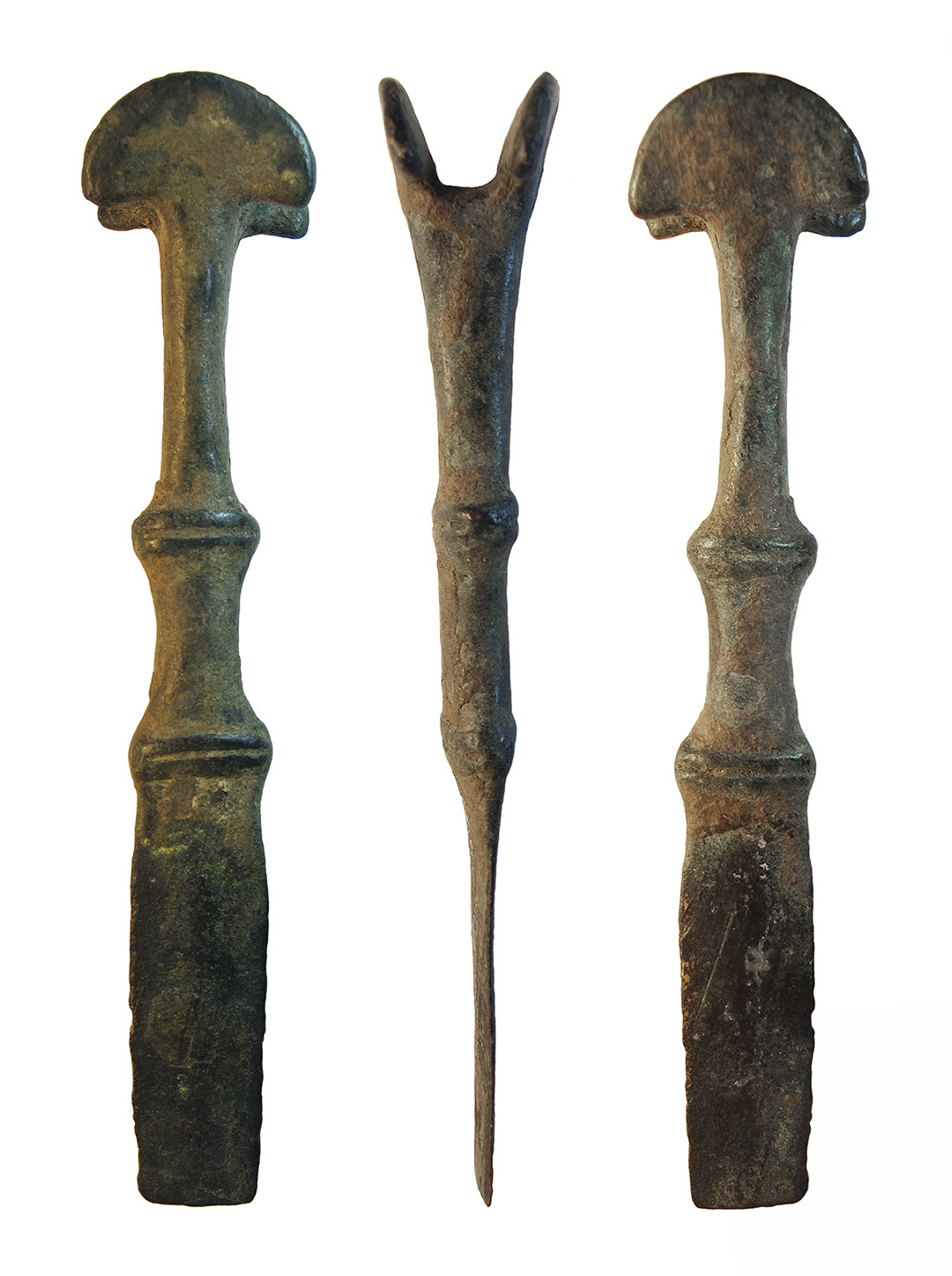 Such small imitative weapons are described by Houshang Mahboubian as surgical instruments. Whether or not that is a reasonable speculation, I don't know. Mahboubian, who possesses what has been described as "one of the most magnificent collections of early Iranian bronzes in the world," illustrates a number of them in his book Art of Ancient Iran: Copper and Bronze. (See below) Most of his examples have, as this one does, a double ear pommel. Here's a picture from his book: 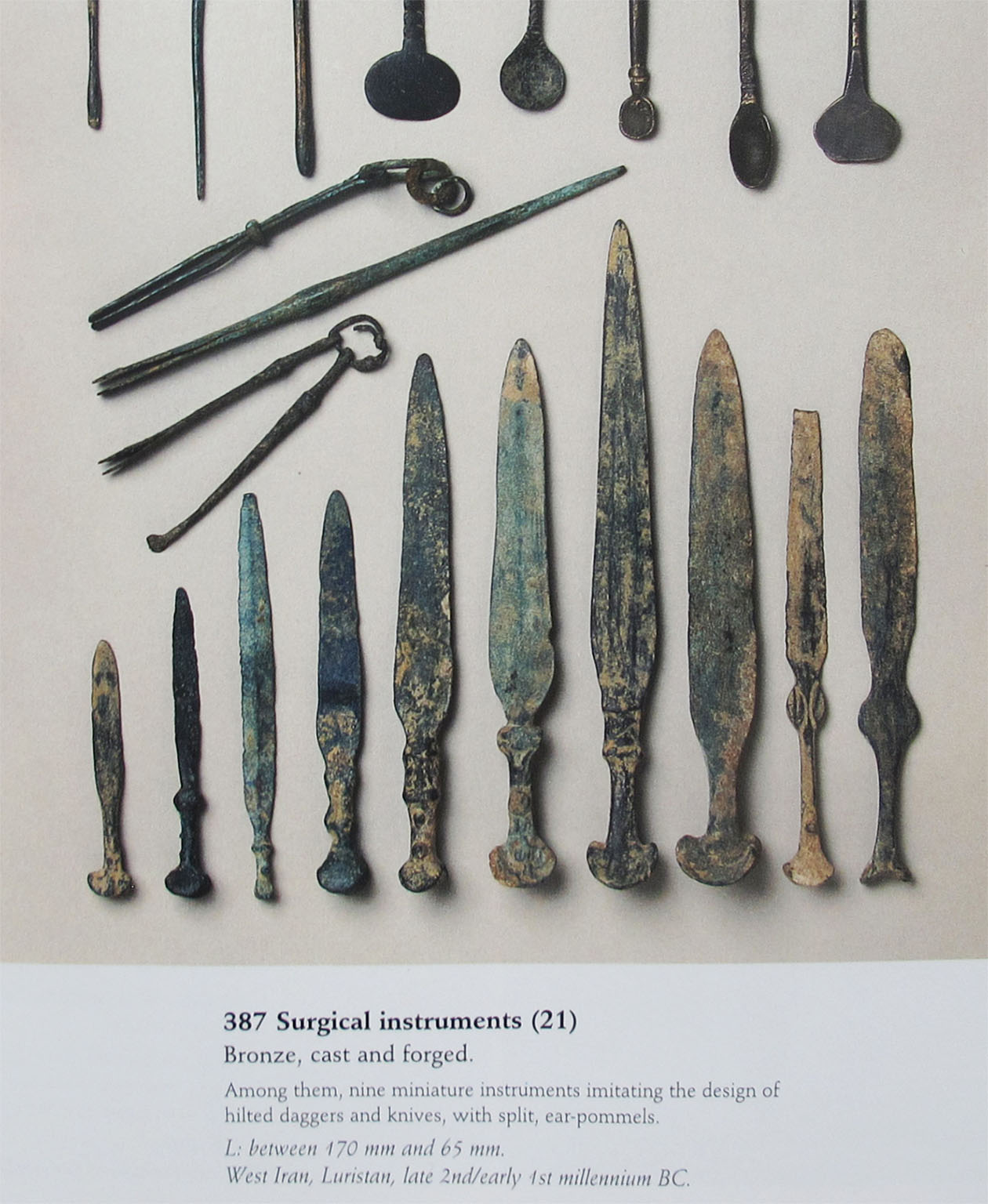 My image, above, crops off most of the more conventional-looking instruments above the "daggers." By contrast, I found this listing from a specimen quite similar to mine (but considerably more expensive!), from a 2019 sale. This one was entirely intact, but measured only 72 mm (less than 3"): "Luristan Bronze Miniature Dagger, Votive Rare Luristan, ca. 1000 BC Accurate miniature version of a typical Luristan dagger with double-eared pommel, long grip and lanceolate blade. The small scale is rare and points to a votive or ceremonial function of the item." https://www.catawiki.com/l/29931947...-votive-rareI suppose the votive interpretation makes more sense to me than the surgical instrument theory. Why, after all, would the ancient Iranians have had certain surgical instruments designed exclusively based on function (as in the upper part of the illustration), and some others that were designed to look like tiny daggers with fancy pommels? Also, we know that weapons were buried with the mercenaries who traveled throughout the region. Most of the ancient Iranian weapons one sees on the market were originally burial goods. So, we can infer that such weapons had some special symbolic or ritual significance beyond their obvious usage. It's not a big leap, then, to imagine that small-scale imitative daggers may have been used for some ritualistic or symbolic purpose as well. Edited by Kamnaskires
12/29/2020 5:16 pm
|
| |
Replies: 149 / Views: 16,048 |





 First Page
 Previous Page


 Posted 12/27/2019 12:58 am





