| Author |
 Replies: 27 / Views: 8,479 Replies: 27 / Views: 8,479 |
|
|
|
Bedrock of the Community
United States
12057 Posts |
The photo in question was actually obtained from PCGS TrueView, as credited directly on the image itself.
Member ANA - EAC - TNA - SSDC - CCT #890 "Most of the things worth doing in the world had been declared impossible before they were done." -- Louis D. Brandeis |
|
Pillar of the Community
Taiwan
607 Posts |
Well GodlessWanderer, the ball is in your court. Care to comment ?
|
|
New Member
United States
8 Posts |
 Here is a picture of my coin... NOTE: The lines between the base of the denticles and the rim that make a circumferential (did I spell that right?) circle around the coin. Just as the comment above that provided the image used to show what a branch mint proof's rim and denticles should look like. |
|
New Member
United States
8 Posts |
 You can see that circumferential line that separates the base of the denticles from the rim clearly. Edited by GodlessWanderer
06/27/2024 10:57 pm
|
|
New Member
United States
8 Posts |
Just showing the reflective properties  |
|
New Member
United States
8 Posts |
Mind you, me, everyone... these pictures were taken in 2011. The cameras on phones have improved quite a bit since then. I think they still hold up for an under 300kb file.
Edited by GodlessWanderer
06/27/2024 10:58 pm
|
|
Valued Member
United States
358 Posts |
@GodlessWanderer Have you checked your 1881-O for VAMs? I know that VAM-16 (Doubled 1, Over Polished Reverse) is known for having Prooflike strikes, seems like a decent place to start if you were so inclined. Here are a couple pics of a DMPL VAM-16: 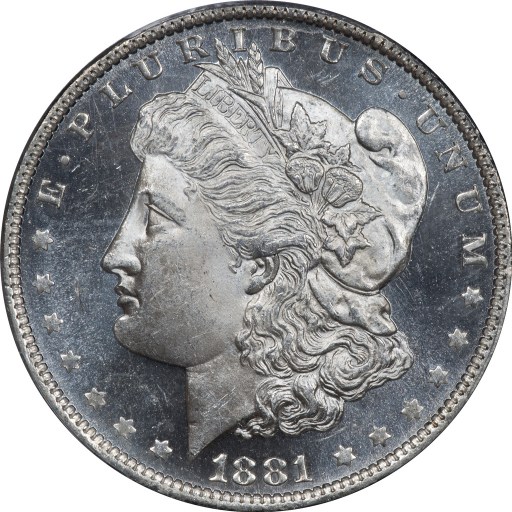 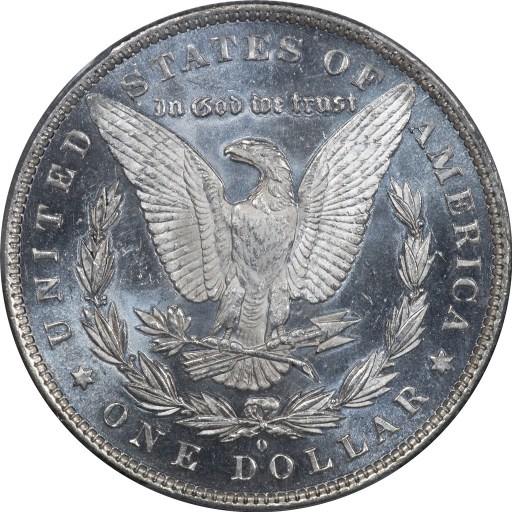 Edited by UnimpossibIe
06/27/2024 11:20 pm
|
|
New Member
United States
8 Posts |
Let's see what today's camera phones can do. I'll take a similar photo of the "pink flower" one I did to show it's reflective properties... don't hold your breath.
Maybe a picture with words in the distance... hmmm.
|
|
New Member
United States
8 Posts |
The difference between that DMPL and my coin is the space between the denticles is polished on mine. Whereas that DMPL, and all other business strikes struck at the New Orleans Mint, have a (what I can only refer to as a) "filler" between the denticles. That characteristic is what sets my coin and it's Branch Mint Proof counterparts... apart from the single-struck business strikes. More inspection on my coin would reveal that the die used was not new. So my coin's reflective properties and extremely well-struck appearance are not due to it being one of the first coins to be struck on a new die. It has a rust mark between the base of the eagle's neck and right-facing wing, Quote:
Also common to both coins, and branch mint proofs in general, there is an unpolished area between the eagle's neck and right (facing) wing. This is common to these pieces because of the branch mint's unfamiliarity with striking proof coinage Quote Source: https://coins.ha.com/itm/proof-morg.../1132-1145.sBottom Paragraph in the middle. |
|
New Member
United States
8 Posts |
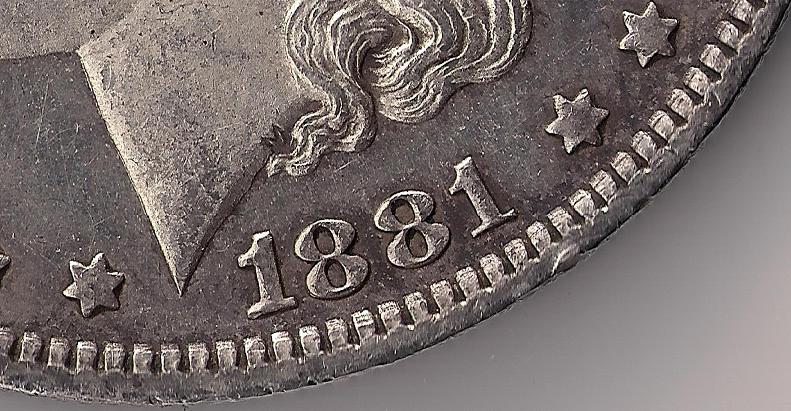 Here's another image. What could have caused the indentations on the denticles? Multiple strikes? Metal displacement between the denticles? Regardless, I know that my coin was struck with the intent of being as proof-like as possible, due to the uncharacteristically un-business struck characteristics it exhibits, both via online images that I have provided, but even moreso when "in hand". It has "across-the-room" reflectivity. |
|
Bedrock of the Community
 United States
18939 Posts |
Quote:
Regardless, I know that my coin was struck with the intent of being as proof-like as possible, due to the uncharacteristically un-business struck characteristics it exhibits, both via online images that I have provided, but even moreso when "in hand". did you read paralyse' comment on the dies? they didnt polish the dies to end up a creating prooflike coins, thats not their intent. keep in mind that the 83(P) coins are typically known for above average strikes overall. your coin just happened to be struck pretty close to after a polishing so not only do you have the solid strike but the surfaces resulted in PL appearance. both sides need to exhibit PL and we are really only seeing the obv. to be certain of a PL designation the reverse needs assessed as well. its possible that one side of the die was polished and the other was not |
|
Bedrock of the Community
United States
12057 Posts |
Easiest way to resolve this issue would be to submit the coin to PCGS, NGC or ANACS for certification and verification. Reaching out to John Roberts directly at ANACS would also be a good start, as he's one of the foremost numismatic experts on Morgan dollars and their varieties. You could also reach out to Roger Burdette at CoinWeek as well. Do some reading on the Roe/Bolender coin for further information about one of the great Morgan mysteries (the supposed 1881-O branch mint proof which has never been rediscovered.) Dies don't need to be "fresh" to have prooflike surfaces, by the way. PL Morgans exist that were clearly struck from repolished dies, including those struck after a process called "basining" the dies where the metal was moved inwards (away from the rims) as a result of polishing which resulted in more concavity and can make the rims appear deeper/sharper than usual. Sometimes the Mint workers would get overzealous and polish the dies TOO much leading to missing parts of the design (missing hair, missing feathers, etc.) creating, e.g. the "overpolished dies" VAM 16 that Unimpossible linked above. The 1878 Morgans from both mints also have numerous examples of overpolished dies. Member ANA - EAC - TNA - SSDC - CCT #890 "Most of the things worth doing in the world had been declared impossible before they were done." -- Louis D. Brandeis |
| |
Replies: 27 / Views: 8,479 |







 First Page


 Posted 05/27/2024 2:45 pm





