











 Posted 09/07/2019 11:20 pm


This post is a bit longer than most but I am trying to cover the situation completely and at the same time explain my methodology of determining classification.
PatAR Interesting fake and a better question about when it was manufactured. There are two distinct types of fakes that exist. The first are the Contemporary Circulating Counterfeits (CCC) - these were made to circulate alongside the original coins in commerce. The second are the Numismatic Forgeries (NF) - these were made to deceive coin collectors at any point in time AFTER the coin became collectable. In some cases, there is a third class of fakes made to fraudulently take advantage of monetary metal fluctuations on the world market. These are more common than most collectors and dealers realize and to my knowledge no one has yet given the type a name. Because they depend on fraud in terms of metallic value, I see them as very closely related to the NF type. I will refer to them as Monetary Frauds (MF). More about the third classification MF later.
The difference in classification is critical since CCC types are generally collectable as part of the numismatic history of the country it came from while NF's are only of nuisance value for identification and avoidance. The MF type are slightly superior to the NF type but they are clearly not as desirable as CCC types.
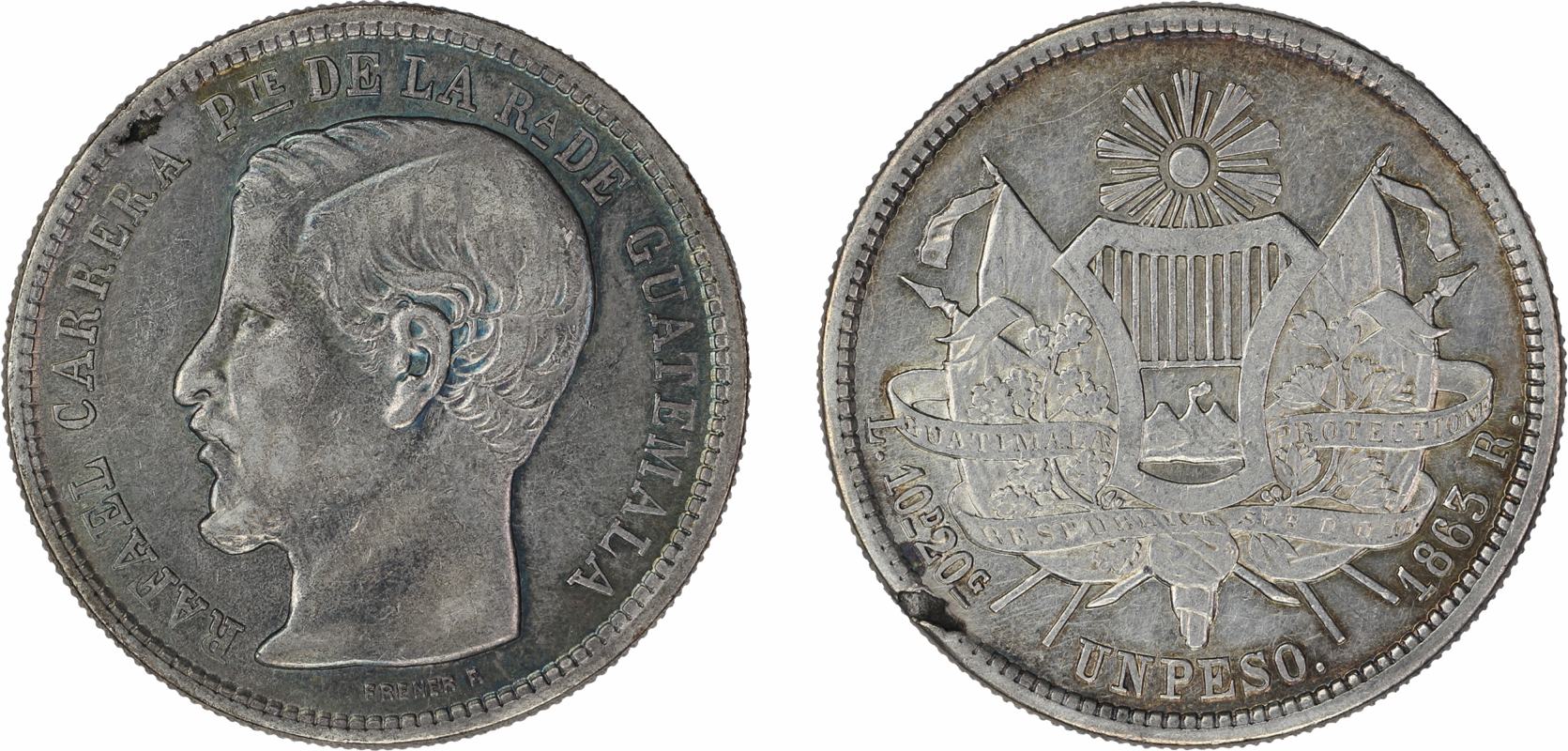
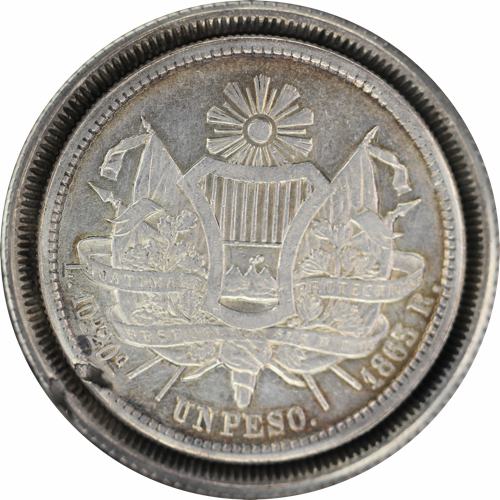
The 1863 Peso from Guatemala is known to exist as both a CCC and a NF. I own one of the latter. My example is copper-nickel and the edge was applied as a second distinct operation. Mine is also close to yours in weight because it was struck on a thicker than normal planchet. I have not encountered a centrifugal cast copy but I suspect they do exist. You would need a collector of Guatemalan forgeries to confirm that last fact.
The size of your coin seems to indicate a volume that is too great to match an original coin. Using your dimensions I arrived at a volume of 2.75 cubic cm which would weigh 28.3 grams if it was coin silver. The Peso of 1863 had an actual standard weight of 27 grams. Your coin weighs 24.4 grams.
In the period from 1863 to the early 1900s the use of Counterfeit Detection balances was very popular and a thick coin or underweight coin would be easily detected. This is a factor that would tend to make the coin easily detected in circulation.
I agree with John when I say that I am unaware of the Chinese producing a layered forgery of this coin but anything is possible. So can you rule out a simple layered coin by checking the edge for a color change? If there is no color change and no bonding seam from the application of a false silver edge, we need to go elsewhere on our quest.
But first there are a couple facts that apply to the world of coin fraud which we need to keep in mind.
These statements as obvious as they seem are often overlooked by collectors when they attempt to determine the age of fakes.
The first fact is clearly true for a CCC because the coin here is debased significantly to create a profit margin if it was accepted into circulation. It is also clearly true if the coin is a NF since the coin as a collectable has a value far above the worth of the silver.
Moving on to question two - we need to know how was the coin manufactured? All layered coins with the exception of an electroplate are struck. Your description of the plate thickness eliminates that single exception. So the coin was struck using dies.
When you indicate a "relatively thick plating" over a base metal core, exactly what are you comparing it to? Sheffield Plate comes in thicknesses which from my observation not normally exceed 0.007 inches. The technology as first developed (ca 1780) was based on the use of a near pure copper core over which silver was bonded by heat and pressure. The bond created is seamless. Later in time, after 1835-49, Sheffield plate was modified to use copper nickel varieties very similar to German Silver. Once again the bond is seamless. Fouree technology developed in antiquity (B.C.) uses a silver foil surface of variable thickness which is mechanically bonded to a base metal core. Unlike Sheffield plate the Fouree technology leaves a very visible seam that often separates over time due to corrosion along the bonding line.
So to help decide the question of methodology is there a seam?
Presuming that the answer above is resolved, the next step is to determine how the image of the coin was placed on the die. To do so you need to know how dies are made. In 1863 Guatemala used French made coining dies. Hubs were likely employed. France was a leader in coining technologies and they were credited with possessed the technology needed to duplicate some dies very early ca 1845. However, that ability was based on their possessing the die punches needed for the creation of coining hubs. Very few other mints were as advanced. Counterfeiters of the period 1845 to 1865 simply did not possess the technology needed to create a steel die from a silver coin.
Some authors postulate the existence of a technology using the principles of electrical erosion or deposition to create such dies. In my experience and based on my research I believe that it is simply not true. While electroplating could produce a very decent copy of a coin in copper in 1835 creating a steel die was not possible.
Spark erosion the first methodology employed by counterfeiters did not produce clean die surfaces. I base this on my own examination of hundreds of examples of coins made with this technology which circulated before 1900.
Having examined the pictures of the counterfeit coin and genuine examples, I am of the opinion that the counterfeit dies were essentially perfect lacking the same identification traits seen on CCC dies of the period. It is hard for me to believe that these dies could have been produced anywhere other than an advanced die shop equipped with genuine die punches for the 1863 Guatemalan Peso before 1900.
I also read a bit on the history of Guatemala to determine when the 1863 Peso would have circulated. In 1869 the Peso standard in Guatemala was changed from 27 grams of 900 fine silver to 25 grams of 900 fine silver. That devaluation ended the circulation of the older Pesos. After 1869 this coin did NOT circulate.
So based on the historic data and the method of manufacture as far as that has been determined - the coin must be a form of Numismatic Forgery made to defraud dealers in bullion coins or people who viewed the coin as containing excessive silver.
This classification is third class of fraudulent Guatemalan coins neither a true CCC type nor a typical NF. In the period from roughly 1870 up to the depression in 1929, many countries faced similar issues with the world metal markets. Coins in circulation either contained too much silver for the face value or the value of silver fell below the face value creating an inverse opportunity. There are many similar situations - the Spanish 5 Pesetas of the 1880 and 1890s is the first that comes to mind, but the Morgan dollar in the US fell into the same category after 1893 when world silver prices plummeted. The Peruvian silver sols of the 1920's and 1930's created another type of MF.
So I conclude by saying that this coin is extremely unlikely to be a counterfeit made for actual circulation. It was produced later as a Monetary Fraud - a classification akin to Numismatic Forgery.
PatAR Interesting fake and a better question about when it was manufactured. There are two distinct types of fakes that exist. The first are the Contemporary Circulating Counterfeits (CCC) - these were made to circulate alongside the original coins in commerce. The second are the Numismatic Forgeries (NF) - these were made to deceive coin collectors at any point in time AFTER the coin became collectable. In some cases, there is a third class of fakes made to fraudulently take advantage of monetary metal fluctuations on the world market. These are more common than most collectors and dealers realize and to my knowledge no one has yet given the type a name. Because they depend on fraud in terms of metallic value, I see them as very closely related to the NF type. I will refer to them as Monetary Frauds (MF). More about the third classification MF later.
The difference in classification is critical since CCC types are generally collectable as part of the numismatic history of the country it came from while NF's are only of nuisance value for identification and avoidance. The MF type are slightly superior to the NF type but they are clearly not as desirable as CCC types.
The 1863 Peso from Guatemala is known to exist as both a CCC and a NF. I own one of the latter. My example is copper-nickel and the edge was applied as a second distinct operation. Mine is also close to yours in weight because it was struck on a thicker than normal planchet. I have not encountered a centrifugal cast copy but I suspect they do exist. You would need a collector of Guatemalan forgeries to confirm that last fact.
The size of your coin seems to indicate a volume that is too great to match an original coin. Using your dimensions I arrived at a volume of 2.75 cubic cm which would weigh 28.3 grams if it was coin silver. The Peso of 1863 had an actual standard weight of 27 grams. Your coin weighs 24.4 grams.
In the period from 1863 to the early 1900s the use of Counterfeit Detection balances was very popular and a thick coin or underweight coin would be easily detected. This is a factor that would tend to make the coin easily detected in circulation.
I agree with John when I say that I am unaware of the Chinese producing a layered forgery of this coin but anything is possible. So can you rule out a simple layered coin by checking the edge for a color change? If there is no color change and no bonding seam from the application of a false silver edge, we need to go elsewhere on our quest.
But first there are a couple facts that apply to the world of coin fraud which we need to keep in mind.
Quote:
First: No fake will be made that does not generate a profit for the maker.
Second: No fake can be made before the technology used to make it was invented.
First: No fake will be made that does not generate a profit for the maker.
Second: No fake can be made before the technology used to make it was invented.
These statements as obvious as they seem are often overlooked by collectors when they attempt to determine the age of fakes.
The first fact is clearly true for a CCC because the coin here is debased significantly to create a profit margin if it was accepted into circulation. It is also clearly true if the coin is a NF since the coin as a collectable has a value far above the worth of the silver.
Moving on to question two - we need to know how was the coin manufactured? All layered coins with the exception of an electroplate are struck. Your description of the plate thickness eliminates that single exception. So the coin was struck using dies.
When you indicate a "relatively thick plating" over a base metal core, exactly what are you comparing it to? Sheffield Plate comes in thicknesses which from my observation not normally exceed 0.007 inches. The technology as first developed (ca 1780) was based on the use of a near pure copper core over which silver was bonded by heat and pressure. The bond created is seamless. Later in time, after 1835-49, Sheffield plate was modified to use copper nickel varieties very similar to German Silver. Once again the bond is seamless. Fouree technology developed in antiquity (B.C.) uses a silver foil surface of variable thickness which is mechanically bonded to a base metal core. Unlike Sheffield plate the Fouree technology leaves a very visible seam that often separates over time due to corrosion along the bonding line.
So to help decide the question of methodology is there a seam?
Presuming that the answer above is resolved, the next step is to determine how the image of the coin was placed on the die. To do so you need to know how dies are made. In 1863 Guatemala used French made coining dies. Hubs were likely employed. France was a leader in coining technologies and they were credited with possessed the technology needed to duplicate some dies very early ca 1845. However, that ability was based on their possessing the die punches needed for the creation of coining hubs. Very few other mints were as advanced. Counterfeiters of the period 1845 to 1865 simply did not possess the technology needed to create a steel die from a silver coin.
Some authors postulate the existence of a technology using the principles of electrical erosion or deposition to create such dies. In my experience and based on my research I believe that it is simply not true. While electroplating could produce a very decent copy of a coin in copper in 1835 creating a steel die was not possible.
Spark erosion the first methodology employed by counterfeiters did not produce clean die surfaces. I base this on my own examination of hundreds of examples of coins made with this technology which circulated before 1900.
Having examined the pictures of the counterfeit coin and genuine examples, I am of the opinion that the counterfeit dies were essentially perfect lacking the same identification traits seen on CCC dies of the period. It is hard for me to believe that these dies could have been produced anywhere other than an advanced die shop equipped with genuine die punches for the 1863 Guatemalan Peso before 1900.
I also read a bit on the history of Guatemala to determine when the 1863 Peso would have circulated. In 1869 the Peso standard in Guatemala was changed from 27 grams of 900 fine silver to 25 grams of 900 fine silver. That devaluation ended the circulation of the older Pesos. After 1869 this coin did NOT circulate.
So based on the historic data and the method of manufacture as far as that has been determined - the coin must be a form of Numismatic Forgery made to defraud dealers in bullion coins or people who viewed the coin as containing excessive silver.
This classification is third class of fraudulent Guatemalan coins neither a true CCC type nor a typical NF. In the period from roughly 1870 up to the depression in 1929, many countries faced similar issues with the world metal markets. Coins in circulation either contained too much silver for the face value or the value of silver fell below the face value creating an inverse opportunity. There are many similar situations - the Spanish 5 Pesetas of the 1880 and 1890s is the first that comes to mind, but the Morgan dollar in the US fell into the same category after 1893 when world silver prices plummeted. The Peruvian silver sols of the 1920's and 1930's created another type of MF.
So I conclude by saying that this coin is extremely unlikely to be a counterfeit made for actual circulation. It was produced later as a Monetary Fraud - a classification akin to Numismatic Forgery.


