| Author |
 Replies: 12 / Views: 3,044 Replies: 12 / Views: 3,044 |
|
|
New Member
United States
6 Posts |
I'm deciding whether to return this and need some opinions. Weight and specific gravity are correct for 90% silver, but the coin doesn't ring like silver when plinked. It does seem to pass the magnet test, and it isn't magnetic. Is there an alloy that would have not only the same weight, but also specific gravity as coin silver? Here's the info I've tested: Size: 39.2mm x 39.9mm = good Thickness: 2mm = unsure Weight: 26.58g = good factoring for wear Specific Gravity: 10.30 = almost dead on. Would a small crack in the coin prevent it from ringing? It does have a small crack opposite one of the knife marks. Also, it almost looks like there is copper color under some worn spots, but it doesn't make sense for this to be copper plated if the weight and density are right. Could that just be some strange natural patina? Any opinions are welcome, I just need some advice. Thanks! 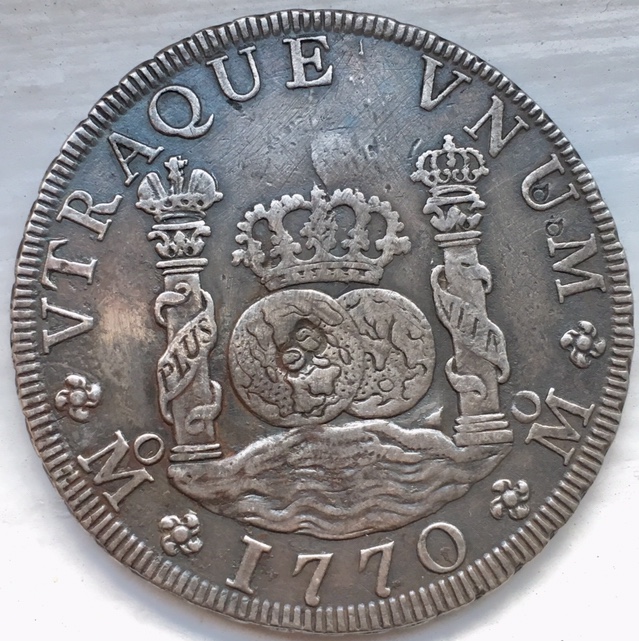 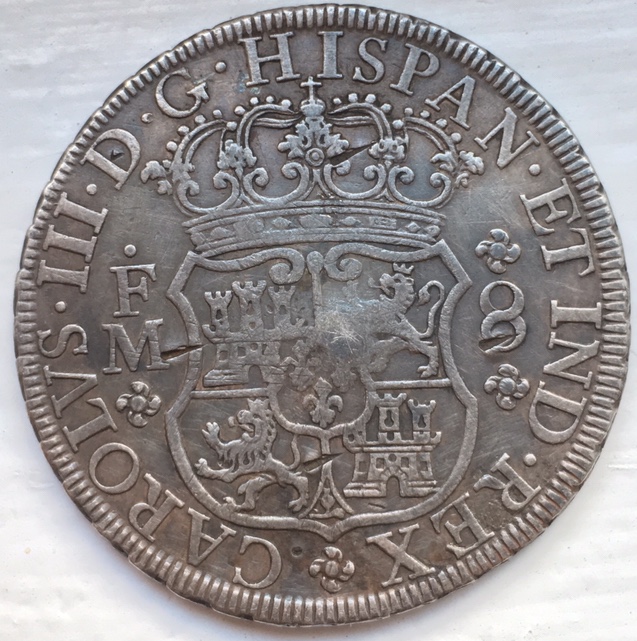 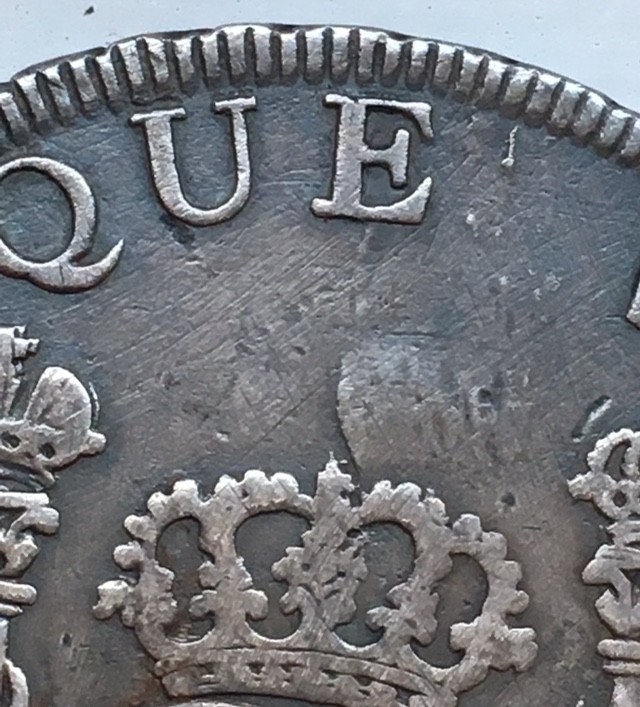 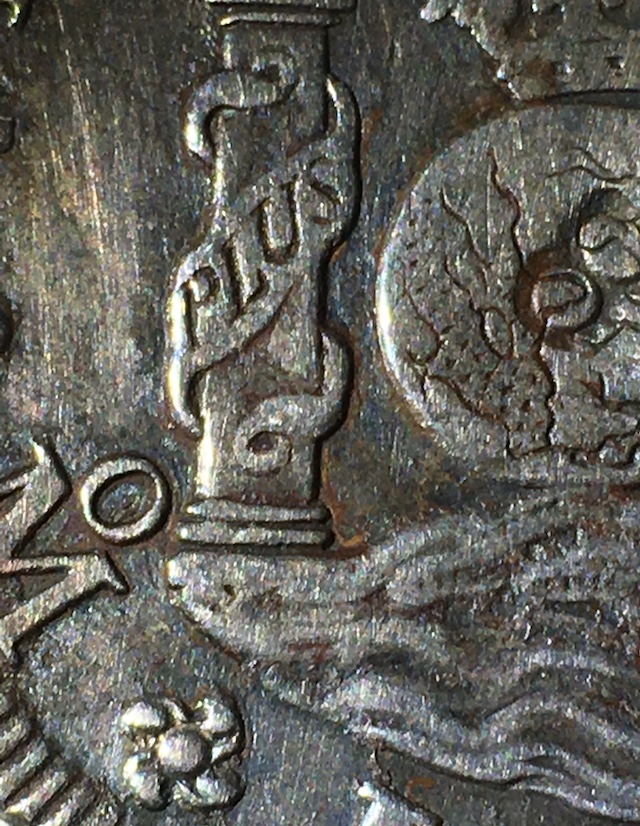 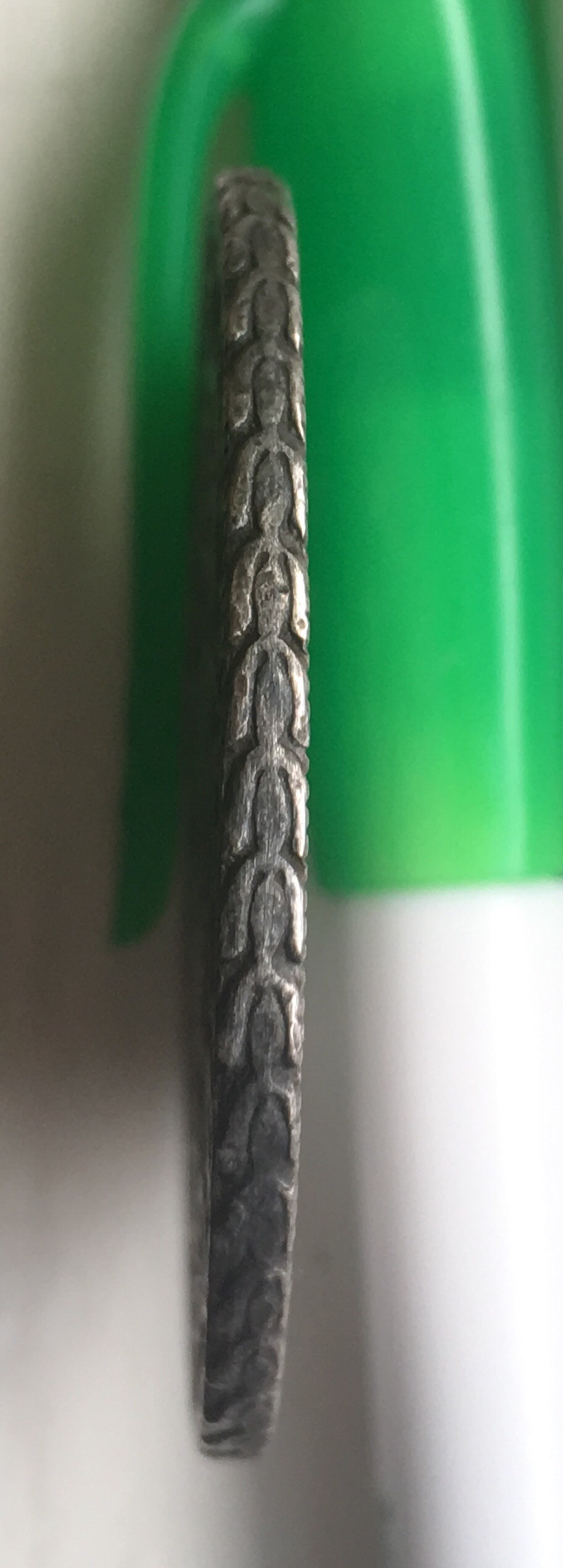 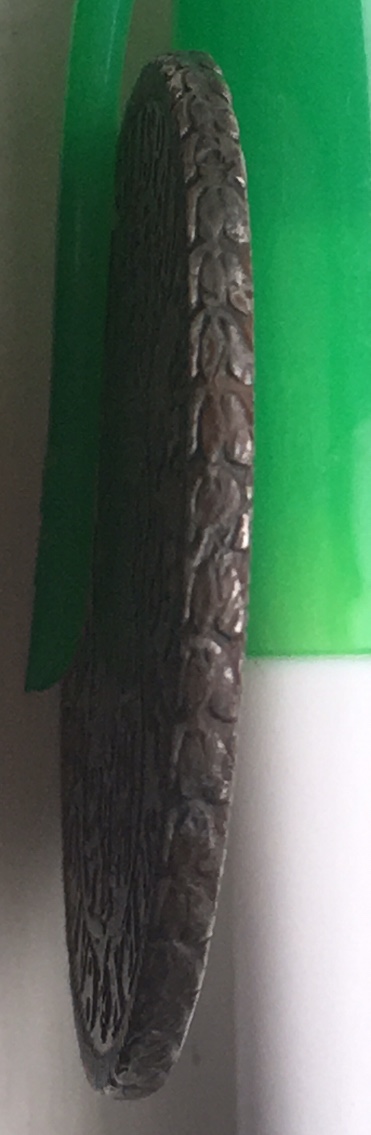 |
|
|
|
Moderator
 United States
198004 Posts |
 to the Community! Your post was moved to the appropriate forum for the proper attention.  |
|
Moderator
United States
56855 Posts |
to CCF. Very nice photos. John1  |
|
Pillar of the Community
United States
4883 Posts |
 Excellent photos, for sure. I don't see anything that sets off alarms for me, and it's almost impossiblr to fake a silver coin and come out with a near correct weight and specific gravity. Interesting "8" counterstamp. Also, I'd opine that the cuts into the coin's surface were made specifically to check that there it wasn't a case of a silver overlay on a copper core. Colligo ergo sum
|
|
Rest in Peace
United States
17900 Posts |
I see nothing indicating it to be a counterfeit. Yours is actually quite nice. One for NGC or PCGS I'd say.
|
|
New Member
 United States
6 Posts |
Thanks so much for the info! I know very little about non-US coins, and I've been nervous delving into older Spanish coins knowing they are so highly faked. I'm glad it doesn't raise any red flags.
|
|
Pillar of the Community
United States
1156 Posts |
Since you probably paid more than the melt value, yes there is a reason to counterfeit this type of coin with correct silver/copper alloy. There are many quality images of certified examples of this specific variety and I suggest that you examine them carefully. The two most atypical items that caught my attention are (1) the way the edge design drifts from nicely centered to completely missing one of the tulip leaves and (2) the triangular extrusion to the bottom right of the right globe. Given the obvious post minting damage I don't think you would get the proper authentication attention from the TPGs. I would suggest that you return this one and buy one without the surface issues. IMO, undamaged examples in VF-XF grades have been much more affordable recently than they have in the past decade. Here's one I sold recently that went for $336 including buyers premium -- I bought this raw for $384 in 2011 and paid to have it slabbed. Edited by jgenn
09/06/2019 02:48 am
|
|
New Member
United States
6 Posts |
I did notice the triangular protrusion and have not seen it on other examples. Also, drifting of the tulip leaves, and that one side of the design is extremely worn, but not the other. Almost like something was ground away and made to look damaged - possibly remnants of a sprue or edge seam. If the coin was cast would that explain why it doesn't ring like drop forged silver when struck?
|
|
Pillar of the Community
United States
4883 Posts |
Quote:
...here is a reason to counterfeit this type of coin with correct silver/copper alloy. This is true, and would result in a coin with the proper weight and specific gravity. However, unless the alloy was sourced from coins from the period, the trace elements (or lack thereof) will give it away. Here is where analysis via xray fluorescence (XRF) is a useful tool. I'd remark, though, if someone was going to go to the trouble of faking one of these, the 1770 issue would be a poor choice compared to other, much more numismatically desirable dates for this type. I also don't think a counterfeiter would compromise his return by inflicting damage on his product such as we see here. I frankly don't see any compelling evidence that this is a casting, either. I vote genuine, but it's going to get a "details" annotated grade. Colligo ergo sum
|
|
New Member
United States
6 Posts |
Quote:
...I also don't think a counterfeiter would compromise his return by inflicting damage on his product such as we see here... . This makes sense. Good to hear it doesn't seem cast to you. I guess I'll keep it since 3/4 suspect authentic. I don't know much about the various years either, so thanks for that info regarding 1770 - it makes sense. So I guess that triangular protrusion must be some sort of die break then. A counterfeiter could probably have ground that down or filled the hole in the die, given the quality of the rest of the piece, I imagine they would have. |
|
Pillar of the Community
United States
689 Posts |
There are few things that bother me; the bubbles on the dos mundos side about 12:30; the field scratches; I do not understand how that edge could be made. The eight counter stamp is cool. Sometimes counterfeiters add test cuts and chops to distract. The numbers are good but I would not buy it.
|
|
Pillar of the Community
United States
5362 Posts |
Seymour Coins
I will add a word of caution on this particular coin. Lately I have noticed an increase in the quality of forgeries (very recently discovered) that makes me far more cautious about saying any Pillar Dollar is genuine without an XRF (laboratory grade) test.
I want to compliment the quality of the pictures before going further.
Also before continuing, there is a comment by Lucky Cuss to the effect that he would not copy a 1770 (common date) and then damage it. That is likely why he is not a counterfeiter. A successful counterfeiter or forger picks objects that attract no attention to perfect his craft. This is a way to make a profit while avoiding the likelihood of being caught. Many Numismatic Forgeries are not detected until they have passed hands several times. The forger needs only one pass to profit and unless his work come to light quickly he is off to another target. All Pillar dollar dates are targets - common first - rare less common for high quality fakes.
I evaluate any coin based on a 20 point scale of typical problems seen on other forgeries. Some of the points are seen on genuine coins but when too many points appear on one specimen that needs explanation and I get cautious.
Coincidence of these points is often a great problem because they were developed for edge and faces and for different types of forgery/counterfeiting. Too wide a range is also very bad news.
As jgenn points out correctly the edge design wobbles. While this is possible when using a very worn edger - most 1770 examples were edged without such a wobble. I would say this is a rather serious issue and needs a bit more evaluation. So does the coin have visible opposing seams in the edge design? All Spanish colonial milled coins were produced on a two bar edger (mill or Castang machine if you prefer). What happens on one side of the coin effects the opposite side at exactly 180 degrees apart. The final photo of the edge shows a possible seam just above the green transition. Was that green line of demarcation meant to identify the seams? I also note that the details of the lotus design are NOT identical. These were punched into the edge die with an element punch - does the edge design as it appears conform to the method of punching employed? The appearance might be explained as post strike damage or wear however it needs to be closely reviewed before accepting that explaination. Next I noted that some of the scratches that are visible on the edge run parallel to the coin faces around the perimeter. I find that disturbing. Such scratches can be made on the edge of a coin but not normally. Usually as someone pointed out such scratches are made to obscure edge seams and anomalies. This adds suspicion. So I have several points attributable to the edging process that would make me unlikely to classify the coin as genuine without conclusive scientific proof.
Turning to the faces of the coin - the die surfaces are poor. Again this does happen to genuine coin dies when they wear or rust but 1770 is generally a rather clean date for the series. Dies were well finished and properly maintained. Strikes are generally crisp and clean looking.
Regarding the raised triangle which would be a depression in the die, that could be caused by post die creation damage to the die. Possible but not normal and rarely seen. I am bothered more by several other areas of die damage that make even less sense when viewed as a group. I will focus on only three.
First above the crown there appears to be a raised area in the field that would correspond to a failure of the die surface (a depression). This does happen occasionally when there is a void in the steel close to the die face that collapses under striking pressure. It could possibly result from the die face itself delaminating, however that circumstance is extremely rare. Here delamination seems to be the case because there are tiny raised bumps on both sides extending to the base of the E in the legend and the rim between the E and the V. This looks more like the die face delaminated along a strip. Does that happen - possibly but extremely rarely when dealing with a steel die but very often when dealing with a plastic mold used for centrifugal casting. Next note the shape of the last element of the right side of the "delamination" strip as it approaches the dentil arc. I see a line sharply defined with a round terminus. Is that what I would expect to see in a steel die chip or is it more often seen on plastic centrifugal molds?
Second within the 0 of the date note a "leaf" shaped feature extending from the 4-5 o'clock position on the 0 toward the center of the 0. Is this as it appears also a raised feature? That means a die dent that did not impinge on the 0 itself or a feature of the 0 punch used. I can not recall seeing this on other 0's on 1770 coins so a punch feature is a bit less likely. To me it resembles a pull or tear in plastic which is seen when a finished mold is removed too early from the mold that created it. Again just suspicious.
Third there is something similar above the horizontal bar on the 7. I am again suspicious although I have seen things like this on genuine coins.
Next I want to comment on the number of anomalous stray lumps of metal here and there which would be small rust holes in the die face. They are all over. I counted nearly 20 on the obverse die without enlarging the image. These are typically seen on poorly stored dies that have rusted or they are seen on surfaces that were liquid at some point. I am not saying it is proof of a cast transfer image just very suspicious.
Someone pointed out the field scratches, to these I would add the numerous small surface dings. The coin looks intentionally distressed for some reason - not quite normal. Can this happen to a genuine coin - of course it can - not proof just suspicious.
At this point I will stop. There are more many more I could enumerate but there is no purpose. I have reached a point where I would conclude that the coin could not be considered to be genuine before extensive study to determine if all the suspicious elements are in fact only coincidental.
I would buy the coin only as a Numismatic Forgery not as a Counterfeit. The coin can not be a CCC because the technology used did not exist.
|
|
New Member
United States
6 Posts |
Quote:
I will add a word of caution on this particular coin. Lately I have noticed an increase in the quality of forgeries (very recently discovered) that makes me far more cautious about saying any Pillar Dollar is genuine without an XRF (laboratory grade) test. Thanks so much for taking the time to look at these pictures and really analyze them. You've outlined some very good reasons for me to doubt the authenticity, and I can't thank you enough, since you likely just saved me about $180.00. The seller does do refunds, so I'll be returning this. Maybe I'll look for something less high risk this time. |
| |
Replies: 12 / Views: 3,044 |
|




 Posted 09/05/2019 3:37 pm





