











 Posted 11/02/2019 11:51 pm


To expand and clarify a little on what Numista states there:
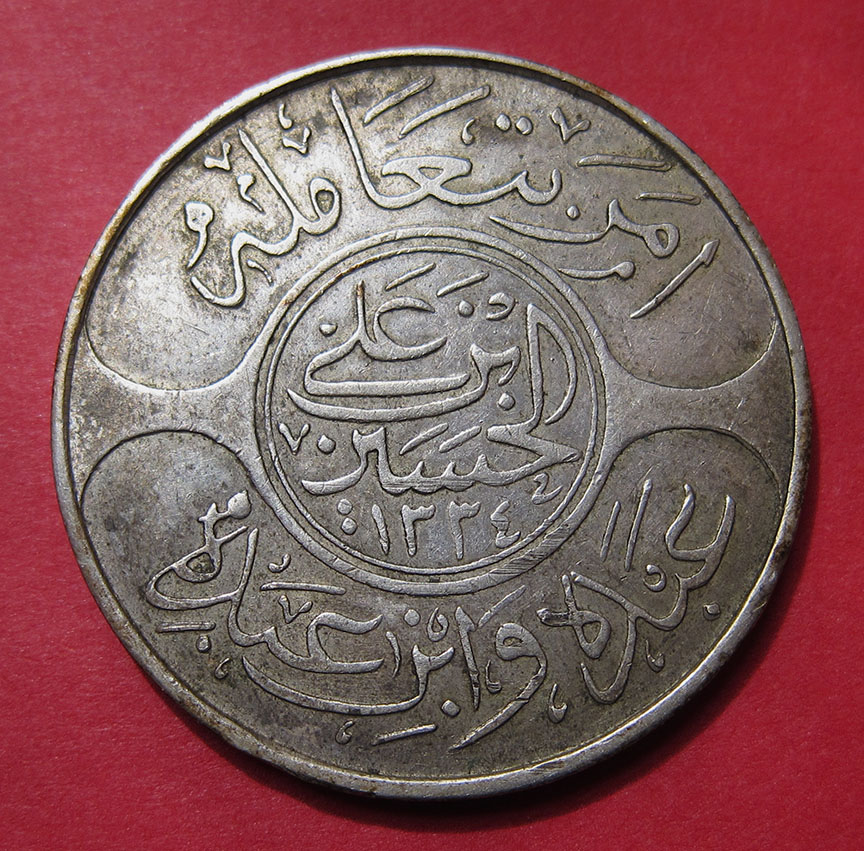
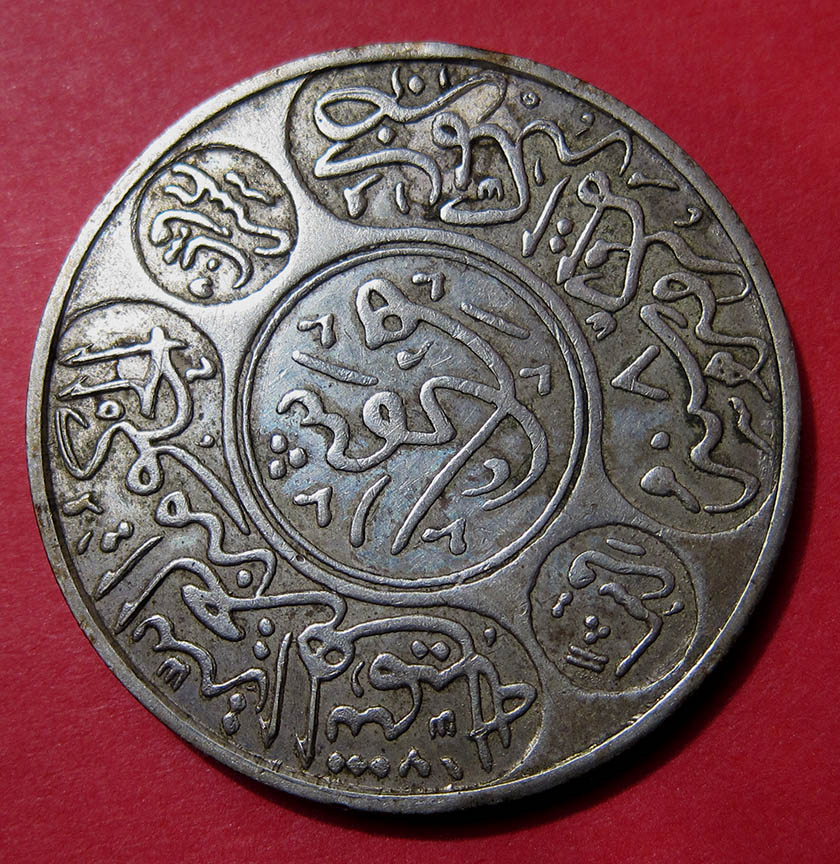
Country: the Kingdom of Hejaz, one of the precursor states to what we now call Saudi Arabia. It comprised the eastern coastline of the Red Sea, including the Islamic holy cities of Mecca and Medina. The coin claims to be "struck in Mecca", though I'm not sure it actually was.
Denomination: the denomination actually stated on the coin is "twenty qirsh". The Arabic word "qirsh" is often translated into English as "piastre" or "piaster", so it may appear in catalogues under that name too - the Krause catalogues call it "20 piastres". Also, in the monetary system then in use in Hejaz, 20 qirsh equalled 1 riyal, so it is in effect a "1 riyal" coin.
Date: The coin is dated "1334", in the Islamic calendar, a year which began on 9th November 1915 and ended on 28th October 1916. Hejaz did not become an independent kingdom until June 1916, so "1916" is the best translation of the date. The coin also bears a "regnal date" on it, Year 8. This coin comes in two varieties, Year 8 and Year 9, with Year 9 being scarcer (as the "1334/9" period only lasted from the 8th to the 28th of October 1916).
The coin is quite scarce, and would be worth considerably more than its bullion value in this condition, if genuine. Here's the NGC catalogue page for it.
Country: the Kingdom of Hejaz, one of the precursor states to what we now call Saudi Arabia. It comprised the eastern coastline of the Red Sea, including the Islamic holy cities of Mecca and Medina. The coin claims to be "struck in Mecca", though I'm not sure it actually was.
Denomination: the denomination actually stated on the coin is "twenty qirsh". The Arabic word "qirsh" is often translated into English as "piastre" or "piaster", so it may appear in catalogues under that name too - the Krause catalogues call it "20 piastres". Also, in the monetary system then in use in Hejaz, 20 qirsh equalled 1 riyal, so it is in effect a "1 riyal" coin.
Date: The coin is dated "1334", in the Islamic calendar, a year which began on 9th November 1915 and ended on 28th October 1916. Hejaz did not become an independent kingdom until June 1916, so "1916" is the best translation of the date. The coin also bears a "regnal date" on it, Year 8. This coin comes in two varieties, Year 8 and Year 9, with Year 9 being scarcer (as the "1334/9" period only lasted from the 8th to the 28th of October 1916).
The coin is quite scarce, and would be worth considerably more than its bullion value in this condition, if genuine. Here's the NGC catalogue page for it.
Don't say "infinitely" when you mean "very"; otherwise, you'll have no word left when you want to talk about something really infinite. - C. S. Lewis


