| Author |
 Replies: 13 / Views: 1,736 Replies: 13 / Views: 1,736 |
|
|
New Member
Australia
10 Posts |
Hi everyone, I would be very grateful if anyone can help me identify one or both of these two coins I have. The first is a little easier to make out detail on (the one not in the protective sleeve), but I have no context for what it is. The second, as you can see from the photo, is allegedly a 'Window's Mite', but the detail is incredibly worn and I can barely make anything out. The photos can be zoomed in on for better detail. https://ibb.co/bB5hsmChttps://ibb.co/594mwQWhttps://ibb.co/kcs0xtthttps://ibb.co/fk8yr2jThanks for any help! *** Moved by Staff moved to a more appropriate forum. *** |
|
|
|
Moderator
 Australia
16985 Posts |
Hello and welcome.  Your first coin is indeed Roman, or perhaps a Barbarian copy of a Roman coin - Roman coin quality was not very good in the mid-200s AD. It claims to be a coin of Anglo-Gallic emperor Tetricus II, who alongside his father ruled Britain and parts of France as a breakaway Empire in 273-274 AD, before Britain was reconquered by emperor Aurelian. On the reverse is Spes, goddess of hope, holding a (very large!) lily. Coins like this are very common metal detector finds in Britain; despite their relatively brief reigns, the coinage issue of these two Tetricii, plus the numerous Barbarian imitations of them, were quite prolific coin issues. Unfortunately, we can't really see any detail of the second coin while it's inside the plastic holder. The information written on the holder is inconsistent; the coins normally described by coin dealers as "Widow's mites" are the bronze prutahs of Hasmonean king Alexander Jannaeus, who reigned in the 1st century BC, not AD. Don't say "infinitely" when you mean "very"; otherwise, you'll have no word left when you want to talk about something really infinite. - C. S. Lewis
|
|
New Member
 Australia
10 Posts |
Hi Sap, Thank you so much! I spent an hour trying to identify that first coin and had seen the portrait resembled Tetricus II, but the reverse side I couldn't find a match anywhere for, so I wasn't sure. Very interesting if it's a barbarian imitation! Thanks for the history! Sorry about the image qualiry of the other, I've pulled it out and taken what I hope are better photos in case that can help in identification! It's still very worn, but the detail's a little more visible. https://ibb.co/C1C8QMdhttps://ibb.co/yy4kpdtIf it's still no good, let me know and I can try again! :) |
|
Moderator
Australia
16985 Posts |
I can't quite identify it, but I can guarantee you that it absolutely, definitely is not a Jewish "widow's mite". The spiky headgear on the portrait gives it away: it's another 3rd century Roman coin, very much like your first coin. Possibly another Anglo-Gallic Empire coin, or it might be a "proper" Roman coin of emperors Claudius II or Gallienus. My bet would be on Gallienus. For the record, Widow's mites don't have portraits on them. No ancient Jewish coins do; the Jews regarded portraits on coins as "graven images", and thus were forbidden. The coins usually marketed as "widow's mites" look like the coins on this page, with an anchor on one side and a star on the other. Or, if people were marketing the coins actually issued at around the time of Christ, then they look like these, with a sheaf of wheat and a ladle. Don't say "infinitely" when you mean "very"; otherwise, you'll have no word left when you want to talk about something really infinite. - C. S. Lewis
|
|
New Member
Australia
10 Posts |
Thank you again, very informative!
That coin belonged to a family member and came from a usually reputable dealer (to my understanding), but based on what you've said and a quick look myself it looks like it definitely isn't a Widow's mite. I'd originally been suspicious purely because it was so hard to identify, haha.
Thank you very much for your help!
(I know I've got another unidentified ancient coin somewhere, so I might be back again!)
|
|
Moderator
United States
23731 Posts |
 to the community The first coin does appear to be Roman, but we will need better pictures to tell you more about it. I can't see any detail on the second coin. It would be best to remove them from the holders and under better light take better pictures. |
|
New Member
Australia
10 Posts |
Thanks echizento, unfortunately they were the best pictures I could get on my camera. I did include better photos of the second one in my second post, if that helps. Sap already gave me an excellent run-down of his thoughts on the coins though!
|
|
CCF Advertiser
United States
1318 Posts |
Here is your coin. Could be Claudius II as his are often in such a state as your coin is. Just my opinion of course. I tried to orient the head to show the radiate others have noticed. Might be Gallienus as well but his held up better often.   Edited by louisvillekyshop
11/17/2019 10:30 pm
|
|
New Member
Australia
10 Posts |
Thanks for the improved images! I tried to take a couple more of that coin with better light. Not sure if it helps that much, but the reverse might be a bit clearer? Apologies for the low quality! https://ibb.co/mH3NVnmhttps://ibb.co/7rTDMJ4 |
|
Moderator
United States
195259 Posts |
to the Community! |
|
Valued Member
Bulgaria
141 Posts |
Edited by iulius
11/18/2019 2:28 pm
|
|
New Member
Australia
10 Posts |
Thanks for the picture and link, iulius! Looks cool to see a much clearer one! Okay, I had another go at the second coin (the one originally marked as a Widow's Mite which, as Sap said, it definitely isn't. I got much clearer photos this time! Particularly of the reverse. Images:https://ibb.co/QYHfD8fhttps://ibb.co/2WTV4tgAny thoughts? |
|
Moderator
Australia
16985 Posts |
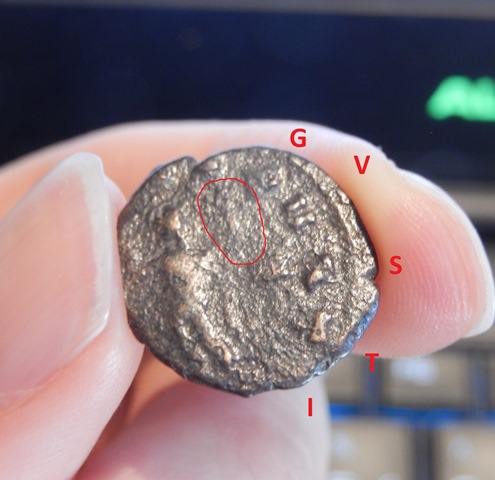
The reverse is relatively clear, but unfortunately, it was struck off-centre - an all too common fate for ancient coins, made as they were with hand-held dies. I think I can read the four letters as "AVGG" to the right of the standing figure, but this doesn't help narrow things down, since many coins have reverse legends that end in AVGG. Given the wide spacing of those four surviving letters, the missing word that ought to be to the left f the standing figure must be something quite short, like PAX or SPES. There also seems to be a mintmark of some kind between the legend and the standing figure, but it's too badly corroded for me to guess at.
It may not be possible to identify it further - it clearly has some serious corrosion, most evident on the obverse. Since we can see "bare metal", I would presume the corrosion is from electrolytic cleaning. Electrolysis is a harsh cleaning method (not entirely different to soaking the coin in strong acid), usually only done by folks in a hurry or on coins for which none of the gentle methods have worked.
Some ancient coins are simply unidentifiable - either they were poorly made to start with, were already worn flat in ancient times before they were buried, or the soil conditions where they were buried were particularly corrosive. This may end up being the case with your second coin.
Don't say "infinitely" when you mean "very"; otherwise, you'll have no word left when you want to talk about something really infinite. - C. S. Lewis
|
|
Valued Member
Bulgaria
141 Posts |
|
| |
Replies: 13 / Views: 1,736 |
|










 Posted 11/17/2019 4:20 pm