| Author |
 Replies: 8 / Views: 3,507 Replies: 8 / Views: 3,507 |
|
|
New Member
United States
38 Posts |
|
|
|
|
Pillar of the Community
Canada
5297 Posts |
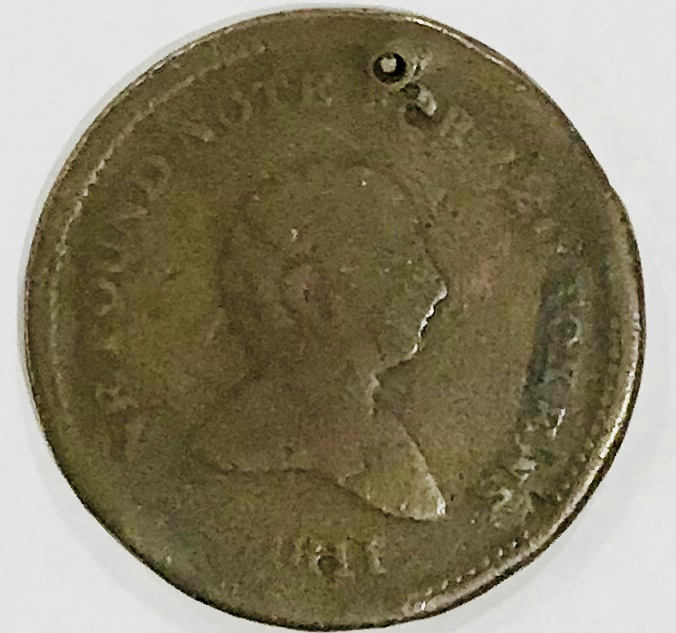
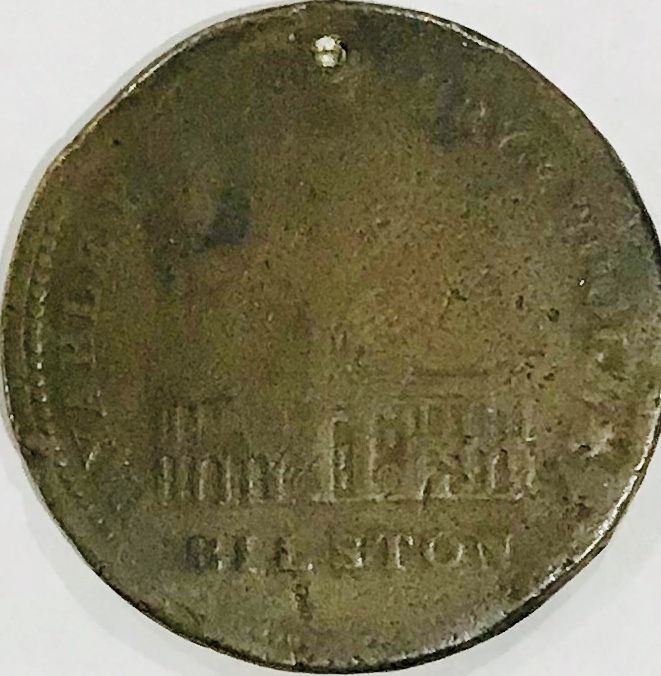
What you have is a TWO pence token. One pound note for 120 tokens. These were all machine struck. It looks crude because is is worn/ damaged. Two pence tokens are not that common, although I see one selling on ebay for less than 9 pounds. It is holed but better than yours. Edited by oriole
12/10/2019 5:28 pm
|
|
Bedrock of the Community
United Kingdom
18987 Posts |
Interesting token!
My ancient (1966) copy of 'British Copper Coins & Their Values' lists it at 50/- (£2.50) in VF. Regular common halfpenny tokens are valued at 5/- (25p). So it must be quite scarce!
|
|
Valued Member
United States
413 Posts |
Was this coin or token issued during the coin shortage in England?
I would appreciate a wee history behind this token?
Thanks!
|
|
New Member
 United States
38 Posts |
I'm relatively uninformed on this subject. From my understanding it was during the coin shortage. Copper was becoming more valuable because of the war in the United States and the war with Napoleon. They manufactured the copper tokens from 1811 through 1820. I've been researching the history of British Copper Tokens and there is a good deal of information that would be more accurate than me try do give the details with my lack of experience. Very interesting! I appreciate everyone's interest and thoughts! Thank you!
|
|
New Member
3 Posts |
I know Bilston and have been there several times Bilston was in Staffordshire and is now in the West Midlands As you know it's known as a provincial token, they were minted by private individuals from the late 18th c. as there was a lack of low denomination coins in Britain (also prior to this in the 17th c.) It has the bust of King George Third on one side and on t'other side, the Royal Exchange in London. Rushbury and Woolley were military ornament makers in Bilston Rushbury and Woolley issued these 2d tokens which were circulated in Bilston ,local merchants would accept them with the promise that they would be exchanged for official coinage of a higher denomination, as Oriole says, 120 of these would equate to £1-00 (240 pennies to a pound) There's an awful lot of information to be had about UK tokens, search UK history sites, as Politics and Monarchs affected our Mint EDIT : this may appear to be obvious but knowing the history of country/s and when certain upheavals and events occurred and the foreign trading etc that was occurring, gives one a pointer as to what events could have effected the currency etc, whether it is a time in history you're interested in or not. Also it gives pointers to the reaction of the citizens, governments and monarchs and knock on effects. In this case (18th c. , 19th c.) a shortage of low denomination coins was not just caused by wars (although the English Civil war in 17th c. without doubt was a massive factor at the time, that affected coinage) it's also because of the amount of forgery's that were circulating and King George III's reaction to it. Also knowing his state of mind is an indication as to events in his reign, so knowing other history and not just coinage history, helps a great deal to discover and understand monetary history. Also Tokens were not always welcome. Many people were forced to only 'spend' them with certain merchants, a form of blackmail, the merchants could charge way above the goods true value and this, in turn, caused a lot of hardship amongst the poor. Also search UK monetary history sites and believe it or not, Flickr, you'll be amazed the amount of information attached to photographs on that site, I add historical and geographical facts to my photographs along with many others on there.  Edited by Feoh
12/11/2019 7:40 pm
|
|
Moderator
 Australia
17012 Posts |
Quote:
Was this coin or token issued during the coin shortage in England?
I would appreciate a wee history behind this token? Britain faced a shortage of copper coins since the American revolution in the mid-1770s. Copper at the time was a war material, needed for constructing sailing ships and cannons - they had little spare for coinage, and the rising price of copper made producing official coinage uneconomical. Thus, tokens emerged to fill the void. The earliest tokens in the series are dated 1787, from the Welsh copper-mining towns. By the outbreak of the war with Revolutionary France in the 1790s, the small change shortage had become acute, with much of the trade in cities reverting to barter. As a result, token issues proliferated. Counterfeiters also got in on the act, producing cheap imitations of regal coins and of the more trustworthy tokens; the counterfeits were usually accepted, out of desperation. A Mint survey in 1787 found that 92% of the official-looking "halfpennies" in circulation were actually counterfeits; the percentage dropped to nearly zero by the mid-1790s. Boulton & Watt, operators of the first steam-powered coin press in Birmingham, wished to promote their business to the government as a prospective coin manufacturer, and did so by producing low-cost, high-quality, difficult-to-counterfeit tokens. In 1797, Boulton finally won a contract to produce official government coin, and token production finally tailed off by 1800. A series of tokens, including yours, were issued in the early 1810s, mainly for use in the workhouses - an early form of social security, though the conditions inside the workhouses were somewhere between a sweatshop and a prison - workhouses were deliberately designed to be unpleasant, to try to discourage all but the most desperate from going there. Workers were paid in tokens, partly as a means of ensuring the workers didn't simply go out and buy grog. The Great Recoinage of 1816 finally solved Britain's currency crisis, with all old coins and tokens withdrawn and abundant silver and copper coins were produced from a newly constructed steam-powered mint in central London. A year later in 1817, the production of private tokens was finally made illegal. Don't say "infinitely" when you mean "very"; otherwise, you'll have no word left when you want to talk about something really infinite. - C. S. Lewis
|
|
Pillar of the Community
United Kingdom
709 Posts |
RC Bell only shows one variety of this token in his work " Copper Commercial Coins 1811-1819" published 1964. P&B Withers in "British Copper Tokens 1811-1820" published 1999, show three varieties, of which this is the third. The bottom right corner of the bust protrudes into the circular text, which is how it is identified as the third variety.
Bell lists the token as "very rare". "The Token Book" by P&B Withers, Galata 2010, gives a price of £45 for this token in F, but only mentions one variety. Judging by that price it is probably not that rare. Your token is of course much poorer than F. Price might also be affected by the variety, b ut I have no information on this.
Diesinker Halliday, possibly manufactured by Peter Kempson.
The obverse text is ONE POUND NOTE FOR 120 TOKENS / 1811, and the reverse text is PAYABLE BY RUSHBURY & WOOLLEY / BILSTON. No edge inscription. The building is the South face of the Royal Exchange, London, destroyed by fire in 1838. It is not a completely accurate picture but very close, such as might be created by somebody working from another illustration.
I have tried to look into Rushbury and Woolley to bring these people to life, but have been unable to find out much. I expect more could be found by someone in the area who could consult local records.
When the token was issued, George Rushbury and Edward Woolley jointly ran a private bank in Bilston. They are known to have issued 1d tokens in copper similar to yours, and silver 6d and 1 shilling tokens. They also issued paper notes for 10s and £1. Woolley withdrew from the bank some time before 1814, at which point the bank was run by George, and his son George Rushbury junior. The bank became bankrupt in November 1815. The Cheltenham Chronicle newspaper of 16/11/1815 notes the bank as ceasing to honour payments for its banknotes. It also mentions a rival bank "Fereday, Smith and Fisher" in the same town, which had a run on its notes. This bank was somehow able to meet payments against its notes and is not listed as bankrupt. The Caledonian Mercury newspaper -of Saturday 25/11/1815 lists George Rushbury senior and George junior as bankrupts.
The Staffordshire General & Commercial Directory, Part 3, 1818, lists an attorney by the name of HP Rushbury in Church Street, Bilston, likely to be a family member of George. Edward Woolley is listed as a wood screw and bag lock manufacturer in Church Street.
Things don't appear to have gone well for Edward in spite of his good decision to pull out of the bank before it went bust.
The Hampshire Chronicle 27/11/1820 gives "Edward Woolley Bilston, Stafford, Iron Maker" among a list of bankrupts, as does the "Oxford University & City Herald" dated Sat 2/12/1820.
Aris's Birmingham Gazette of Monday 25 April 1825, mentions an auction of Edward's buildings and land. The description is " the valuable mines of quarry stone, coal and ironstone, lying in and under a piece or parcel of land, and several messuages [ residential buildings and associated outbuildings ], and other buildings, containing upwards of three quarters of an acre, fronting to Wood street, near the new market house, in Bilston".
Edward's third son, Joseph Woolley, died aged 22 on or before 18/11/1824. His son James, aged 16, died 17/5/1828. Reasons for either death not given in the newspapers consulted.
According to the Staffordshire Advertiser dated 6/3/1830, one Joseph Turner was sentenced to 6 months prison for stealing "a quantity of cast iron sleepers " belonging to Edward Woolley. A different newspaper lists the offender as Joseph Farmer. I cannot account for the discrepancy.
An 1834 directory lists as "William Woolley" as a general manufacturer at Church Lane, Bilston. He could possibly be another son of Edward, who had at least three.
I found other mentions of an Edward Woolley, but without geographical details I cannot say they are linked to this particular Edward.
Edited by Anaximander
12/18/2019 11:13 am
|
|
Pillar of the Community
United States
1077 Posts |
Inserting my 2d worth here, just to further illustrate the topic. W89 (Withers 89) is the "first" variety noted by Anaximander, and W92, at left in the photo below, is the "third." Note on W89 how the front of George's effigy stays clear of the legend's path or arc. The "second" variety -- W90 -- differs from W89 only on the Rx in the alignment of the building's eaves with the legend. That one is not shown here because it's unique as far as anyone knows, and I'm not the lucky owner, ho ho. W91 is unassigned in Withers for now, held in reserve as a placeholder in case a "new" 2d variety turns up somewhere. Token Alert! More large British coppers coming up! Watch for the return of another exonumaniacal thread...one that's already entitled "Giant 1813 Birmingham Token." As a minor side note, tomorrow is the tenth anniversary of my last (not "final," just "most recent") posting on these forums. I've been collecting like crazy over the last decade, but just more quietly, I guess. Hope to share more of my two little collections in the future, now that I'm retired. 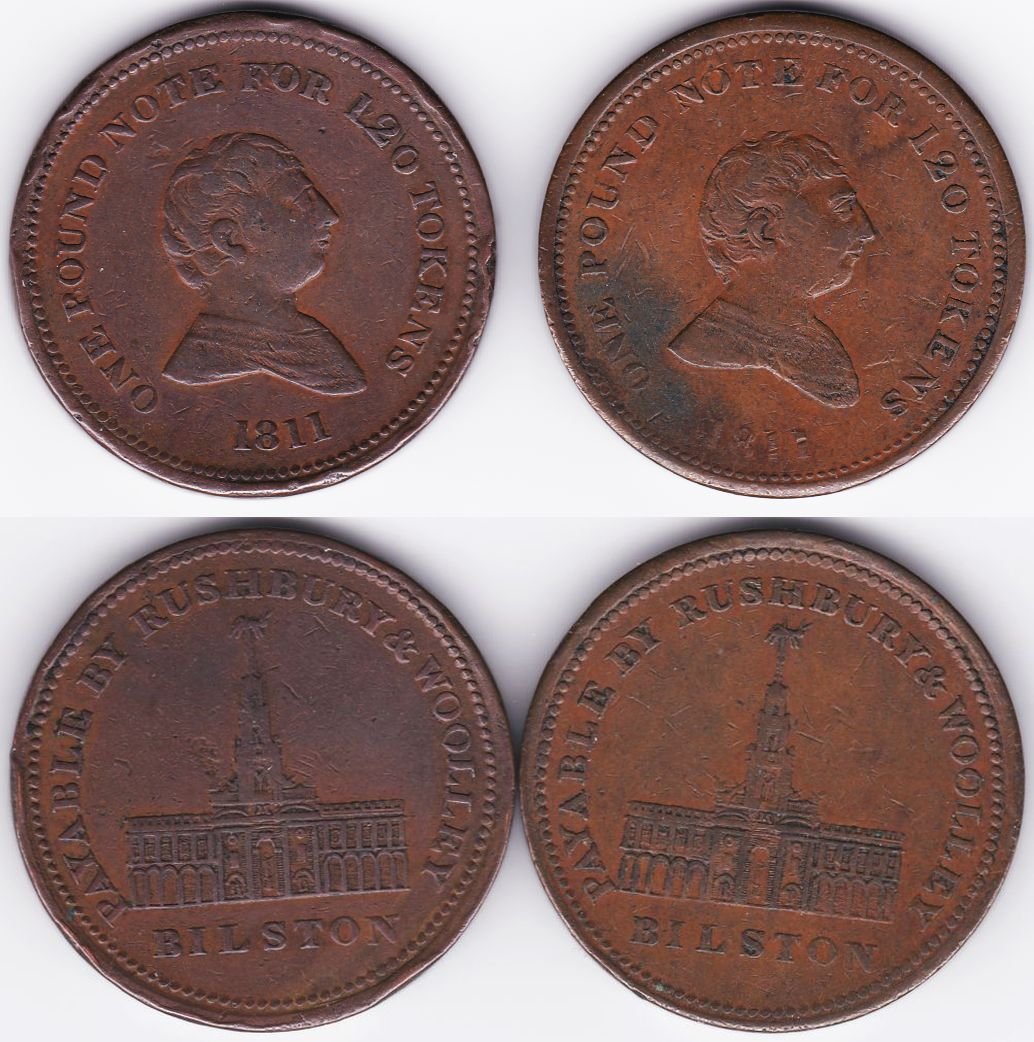 "If everything seems to be under control, you're just not going fast enough."
--- Mario Andretti
|
| |
Replies: 8 / Views: 3,507 |
|
To participate in the forum you must log in or register.
Disclaimer: While a tremendous amount of effort goes into ensuring the accuracy of the information contained in this site, Coin Community assumes no liability for errors. Copyright 2005 - 2026 Coin Community Family- all rights reserved worldwide. Use of any images or content on this website without prior written permission of Coin Community or the original lender is strictly prohibited.
Contact Us | Advertise Here | Privacy Policy / Terms of Use
|
| Coin Community Forum |
© 2005 - 2026 Coin Community Forums |
| It took 0.38 seconds to rattle this change. |
 |
|








 Posted 12/10/2019 6:04 pm


