|
This page may contain links that result in small commissions to keep this free site up and running.

Welcome Guest! Registering and/or logging in will remove the anchor (bottom) ads. It's Free!
To participate in the forum you must log in or register. | Author |
 Replies: 55 / Views: 6,101 Replies: 55 / Views: 6,101 |
|
|
|
Pillar of the Community
United States
1554 Posts |
|
|
Pillar of the Community
 United Kingdom
1168 Posts |
Quote:
I've got the book in hand now, Jim. Second time I've borrowed it from across state. I'll need to find time to peruse it in the coming days (been really busy), but at initial glance it does appear you've got a Göbl 813 (Kanishka I) with Oesho reverse. Btw, the book also covers Kushano-Sasanian. Thank you Bob, there will be a lot of reading in that book. There doesn't appear to be a copy for sale anywhere, and the nearest one is located in the National Library of Scotland in Edinburgh, over 100 miles south of here. Thank you for the link @Kushanshah. That one didn't turn up for me when I did a search. I really like this coin, and it is very pleasing in the hand. It is great to have a correct identity for it. Thank you both for taking the time and trouble to properly ID it for me.  Jim |
|
Pillar of the Community
United Kingdom
1168 Posts |
This one also came my way, and appears to be a Kanishka AE tetradrachm or unit. (c. 128-150 AD) 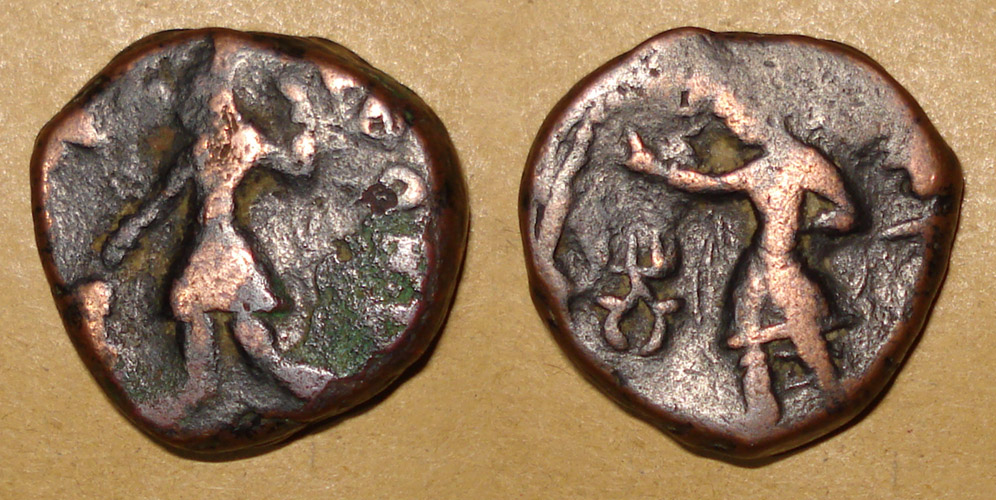 Obverse: Kanishka standing facing, holding spear and sacrificing at altar at left. Reverse: God of metals Athsho standing facing, with head turned to left, one hand on hip, the other holding out diadem, tamgha at left. Diameter: 24 x 25 mm, and Weight: 15.9 gr. Going by the weight (on the CoinIndia site), it fits in with the Eastern "Kashmir" Series. |
|
Pillar of the Community
United States
7067 Posts |
Yes, Kanishka I. You're forming a nice collection of Kushan - and related - coins there, Jim. |
|
Pillar of the Community
United States
7067 Posts |
Wanted to get back to this fine thread now that I've finally found a few minutes to look through Göbl's Münzprägung des Kusanreiches and Sasanian Numismatics. In particular, I spent some time looking at the Kushano-Sasanian section of Kusanreiches. It would seem that, as I suspected earlier, at least four of the five coins below are likely issues of Hormizd I Kushanshah - a.k.a. Hormazd/Ohrmazd, c. 270-300 AD: 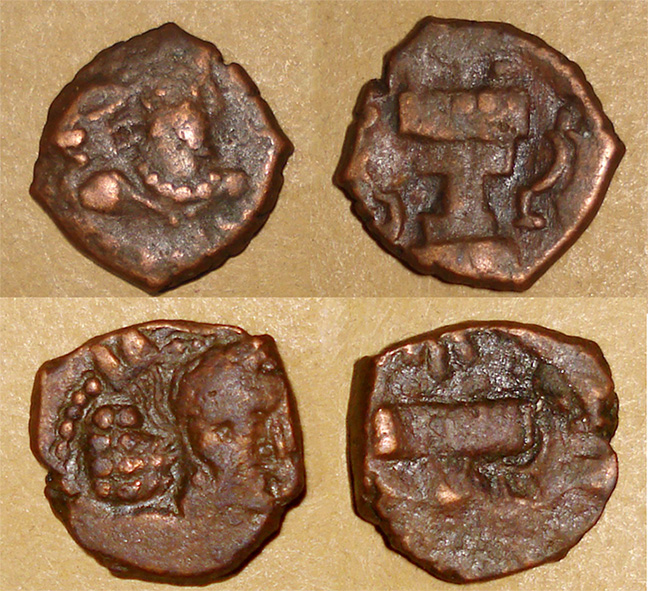 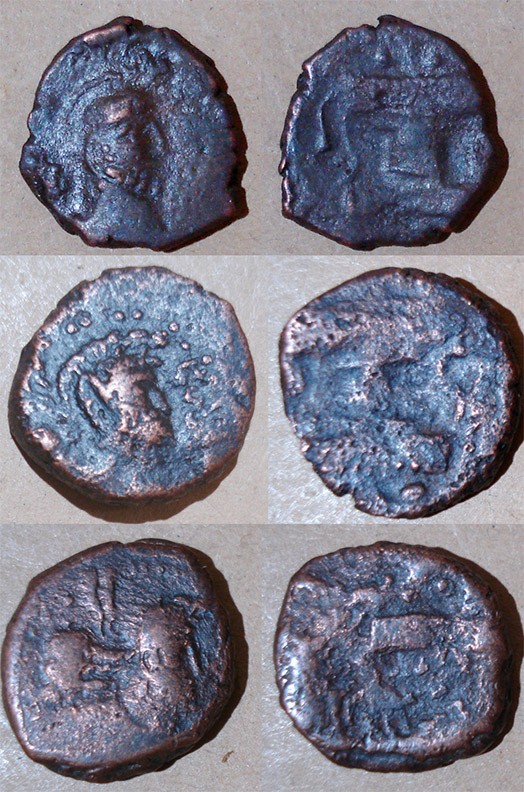 Going by the illustrations in Göbl's corpus, coins #2, 3, 4, and 5 above cannot be Ardashir, Peroz I, Shapur I/II, Varhran, etc., since the busts of those rulers sport very different looking crowns/headgear on their coins. I'm not providing those images/types from Göbl here, but it seems unlikely that the rounded backs of the headgear on coins 2-5 above match the crowns of those rulers. By process of elimination it seems to me that the coins above, with the possible exception of the first one (where the top of the crown is worn off), are Hormizd. Göbl's pics are small and grainy, which makes deciding on the specific Hormizd type (Göbl 1122, 1124, 1125 - which account for all of this king's AE's) rather challenging. As you see below, there are also many varieties for each type. Below are pics of the relevant sections from Göbl's Münzprägung des Kusanreiches. Regarding the reference to "Kawad" for the 1122's and 1124's in the pics below, "Kawad may have been a local governor of Hormizd, as the bust appears to be of Hormizd, but the inscription on the coin reads Kawad (or Kobad). The coins are scarce to rare." (That's from a listing by Coinindia) The Kawad inscription, which is in Bactrian, seems to have often missed the small flans during the strike. The point is that coins struck by this governor Kawad are still properly attributed to Hormizd. 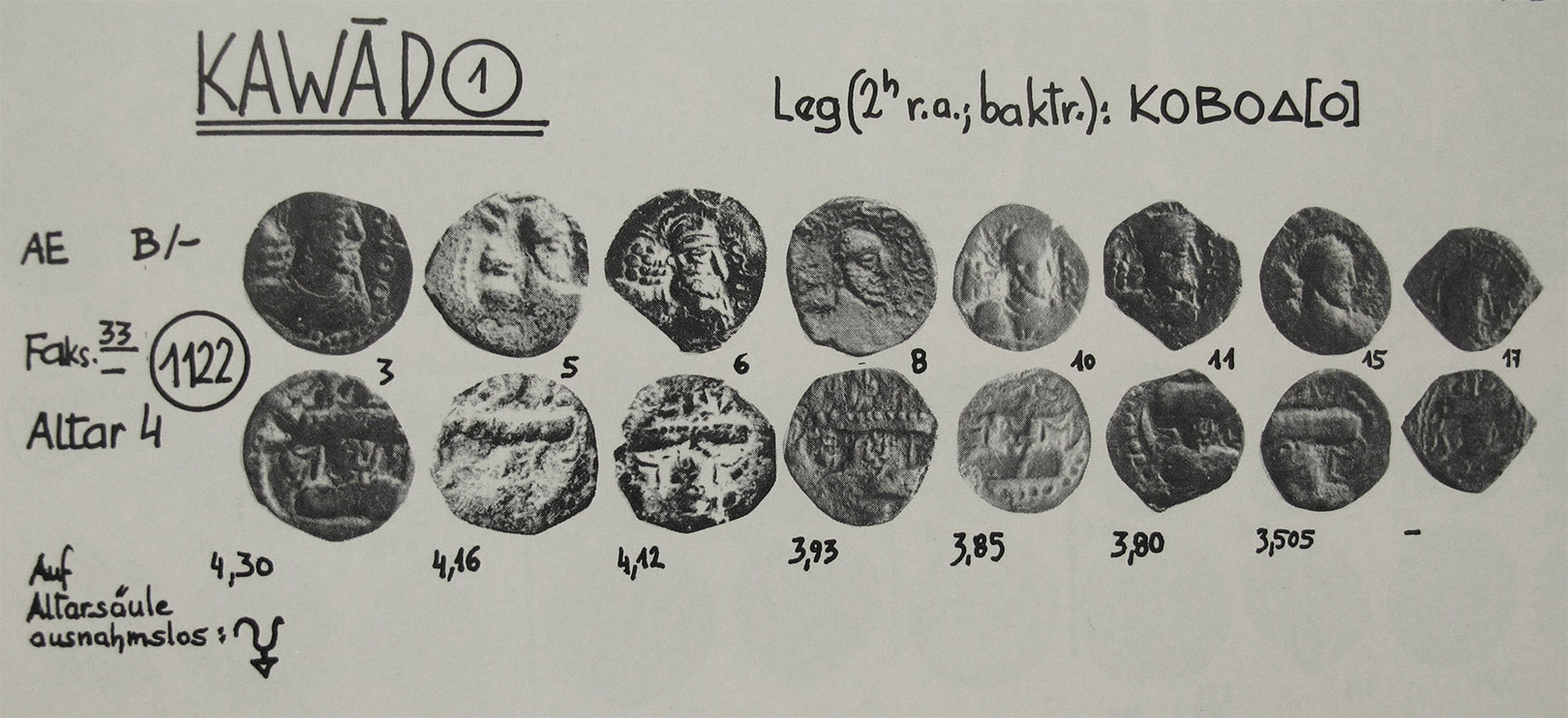 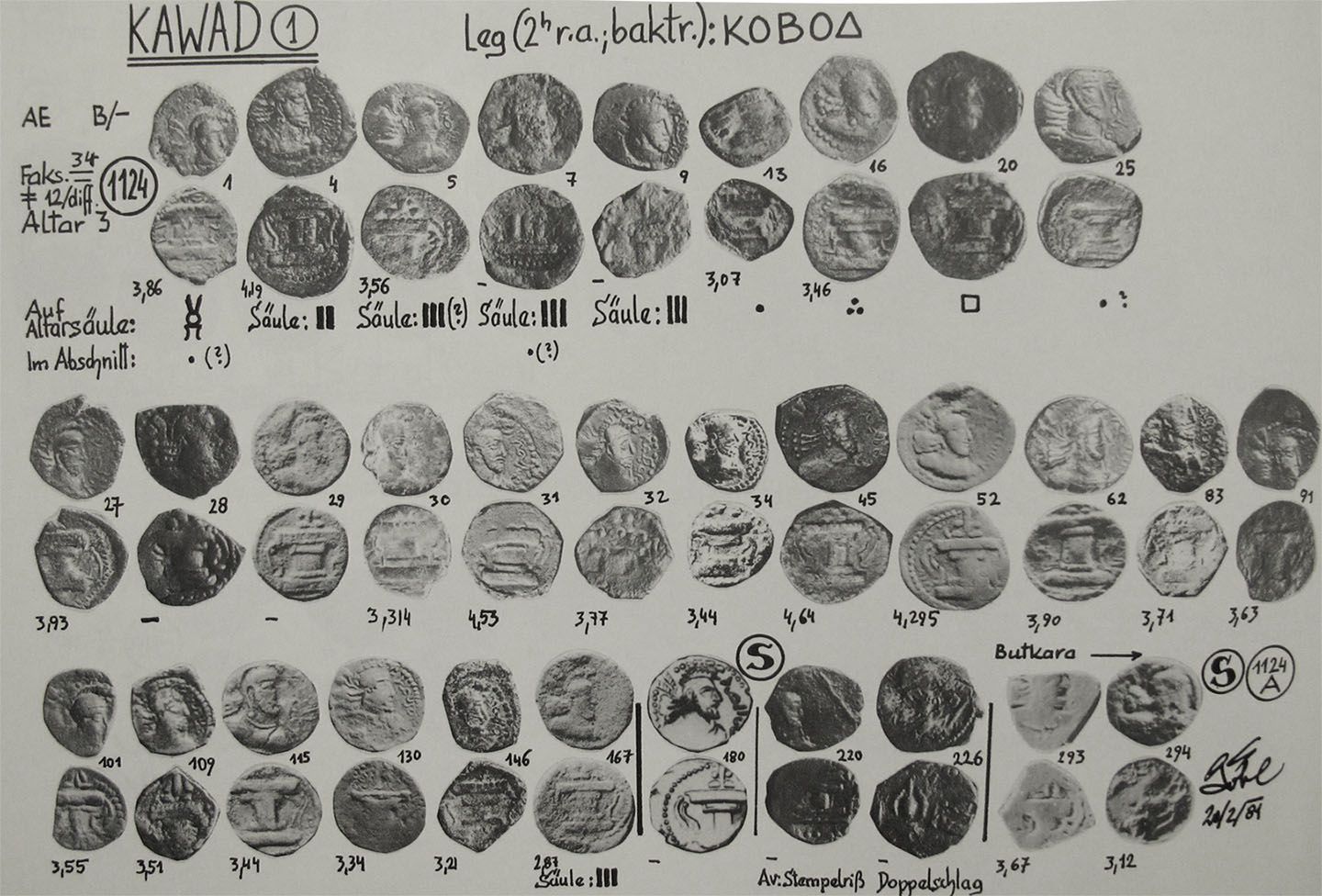 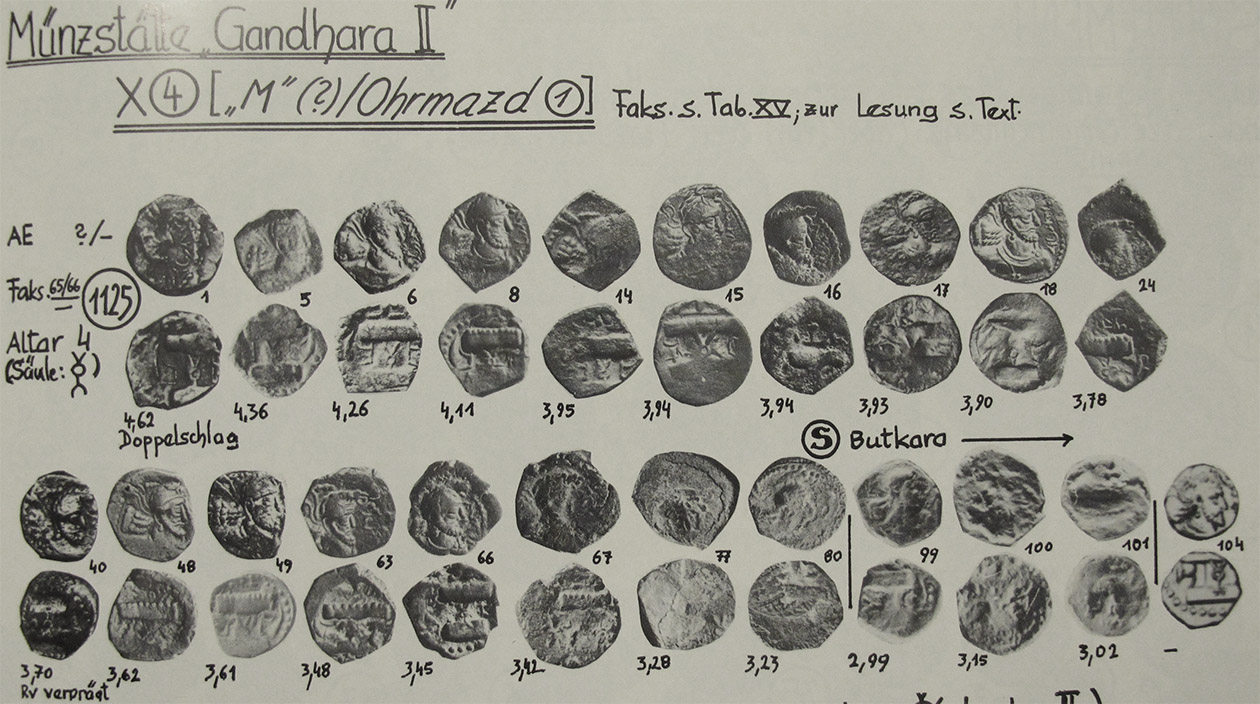 |
|
Pillar of the Community
United Kingdom
1168 Posts |
Thank you so much for the in depth and highly detailed reply Bob. I appreciate the time and effort you have put into this.
Göbl's Münzprägung des Kusanreiches, and its plates of coin images, must be an invaluable research tool.
When I purchased the mixed lot of coins, I had no idea that they would open up a completely new world of ancient coins. I find the history behind these coins fascinating, and it is a history that I was previously unaware of.
I will now be able to enter much more information about these coins into the spreadsheet, than I could ever have thought possible.
Many many thanks,
Jim
|
|
Pillar of the Community
United Kingdom
1168 Posts |
At the end of January I posted a picture of the frog pendant below, but didn't find out anything about it. I have since found a similar item in The British Museum web site. 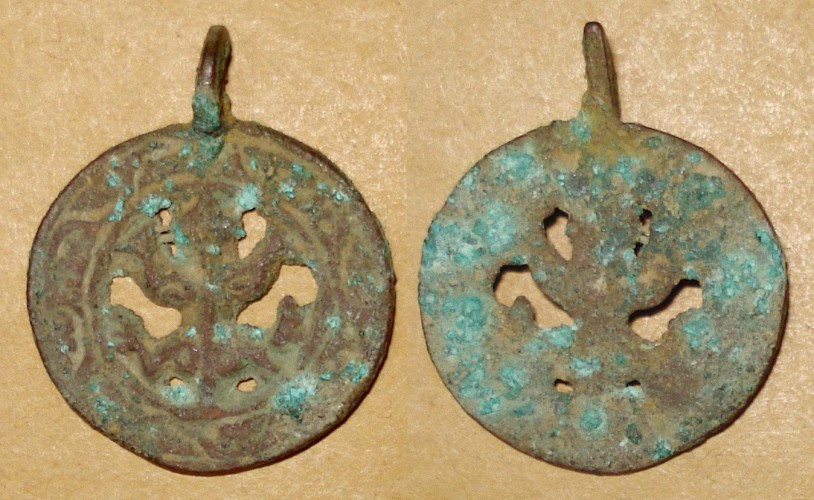 The text from the description of the pendant listed in The British Museum may be of interest, as it has early Eastern/Islamic indications. 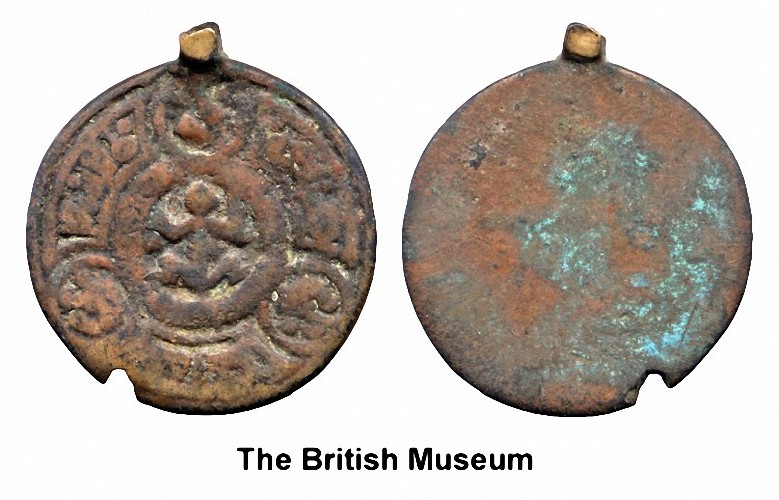 https://research.britishmuseum.org/...rchText=frog https://research.britishmuseum.org/...rchText=frogDescription: Cast, circular copper alloy pendant showing a stylised frog, the front legs turned up and back legs turned down, encircled by two concentric friezes. The motifs of the inner frieze are defaced, but seem to comprise a pattern of alternating dots and lines. The outer, wider one is decorated with three framed, short, illegible Arabic - possibly Quranic - inscriptions, alternating with three circles each containing a bird. The reverse is plain. The broken suspension loop is flat at the back. Culture/period Islamic Date 12thC (circa) Production place Made in: Afghanistan (Asia,Afghanistan) Findspot Found/Acquired: Begram (Asia,Afghanistan,Kabul (province),Begram) Materials copper alloy Technique cast Curator's comments: Found in an unnumbered box of miscellaneous Masson collection ornaments and fragments. Two similar specimens, different only in an openwork frog in the centre encircled by a single frieze, are known. The first, again encircled by an illegible Arabic inscription, is from an unspecified site in Uzbekistan and is assigned to the twelfth century. The other has a frieze decorated with a moulded undulating line, and was found in the vicinity of the c. 1st-13th-century cave site of Kashmir Smast, in north-west Pakistan. The resemblance between the Kashmir Smast, Begram and Uzbekistan pendants indicates a similarity in date; and further suggests that all three specimens could be Ghurid, since the sites where they were found were all part of the Ghurid empire in the 12th century. It should be noted, however, that the frog motif dates back to remote antiquity. A miniature Bactrian seal in the shape of a hand has a frog on the palm. The seal comes from an undated plundered grave, but resembles an early 2nd-millennium BC hand-shaped seal (a surface find at Gonur, in Margiana, Turkmenistan), with a circle in place of a frog on the palm. The frog also appears on 3rd-2nd-century BC Indian punch-marked coins. After this date, it is not traceable until its re-appearance in the Islamic period. Edited by Novicius
02/29/2020 10:56 pm
|
|
Pillar of the Community
United States
7067 Posts |
Great detective work there, Jim. Quote:
Two similar specimens, different only in an openwork frog in the centre encircled by a single frieze, are known. I guess there are now three with openwork known. |
|
Pillar of the Community
United States
1554 Posts |
|
|
Pillar of the Community
United Kingdom
1168 Posts |
Thank you both for the replies.
It is nice to finally know what the significance of the frog is, though I would not have guessed that it was Islamic.
There is an email address on The British Museum page, so I'll send some HQ images and see if they can throw any more light on the pendant.
Jim
|
| |
Replies: 55 / Views: 6,101 |
To participate in the forum you must log in or register.
Disclaimer: While a tremendous amount of effort goes into ensuring the accuracy of the information contained in this site, Coin Community assumes no liability for errors. Copyright 2005 - 2026 Coin Community Family- all rights reserved worldwide. Use of any images or content on this website without prior written permission of Coin Community or the original lender is strictly prohibited.
Contact Us | Advertise Here | Privacy Policy / Terms of Use
|
| Coin Community Forum |
© 2005 - 2026 Coin Community Forums |
| It took 0.36 seconds to rattle this change. |
 |
|
| |
| |







 First Page
 Previous Page


 Posted 01/31/2020 07:56 am


