Coin Community Family of Web Sites Join Thousands of Coin, Bullion, & Money Collectors
Join Thousands of Coin, Bullion, & Money Collectors Shop for APMEX Bullion on eBay!Vancouvers #1 Coin and Paper Money Dealer Specializing in Modern Numismatics Coin, Banknote and Medal Collectors's Online Mall Royal Canadian Mint products, Canadian, Polish, American, and world coins and banknotes. 300,000 items to help build your collection!


Username:
Password:
Save Password
Forgot your Password?


This page may contain links that result in small commissions to keep this free site up and running.

Welcome Guest! Registering and/or logging in will remove the anchor (bottom) ads. It's Free!

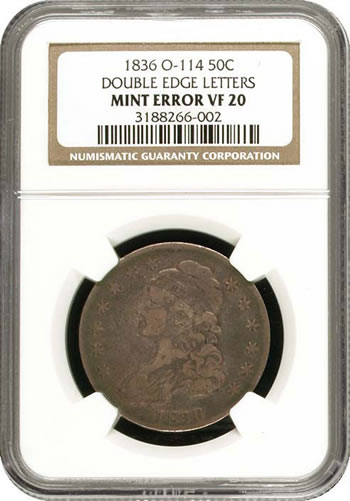
1836 Half Dollar With Doubled Edge Lettering

To participate in the forum you must log in or register.
Author Previous TopicReplies: 5 / Views: 1,571Next Topic  
Press Manager
Learn More...
CCFPress's Avatar
United States
1420 Posts
 Posted 10/14/2008  8:02 pm Show Profile   Bookmark this topic Add CCFPress to your friends list Get a Link to this Message Number of Subscribers
1836-Half-Dollar-With-Doubled-Edge-Lettering
1836 Half Dollar with Doubled Edge Lettering
NGC's distinctive EdgeView™ holder gives collectors a unique view of lettered-edge coins, a feature of renewed interest in numismatics.

Initiation of the Presidential dollar coin program in 2007 brought about a renewed interest in lettered-edge coins, as most collectors were not in the habit of examining a coin's "third side." Applying text to the edges of its coins was a common practice at the US Mint from 1793 through 1836, when the feature was discontinued in favor of reeded or plain edges, exclusively. It was revived solely for the Saint-Gaudens Double Eagle of 1907-33, until being utilized once again for the current dollar coin program.

Different methods have been used to apply this lettering, but during the Mint's early decades such edge lettering was performed prior to striking a coin's obverse and reverse. A Castaing machine was utilized to squeeze incuse lettering and symbols into the planchet's edge. This device consisted of two straight-edge dies, facing one another, parallel and at a distance of just slightly less than the planchet's diameter. Each die carried one half of edge inscription in raised letters and symbols. One die was fixed in place, while the other moved when a crank was turned. The planchet was placed between the dies at one end of their parallel path, and the cranking action caused the planchet to rotate as it was squeezed between the moving and fixed-edge dies.

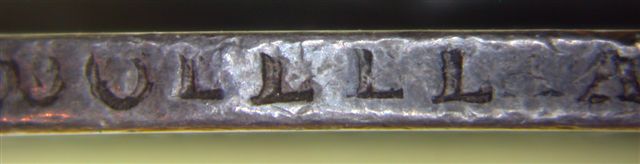
The geometric symbols that appeared on the edges of half dollars varied a bit between 1794 and 1836, but the lettering portion remained the same, reading FIFTY CENTS OR HALF A DOLLAR. The lettering operation was often imperfect, with portions of the inscription overlapping or missing in places. Since this lettering operation also produced a raised rim, incomplete lettering resulted in slight edge bulges and missing portions of the rim. More common was when the edge lettering operation overlapped due to the planchet slipping or being passed through the edge dies more than once. Al Overton's reference book on early half dollars lists nearly six dozen comical variations of overlapping and duplicated lettering.
1836-Half-Dollar-With-Doubled-Edge-Lettering

The coin illustrated here, submitted by Christopher Mang of Chris' Coins, is boldly overlapped and doubled on its edge. An example of O-114, it is a relatively common die marriage that is spotted fairly easily by its clearly repunched seventh star. The doubled edge lettering is a feature that easily could have been overlooked. Instead, NGC's distinctive EdgeView™ holder permits collectors to enjoy this numismatic bonus as never before.

All Recent News

Bedrock of the Community
Conder101's Avatar
United States
17884 Posts
 Posted 10/15/2008  09:37 am  Show Profile   Bookmark this reply Add Conder101 to your friends list Get a Link to this Reply

Quote:
The doubled edge lettering is a feature that easily could have been overlooked. Instead, NGC's distinctive EdgeView™ holder permits collectors to enjoy this numismatic bonus as never before.

True, and it only took twenty years from the time early federal coin collectors first started complaining that slabs kept you from seeing the edge of the coin.
Pillar of the Community
TreasHunt's Avatar
United States
2540 Posts
 Posted 10/17/2008  09:44 am  Show Profile   Bookmark this reply Add TreasHunt to your friends list Get a Link to this Reply
Great find.
I have found edge lettering errors on Bust 1/2's, but none like that.

Very neat.
Valued Member
bqcoins's Avatar
United States
167 Posts
 Posted 10/17/2008  5:52 pm  Show Profile   Bookmark this reply Add bqcoins to your friends list Get a Link to this Reply
Wow thats pretty cool
Pillar of the Community
United States
588 Posts
 Posted 11/03/2008  6:52 pm  Show Profile   Bookmark this reply Add Podoprigora to your friends list Get a Link to this Reply
nice NGC slab, I think PCGS should come up with a new box already looks like 70's
Pillar of the Community
TreasHunt's Avatar
United States
2540 Posts
 Posted 11/04/2008  06:43 am  Show Profile   Bookmark this reply Add TreasHunt to your friends list Get a Link to this Reply
Just last weekend I was able to cherrypick a 1829/7 O-101, with completely doubled edge lettering.

Does anyone have any idea of the added value for the doubled edge?
Thanks.
  Previous TopicReplies: 5 / Views: 1,571Next Topic  

To participate in the forum you must log in or register.


Disclaimer: While a tremendous amount of effort goes into ensuring the accuracy of the information contained in this site, Coin Community assumes no liability for errors. Copyright 2005 - 2026 Coin Community Family- all rights reserved worldwide. Use of any images or content on this website without prior written permission of Coin Community or the original lender is strictly prohibited.
Contact Us  |  Advertise Here  |  Privacy Policy / Terms of Use

Coin Community Forum © 2005 - 2026 Coin Community Forums
It took 0.27 seconds to rattle this change. Forums


