| Author |
 Replies: 7 / Views: 2,983 Replies: 7 / Views: 2,983 |
|
|
Pillar of the Community
United Kingdom
1168 Posts |
I'm always keeping an eye open for Seleucid coins, coins with animal themes, and coins with nautical themes. This one ticked two of the boxes. I find it particularly interesting, as it shows in good detail what a ship's anchor from 300 BC looked like. 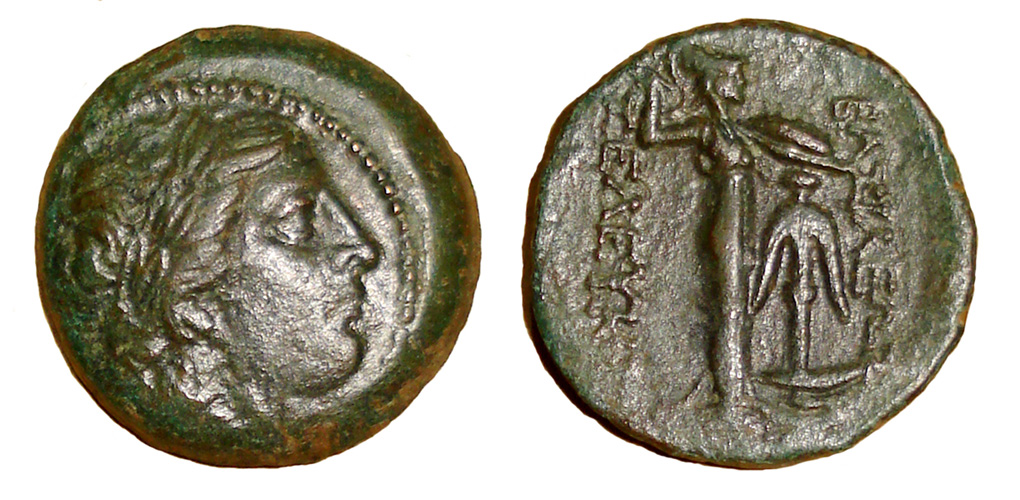 Seleukos I Nikator 312-281 BC. Antioch on the Orontes mint. Struck circa 300-281 BC. Obv: Laureate head of Apollo right. Rev: Athena Promachos in Corinthian helmet standing right, brandishing spear and shield. Seleukid anchor to right. Legend: BAΣIΛEΩΣ ΣEΛEYKOY. Diameter 22 mm. Weight 9.64 g. SC 15.1 |
|
|
|
Pillar of the Community
United States
7067 Posts |
Nice coin, Jim, with an excellent reverse that has held up well.
I have a roundabout interest in the Seleucid anchor motif. It was appropriated by the Elymaeans in the latter part of the second century BC, where it initially may have been intended as a symbol of the mint at Seleucia on the Hedyphon. At that point, early in the history of Elymais (which had supplanted Seleucid control of a small area at the north end of the Persian Gulf), the anchor's shape closely echoed the Seleucid version. Its shape changed some over the next several centuries on Elymaean coins as it became a general symbol of Elymais. It is believed that the number of crossbars on the anchors on coins from Elymais may be an indicator of mint location: one for Susa, two for Seleucia on the Hedyphon, three for a third, unidentified mint. I would guess that most folks who collect coins of Elymais don't think about or even realize that the Seleucid dynastic symbol of the anchor was the antecedent for the symbol of Elymais.
|
|
Pillar of the Community
 Spain
2752 Posts |
Yep great looking coin Jim..  Interesting how the ancient anchor symbol was always depicted with the shank down and the crown above. Unlike the more modern representations, maybe to do with our superstitions (the horse shoe), stopping the good luck from running out?.. Quote:
I would guess that most folks who collect coins of Elymais don't think about or even realize that the Seleucid dynastic symbol of the anchor was the antecedent for the symbol of Elymais. No I hadn't linked the symbol  ..Thanks Bob. |
|
Pillar of the Community
 United Kingdom
1168 Posts |
@Bob L Thank you for that information Bob. I wasn't aware of Elymais, or the anchor symbol connection. That info is going into my Seleucid folder for future reference. I had seen anchor countermarks, and had assumed them to be Seleucid, but obviously they could possibly be also associated with Elymais. It is amazing how topics can be interconnected in unexpected ways. If I had not posted the coin, I would still be unaware of the Elymais connection. Thanks again.
@Palouche Cheers Paul. I had also wondered why the anchors were depicted with the crown uppermost, and it could well be for the same reason as the horseshoe. I can think of no other reason why it should be so.
Interestingly, on the image of the reverse of this coin, it clearly shows a boss on top of the crown. When the vessel was anchored in bad, or rocky, holding ground, the anchor could be laid with a rope secured to the boss. If the anchor stuck and would not break free, the rope could be heaved on to pull the anchor free.
|
|
Pillar of the Community
United Kingdom
1168 Posts |
Quote:
I would guess that most folks who collect coins of Elymais don't think about or even realize that the Seleucid dynastic symbol of the anchor was the antecedent for the symbol of Elymais. With that in mind, I thought it would be nice to add one of the Elymais coins to the collection to illustrate the anchor symbol. I found an inexpensive one in reasonable condition, so it is now in the collection. The vendor said that he believed the coin to be of Orodes I, but on looking through images of Elymais coins, it looks more like Orodes II. Hopefully someone here will be able to identify it properly. 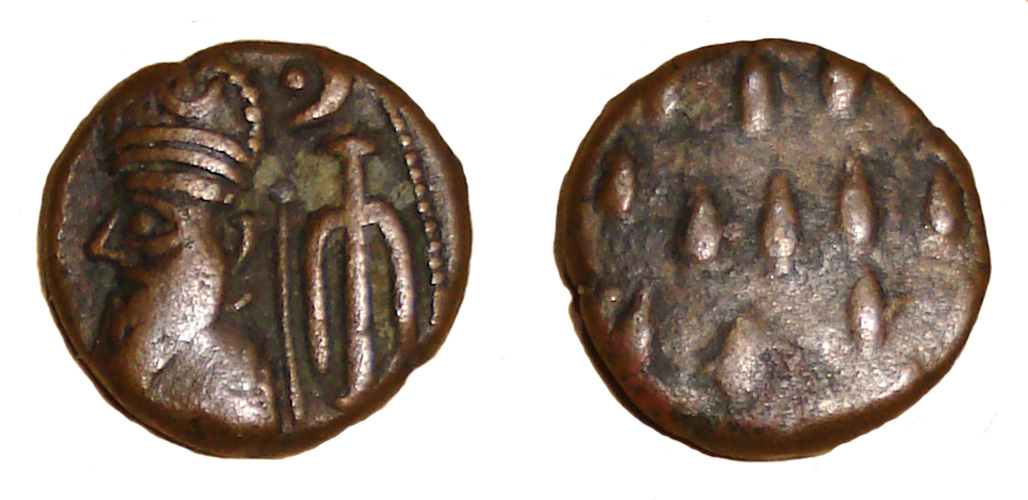 AE drachm of Orodes I of Elymais. Obverse: Bust left, with long beard and diademed tiara ornamented with pellet and crescent. Anchor and pellet-within-crescent to right. Reverse: Regular series of dashes. Diameter: 15mm and weight: 3.7g. Reference: Sear GIC 5896 |
|
Pillar of the Community
United States
7067 Posts |
Welcome to Elymais, Jim. Using van't Haaff, which is the most recent research on Elymaeans, yours is a drachm of Phraates, early - mid 2nd century AD. It can be cataloged as van't Haaff 14.7.2-1.
|
|
Pillar of the Community
United Kingdom
1168 Posts |
Thank you once again Bob. I only found a couple of images with the tall tiara, and three bands at the base during the searches. It's great to have the coin properly attributed now. Thanks, Jim |
|
Pillar of the Community
United States
7067 Posts |
There were only two kings of Elymais who issued coins with obverse left-facing busts wearing tiaras - Phraates and Orodes III (using van't Haaff's attributions, that is). The easy-to-spot difference is that Orodes III's tiara has another anchor motif, while Phraates - like yours - has a crescent facing upward, with a pellet above. If it had horns sticking out the sides it would look very much like Fred Flintstone's Water Buffalo Lodge hat - the symbols are very similar.  |
| |
Replies: 7 / Views: 2,983 |
|










 Posted 04/28/2020 02:31 am


