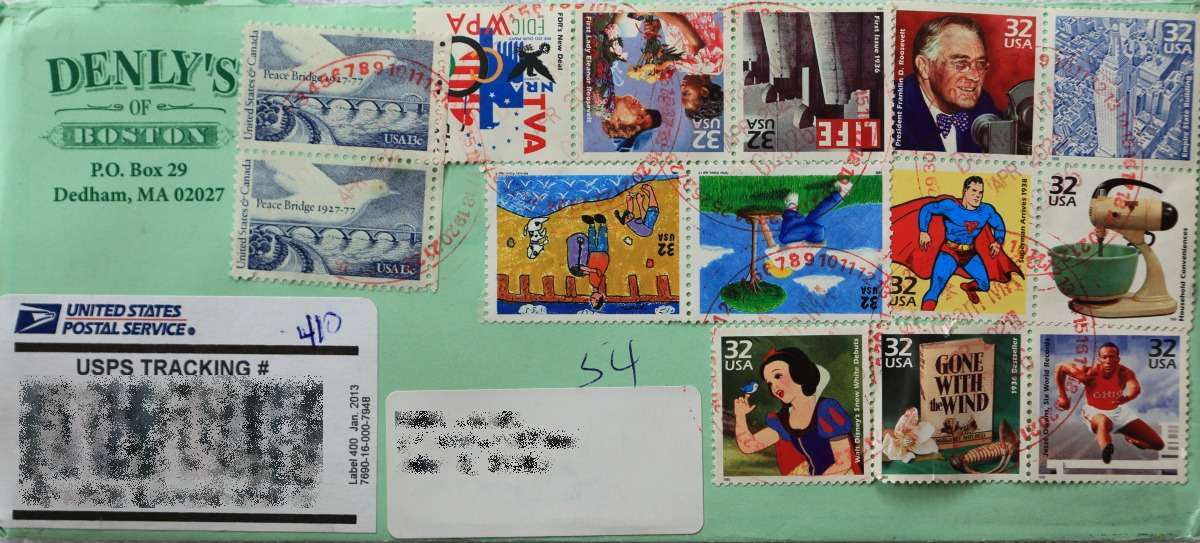
RANT ONI really like packages with stamps and I'm not getting them lately. I'm SAD

;
RANT TWOLook I like some of you (not all), but a few of you have grown on me, and while I like all the business Allen's is getting from you people. STOP buying the notes I want!! Look buy all the others, just leave the ones I want to me


;

So now that I ranted, what did I get? Well I ended up getting 2 notes. Today you get one and maybe tomorrow you get another (need to get that post count up, I read if you have a high post count you get free hot dogs #127860; we need a hot dog emoji).
Today's note is a Continental Currency. Like a few of you, I collect currency as a way to experience history. I'm also looking to eventually (it won't happen as a few are so far above what I would pay) have a type set of the major currency types in the US. So you get today's note.
Continental currency was minted colonial paper currency issued from 1775 to 1779 to finance the cost of the Revolutionary war. The first currency was issued in 1775, the Continental Congress issued $2 million in paper bills of credit. The paper notes represented the colonies' first significant currency distribution and bore the images of Revolutionary soldiers. The issue was that Continentals were not backed by any tangible asset; they were supposed to hold their value on the Continental Congress's expectation of future tax revenues, which, given that they were in the midst of a war, created more uncertainty than the new currency could withstand.
The Revolutionaries continued printing money and ultimately issued more than $200 million in rebel currency. Within five years, continentals suffered significant depreciation and eventually were practically worthless.
Congress stopped issuing continentals in 1779. By 1785, the continental currency was so remarkably worthless that people just stopped accepting the bills as payment for goods or trades. Economic worries plagued the young nation as its leaders faced the challenges of paying back war debts.
To stabilize the economy and correct the country's financial troubles, Alexander Hamilton proposed an idea for a national bank. The national bank would issue paper money and handle the government's tax revenues and debts, among other functions. His idea came to fruition in Dec. 1791 as the Bank of the United States opened in Philadelphia.
The creation of the national bank led to the adoption of the U.S. dollar (USD) during the following year. The invention of the U.S. Mint, the federal monetary system, and the U.S. Coinage Act of 1792 all quickly replaced the paper continentals. These systems have since evolved to become the nation's contemporary money system, still in use today. Although the country adopted the USD, it initially circulated only as coins and did not return to using paper currency until 1861.
This note has a date of 9/26/1778 and was part of a total $75,001,080 payable in Spanish milled dollars, or the equivalent in gold or silver issued. This emission was the first issue of the Continental $50 and $60 denominations. The entire series has nature prints on the reverse as well as new typeset ornamental borders. By the date of this issue the Congress officially valued the currency at $4.00 in Continental dollars for $1 in specie. Printed by Hall and Sellers in Philadelphia. The paper, made at Ivy Mills in Chester County, Pennsylvania, contained blue fibers and mica flakes. Detector bills were printed on blue paper. Denominations printed were the: $5, $7, $8, $20, $30, $40, $50 and $60.
The $8 has the serial numbering and one signature in red ink, the other signature in brown ink. The emblem on the front shows a harp with thirteen strings with the motto: "Majora minoribus consonant" (The larger are in harmony with the smaller). The nature print on the back is of three sage leaves. Paper contains blue threads and mica flakes.
Thanks for looking and reading.









 First Page
 Previous Page

 Replies: 1,005 / Views: 80,609


 Posted 04/12/2021 10:19 am