| Author |
 Replies: 7 / Views: 1,630 Replies: 7 / Views: 1,630 |
|
|
New Member
United States
8 Posts |
I recently purchased online a Drapped Bust 1/2 Cent in an NGC holder simply labeled as "1804 1/2C AU50 BN". The dealer did list it (correctly) as the "Crosslet 4 w/ Stems" type. In looking closer at the coin I believe it is the Cohen 1 (C-1) variety for 1804. The diagnostics I see that would confirm this is the Crosslet 4 on the obverse that nearly touches the bust along with the 1803 reverse w/ the "Cross-eyed Zeros" in the numeral "200" and the die crack that runs from the second T in STATES through F in HALF and to the M of AMERICA as described in Cohen's book. This is the first 1/2 Cent in my collection and so I'd appreciate it if someone with more knowledge of these types of coins could provide their thoughts on the correct variety attribution given the wide difference in values depending upon Cohen variety. Below are copies of the dealer's photos that I've enlarged a bit for better viewing. (The colors are a bit mis-leading as the actual color is a chocolate brown seen on early copper.)  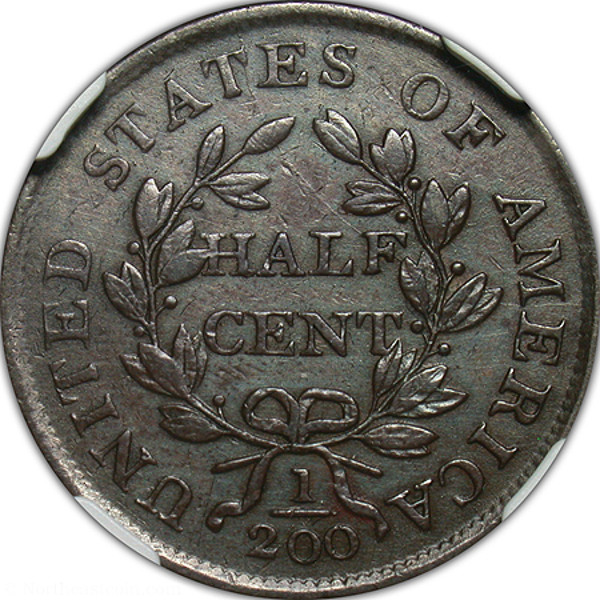 |
|
|
|
Pillar of the Community
 United States
594 Posts |
Well, it certainly is the C-1 variety. An R-3 rarity. My opinion is that is is closer to either an XF-40 or 45 rather than an AU but that is just my opinion. As for as value goes I'm not sure I have the answer. The obverse scratches may hold it's value down a bit. Maybe in the 700-800 range perhaps a bit more? Not a lot of collectors specialize in varieties. Most likely someone else more qualified will address your questions as they get around to reading the post.
Edited by johnjkedel
05/18/2020 9:34 pm
|
|
Bedrock of the Community
United States
94367 Posts |
I'm at EF-45 here at best, and agree C-1.
|
|
Pillar of the Community
United States
1101 Posts |
Yes, that is a nice C-1, and an earlier die state where the reverse crack is still light with the lettering still strong to the right of the crack. More often you will see the C-1 with the lettering to the right of the crack weak due to die collapse. Very nice for your first Half Cent. |
|
New Member
 United States
8 Posts |
Thanks all. I appreciate the feedback.
|
|
Bedrock of the Community
United States
17884 Posts |
The coin is a bit confusing. Yes it is C-1, and the rev does not show the sinking right of the crack usually seen in the late die stages. But it IS a late stage, Die Stage V (Which Breen called extremely rare.) The identifying feature being the dis crack through the top of LIBERTY. On Stage IV it is only between BE. On yours it is through most or all of the letters.
This is kind of a strange variety as the rev die was used on 1803 C-3, 1804 C-1 and C-2 with the emission sequence being 03 C-3, 04 C-1, 03 C-3, 04 C-2, 04 C-1 , and finally 03 C-3.
|
|
New Member
United States
8 Posts |
Gary, thanks for the analysis. In looking closer with a loupe at the LIBERTY on the obverse, those lines really don't seem like die cracks to me. They look more like some form of tooling marks on the die to my untrained eye. Cohen doesn't mention them for the C-1 variety and unfortunately I don't have the Breen reference to read further about the difference die stages. The die state of this coin seems to correspond extremely closely to that of the AU55BN example at PCGS for this variety https://www.PCGS.com/coinfacts/coin...ems-bn/35140 which seems to have some of the same lines between letters of LIBERTY and also the same incompletely formed left foot of the 1 in 1804 which is different than other C-1 examples they show. |
|
Pillar of the Community
United States
1101 Posts |
Quote:
This is kind of a strange variety as the rev die was used on 1803 C-3, 1804 C-1 and C-2 with the emission sequence being 03 C-3, 04 C-1, 03 C-3, 04 C-2, 04 C-1 , and finally 03 C-3. Ron Manley has a different sequence in his die state book for the obverse pairings for this reverse. He has 1803 C3 first use, 1804 C2, 1803 C3 second use, then 1804 C1 as the last pairing. |
| |
Replies: 7 / Views: 1,630 |
|







 Posted 05/18/2020 9:14 pm





