|
This page may contain links that result in small commissions to keep this free site up and running.

Welcome Guest! Registering and/or logging in will remove the anchor (bottom) ads and the security checks. It's Free!
To participate in the forum you must log in or register. | Author |
 Replies: 11 / Views: 2,770 Replies: 11 / Views: 2,770 |
|
|
Pillar of the Community
United States
1080 Posts |
 When I found this token on ebay back in 2013 or 2014, it was a total mystery to me, just as it had been for the seller who came across it and brought it home in 2009. But that mystery is exactly WHY I bought it...I'm sure many of my fellow exonumismaniacs know that impulse well. Over the last six years of periodic fits of research, I've been able to tentatively establish that it's a manorial token issued by John Harvey of Dane Court, Tilmanstone, Deal, Kent, in the temporal neighborhood of 1720-1750. Dane Court was a large manor dating back to the middle of the 13th century, and at various times there were up to three "houses" on the grounds there. At least one of those manor houses remains to this day and is now carved into flats for rent and condos for sale. This token is 24mm in diameter at its broadest, so probably meant to serve as either a large farthing or a small halfpenny, and it was obviously struck without a collar. The woodgrain effect is fascinating to me, but I have no idea what it tells us about how the piece was struck. (Or was it poured?). No one catalogues these things in any detail, apparently, but that statement may just be presumptuous on my part, since I couldn't find any catalogues devoted to (or that even include) manorial tokens. Although I have stumbled across this particular token in a couple of ancient numismatics tomes, like Batty (1877), it's always been just a strictly literal description, without identification, attribution, or background -- geographical or otherwise. So, purely numismatic research has been pretty much futile. Perhaps if I lived on the correct side of the Atlantic Ocean... In any event, I'm assigning a confidence level of .85 to my attribution, drawing on my research into all sorts of relevant primary sources: heraldry references, genealogical databases, land ownership records, museum findings, gravestones, etc. That leftover .15 represents the nontrivial chance that I missed or misinterpreted a clue somewhere along the line and have the whole thing entirely wrong. For example, there were other Dane Courts in England, and even in Kent (Sandwich and Canterbury jump off the page), but only the one in Tilmanstone was owned for a time by someone whose initials were I.H. - and I couldn't find any such properties associated with anyone initialed H.I. The real mystery to me is the whole concept of a "manorial token." Were they disbursed as salary? Payment for game or vegetables, or goods and services? Are they gaming counters? What was their purpose, their uses? How and where were they spent? Please follow up with a reply if you have the same token, or further clues, or a citation to a reference work in which it appears...or if you just like the look. Thanks, everybody, and wash your hands! Tom "If everything seems to be under control, you're just not going fast enough."
--- Mario Andretti
|
|
|
|
Valued Member
United Kingdom
82 Posts |
Tilmanstone in Kent was a mining area and it is possibly just a early colliery token. Compare it with the similar mining tallies from Cumberland and Westmorland issued by the Lowther family among others.
|
|
Pillar of the Community
United Kingdom
945 Posts |
Well that is uncanny! I have had this sat on my desk for weeks with no idea where to start identifying! Obviously much worse condition...  |
|
Valued Member
United Kingdom
82 Posts |
Batty's entry reads as follows:
2267 O.- "I*H" R.- A Crest, two Paws resting on a Bar holding a Crescent.
I can't see it in Montague Guest or Davis and Waters. I did two searches, one on the word "paw" and one on "crescent", and neither turned up anything that matched.
|
|
Pillar of the Community
 United States
1080 Posts |
My thanks to both of you for checking in on this post! I've saved a PDF of a publication of the Kent Archaeological Society entitled "80 Men of Kent," in which a cursory genealogy of the Harvey family suggests, to my reading, that Richard Sr. was the landowner and John was his son and Richard Jr.'s younger brother. Upon reflection, I believe it's equally possible that the John of this token was the elder Richard's nephew, son of Richard's brother, likely also named John...judging by the chronological confusion introduced by the local museum excerpted at the end of this post. According to "80 Men of Kent," the Harveys were a family of gentleman farmers, so this token may have more in common with hop tokens than with colliery tokens...just another avenue for research inquiries, but I still want to learn more about "manorial tokens". I'll paste in some further corroboration and/or clues I've been able to pick up along the way. In line with your findings, tokenscot, I've been unable to find any citations earlier than Batty's 1877 work. 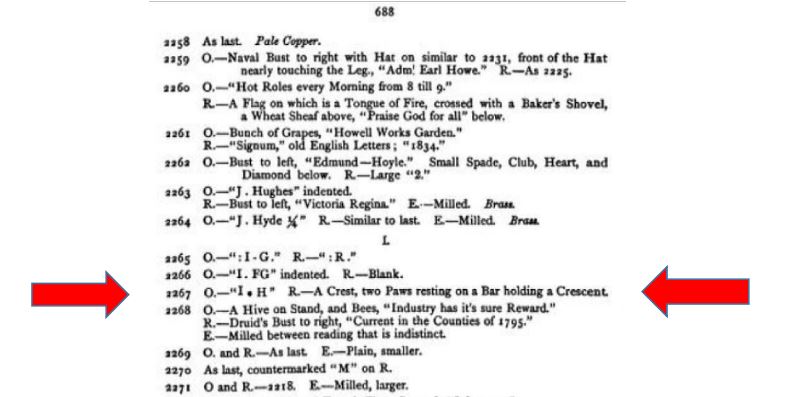 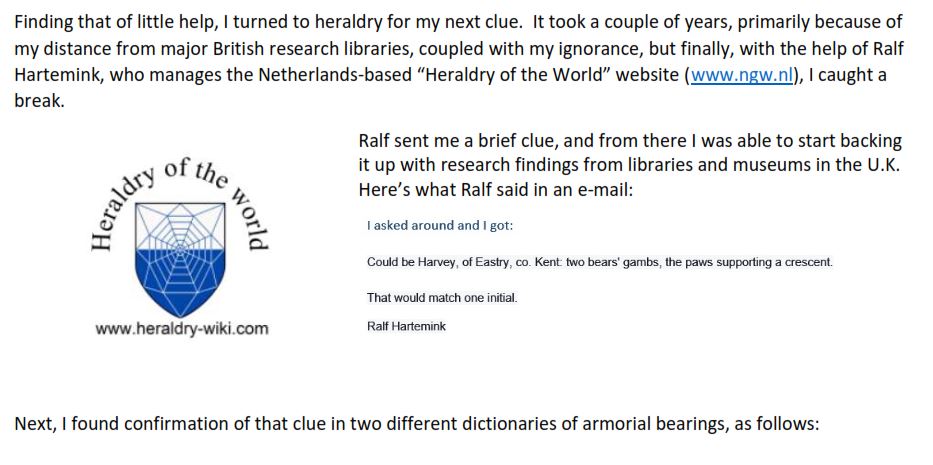 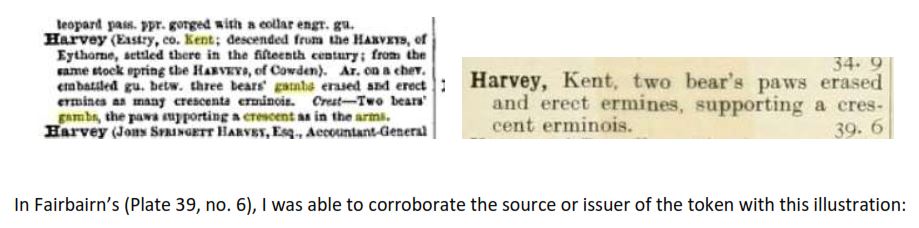 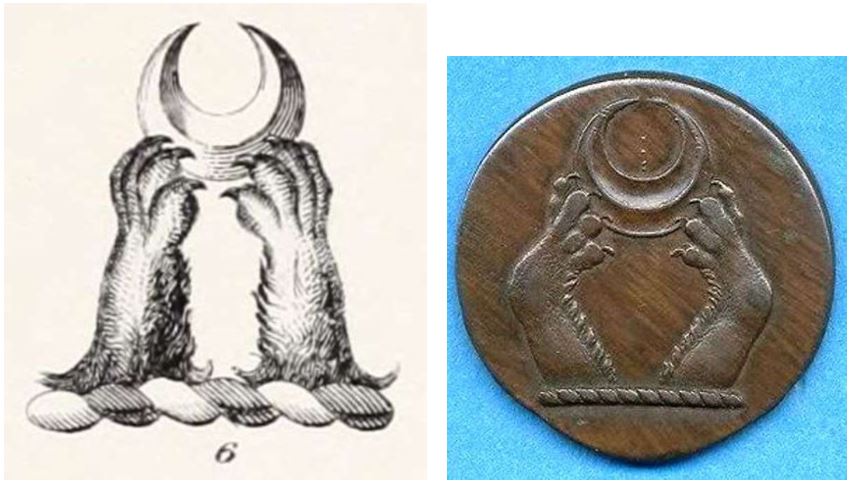 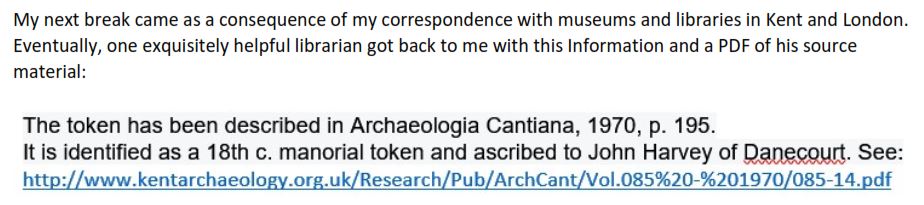  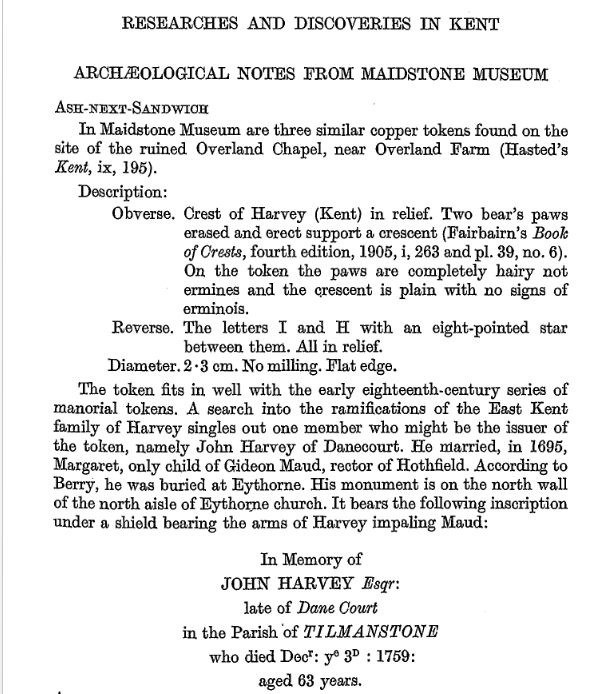  PaddyB PaddyB, stand by and stay tuned. Maybe someone will come along with more information! Wash your hands, everybody! Best ~ Tom "If everything seems to be under control, you're just not going fast enough."
--- Mario Andretti
|
|
New Member
Australia
26 Posts |
Hi, I too have a similar token and have seen another three sold through a UK-based auction house over the past year which suggest there may be quite a few in collections. My token shows a miss-strike with partial rotation of the bear paws and crescent. I cannot add much to the research already listed but personally I think the token is for a commercial purpose but I must confess I'm not sure what constitutes a manorial token and what they were issued for. I did find further clues from an unlikely source - the Harvey's Brewery website which details some history relating to a John Harvey back to the eighteenth century and could suggest a hop related issue but those would normally include a quantity (bushels). I have noticed that there appears to be at least two versions of the reverse(?) die which can be distinguished by the width of the H and the length of the arms on the star - a wide H with small star and a narrow H with a larger star. Mine has the narrow H and larger star. Also of interest are the dots within the crescent which appear to coincide with the various centre points for circles which where used to create the crescent.  |
|
Pillar of the Community
United States
1080 Posts |
 ...and thank you, Landyman, for sharing that great double-struck example...or is it triple-struck? I hadn't given the dots any thought, but I agree with you 100%. I've seen such things referred to as diecutter's scribe marks. Simmons sold one two or three years ago, and Pat Morehead (d/b/a rex-coins) of Sussex has had one on ebay over the last couple of months. Adding the three you saw brings us to an average of one sighting a year, if that, over the last decade. Not sure where that would place it on anyone's rarity scale, but given how few collectors there would be -- compared to, say, Conders -- I'm guessing survivors are pretty scarce. Which auction house handled the ones you came across? I found it interesting that in private correspondence with me, Peter Preston-Morley, the Dean of Exonumia at Dix Noonan Webb, reports that he's only "seen a few examples," and he's been at it for 50 years! (Unfortunately he has no further background to add to the material I've already posted here and commended me on my research.) Best to you Down Under, sir! "If everything seems to be under control, you're just not going fast enough."
--- Mario Andretti
|
|
New Member
Australia
26 Posts |
My example was from Simmons (2016). Simmons also sold similar examples in its MB99 auction (Lot MB99031 - "wide H") and MB100 auction (Lot MB100251 - "narrow H"). The MB99 example was subsequently offered on ebay (seller slavka7470). Other examples include DNW auction 8 March 2010 - part of Lot 187 and Noble sale 61 4-6 August 1999, Lot 487 (three examples ex Baldwins 1987, ex Gladdie 1986, and another). The images show the Simmons examples.     |
|
Pillar of the Community
United States
1080 Posts |
Ho ho, Landyman...small world! Frances Simmons and I have corresponded on these, and until I shared my "findings" with them she and Howard could offer no description whatsoever in their sales. Now, at least, the attribution reads: "Estate check, I*H, Harvey family crest, Tilmanstone, Kent." I see they also tagged it as a "farm token." And it was only about two months ago that Alan Hunt (Slavka) thanked me for the text (which he'd found in this very CCF thread) that he was able to plug into his ebay listing. He wrote: "...delighted to hear that you were the initiator and main contributor to that excellent piece of research." Now, with your clues, I'll go back in time to Noble and Baldwin's to see how they described it in their listings...maybe we can get even closer to nailing down what sort of token this was. So, what kind of census have we got here? Counting yours and mine, it appears that between us we're aware of perhaps a dozen that have popped up in the marketplace over the last 35 years. That strikes me as pretty rare, especially when I do a mental comparison against tokens I'm much more familiar with that show up in sales way more frequently...albeit with a larger collector base and therefore much more demand driving up their "values." Two examples that jump to mind right away are the Magdalen island Penny and, back to Britain, the 1804 Dollar bank token. Both are scarce, to be sure, especially in higher grade, but they're always available, it seems, and they always sell these days at or a little above US $300 in VF condition. Meanwhile, our little I*H token is hardly ever for sale anywhere and struggles to break $40 when it does appear. Presumably that's because only a few dozen people, at most, are collecting in that field, and half of them already own it. Didn't mean to be rattling on like that...the "demand" side of the economic equation has always fascinated me somewhat. I appreciate your additional background on the sales! "If everything seems to be under control, you're just not going fast enough."
--- Mario Andretti
|
|
New Member
Australia
26 Posts |
Unfortunately the DNW and Noble listings don't offer much in the way of clues.
As part of the DNW "Miscellaneous checks" lot it is lumped in with "other hop, mining and friendly society checks, etc".
With Noble it was listed as "UNCERTAIN, Family Crest/ H I (or I H) in copper (24mm) (D&W -; M.5730)."
|
|
Pillar of the Community
United States
1080 Posts |
Thank you for the research, Landyman. One of these days I'll e-mail my Baldwin's contact and see if anyone there has anything to add. If so, I'll of course post it here straightaway so all two of us will be up to speed.  "If everything seems to be under control, you're just not going fast enough."
--- Mario Andretti
|
|
New Member
Australia
26 Posts |
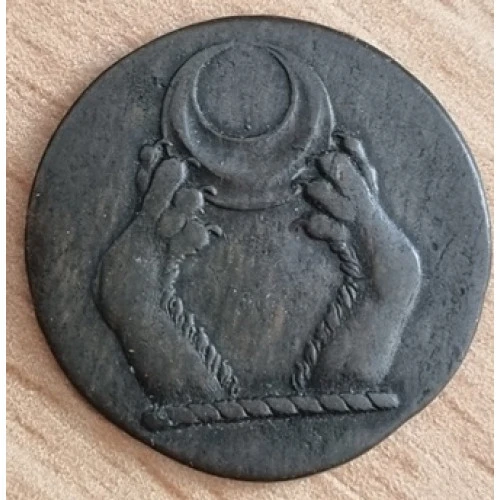 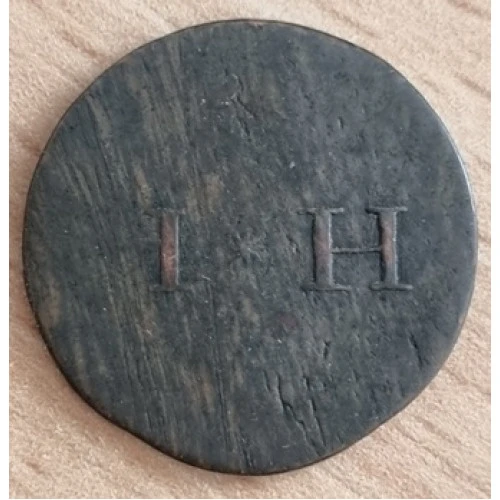 Hi daltonista, it's been a while, but another example of the token has appeared on the Simon Monks website. This one is an example struck using the 'wide H with small star' obverse die. The token entry has the title "Kent Ash -Next Sandwich Boundary token" with the description "Initials I.H are those of John Harvey, mayor of Sandwich 1774-5". Ash (also called Ash-next-Sandwich) is a rural village in the Dover district of east Kent approximately 3 miles west of Sandwich. The use of two slightly different reverse dies suggests a significant mintage (or an early failure of one of the dies  ) |
| |
Replies: 11 / Views: 2,770 |
|
To participate in the forum you must log in or register.
Disclaimer: While a tremendous amount of effort goes into ensuring the accuracy of the information contained in this site, Coin Community assumes no liability for errors. Copyright 2005 - 2026 Coin Community Family- all rights reserved worldwide. Use of any images or content on this website without prior written permission of Coin Community or the original lender is strictly prohibited.
Contact Us | Advertise Here | Privacy Policy / Terms of Use
|
| Coin Community Forum |
© 2005 - 2026 Coin Community Forums |
| It took 0.4 seconds to rattle this change. |
 |
|
| |
| |




 Posted 08/11/2020 06:28 am


