Quote:
Do you know what the inscription translates to ?
On the obverse (the side with the three figures) the Latin legend "multa sunt mala impiorum" appears, which I would translate as "many are the evils of the impious". I found
this one for sale, in better condition, and you can clearly make out all three figures; the central guy is in a Pilgrim-style hat, and the fellow on the left side clearly isn't a native American.
On the other side, the legend is largely missing; the inscription "dabitur" is Latin for "gift" or "be given to", and presumably refers to the cornucopia pictured on this side.
A bit of Google searching came up with
this reference in a Google Book, an old 1800's German token catalogue. It says the Latin reverse inscription is "qui dno fidit bonitate eius circum", which translates to something like "How the Lord relies on the kindness of all around".
It also describes the obverse scene as: "in the middle stands a Dutchman in a large hat holding his hands together, on his right sits an old haggard person, on his left a skeleton sits among armour and shields".
I assume the moral of this token is, "truly pious people would use their money to feed the hungry, not make war".
Don't say "infinitely" when you mean "very"; otherwise, you'll have no word left when you want to talk about something really infinite. - C. S. Lewis










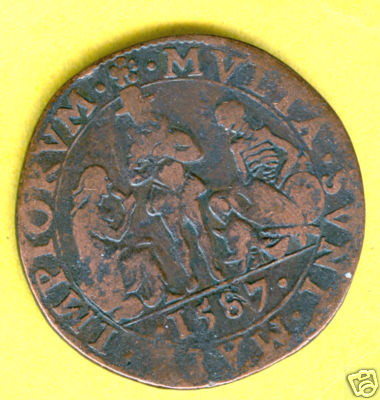 1587-TradeCounter-SpaniardIndianSkeleton-1.jpg
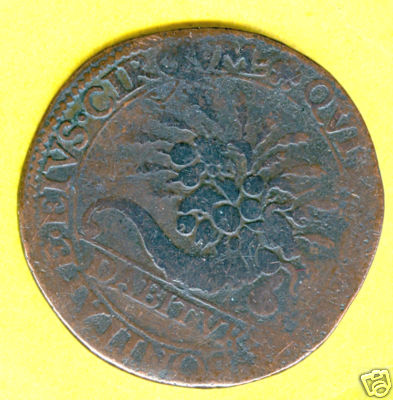 1587-TradeCounter-SpaniardIndianSkeleton-2.jpg


 Posted 11/15/2008 9:59 pm


