| Author |
 Replies: 18 / Views: 4,698 Replies: 18 / Views: 4,698 |
|
Valued Member
United States
179 Posts |
I've been recently engrossed in learning about Canadian Blacksmith tokens, as well as all other types of coinage made in imitation of British regal issues that circulated in North America throughout the late 1700s into the 1830s. The term "blacksmith" originated in an early story recounted by R.W. McLachlan that a Montreal blacksmith was responsible for the production of said tokens, although the term has been extended to describe any crude coppers, typically in imitation of worn British halfpence, that circulated in Canada through the 1830s. The 1910 monograph by Howland Wood remains the standard for the series, although Charlton has generalized it to include more varieties over the years. I share two of my recently obtained examples below. Wood 23 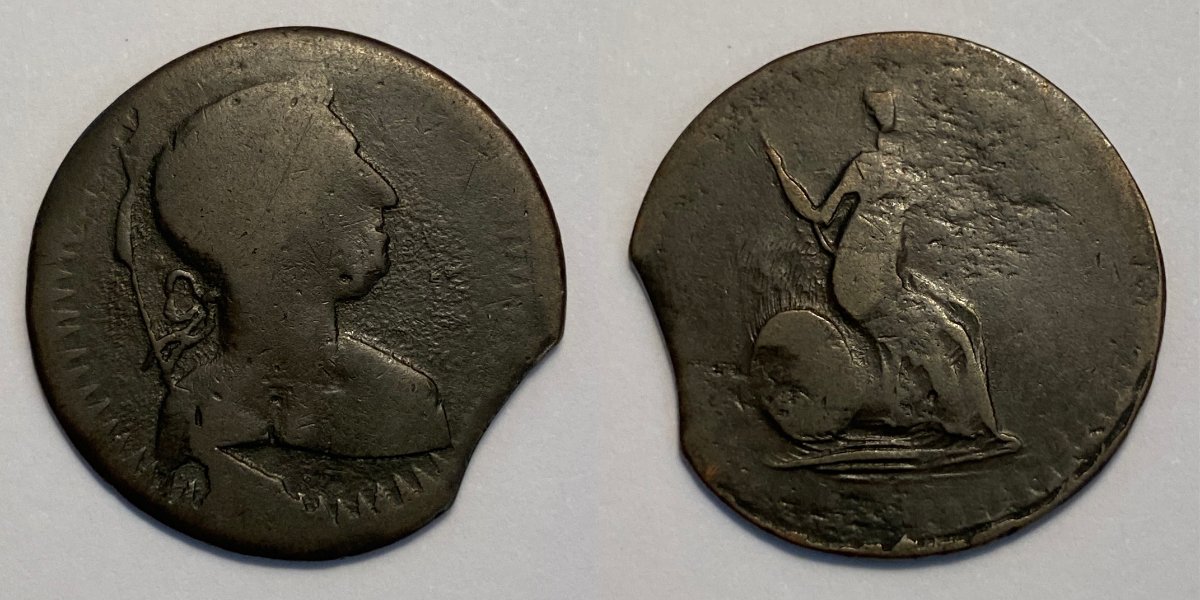 This variety is especially interesting as the obverse is linked with deteriorated American Hard Times Token dies to produce other varieties in the series. The American storecards were made by Daniel and Benjamin True of Troy NY; it remains uncertain whether they were directly responsible for the production of these blacksmith issues, or their discarded dies were shipped elsewhere (Canada?) to another party that was responsible for the blacksmiths. Wood 33  A controversial variety. Listed by Wood, but certainly not a typical blacksmith. Notably, it bears the legends GEORIUVS (or GLORIUVS) III VIS on the obverse and BRITI on the reverse; other blacksmiths imitating worn regal issues generally do not have legends. An early American numismatist John Hickcox (1858) interpreted VIS as VTS and associated the coin with Vermont, using it in support of his theory that "leading men in Vermont" of the 1780s desired to make it a crown dependency. This Vermont association has been soundly debunked since an 1870 monograph "The Vermont Coinage" by Edmund Slafter, although the notion still persists to the present day. More recently it has been shown to be an imitation of some British Evasion issues (a series listed by Atkins in 1892), which bear similar legends and devices. Indeed, it appears Atkins catalogued this very piece as his # 273, although differences in style and fabric remain between this copper and other Evasion issues (hence, it was likely made in imitation of these). This classes Wood 33 as a British import as there is no evidence that Evasion coppers circulated to any appreciable degree in North America. Wood 33 certainly circulated largely in Canada and contemporaneously with other blacksmith tokens, as evidenced by its abundance in hoards, and it is the most common of Wood's "blacksmiths". A really intriguing piece with questions remaining to be answered! Just some information I thought I'd share on two of the more common varieties of a very interesting and often overlooked series. If anyone has examples of their own that they are willing to share I'd love to see them! Cheers to all. |
|
|
|
Bedrock of the Community
United States
10284 Posts |
I only have one but mine is a Woods 33 as well. Thanks for the new information.
|
|
Valued Member
Canada
363 Posts |
I have a few examples of blacksmith tokens and find them as interesting as our other preconfederation tokens. Thanks for sharing your information and I look forward to your posts, great pics and info.
|
|
Valued Member
Canada
289 Posts |
|
|
Valued Member
 United States
179 Posts |
Thank you for the kind words. I'm hoping to pick up a few more of these in the next little while.
Regarding Wood 23 (the first picture above), I've been trying to acquaint myself with the various die states. The reverse die was touched up numerous times throughout its striking to the point that some specimens almost appear to be different varieties. If anyone has their own example and is willing to share, or has any further information, that would be much appreciated.
Cheers!
|
|
Pillar of the Community
Canada
1085 Posts |
Fascinating. Do people bother trying to grade these things? IF so, how?
|
|
Valued Member
United States
179 Posts |
Quote:
Do people bother trying to grade these things? IF so, how? Yes! But it is very difficult, and TPGs rarely get it right. Similarly, Charlton is conservative with grades that rarely, if ever, exceed VF. Experts of the series grade them relative to "as struck": a function of detail, regarding known examples of the series, and surface quality. Prior knowledge of a series prevails as the general strike is known and anticipated. |
|
Pillar of the Community
United States
1082 Posts |
blargish, I'll see your Bitit and raise you one! 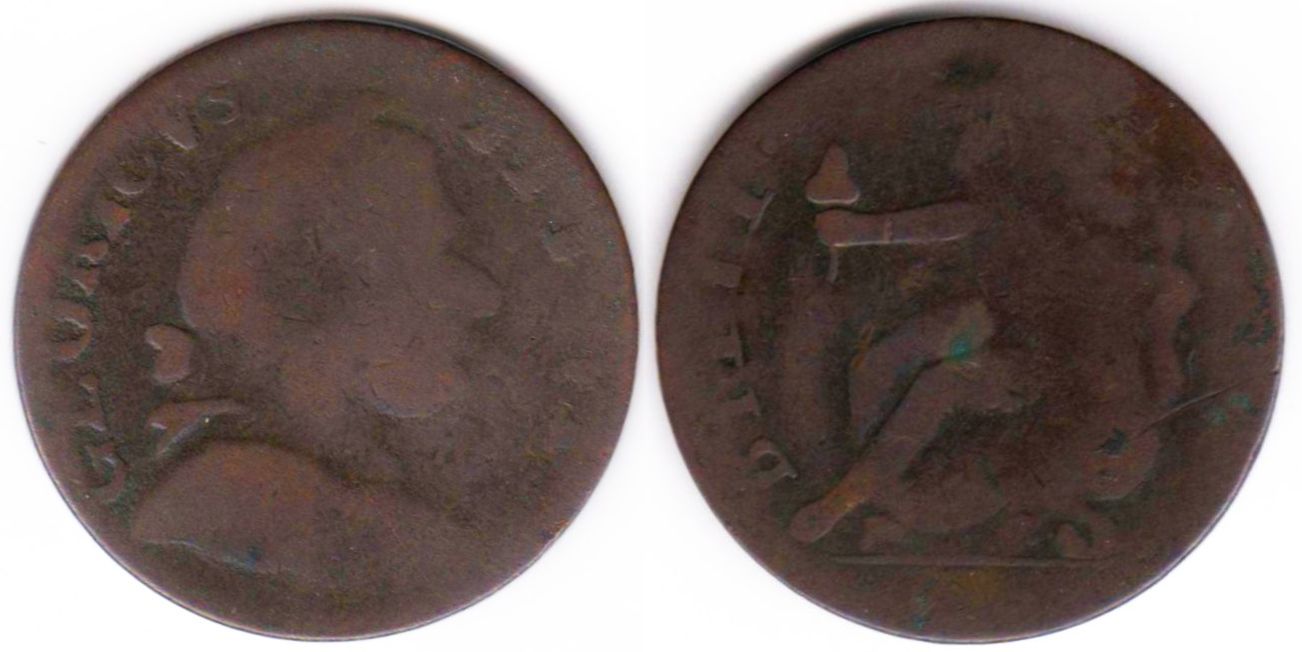 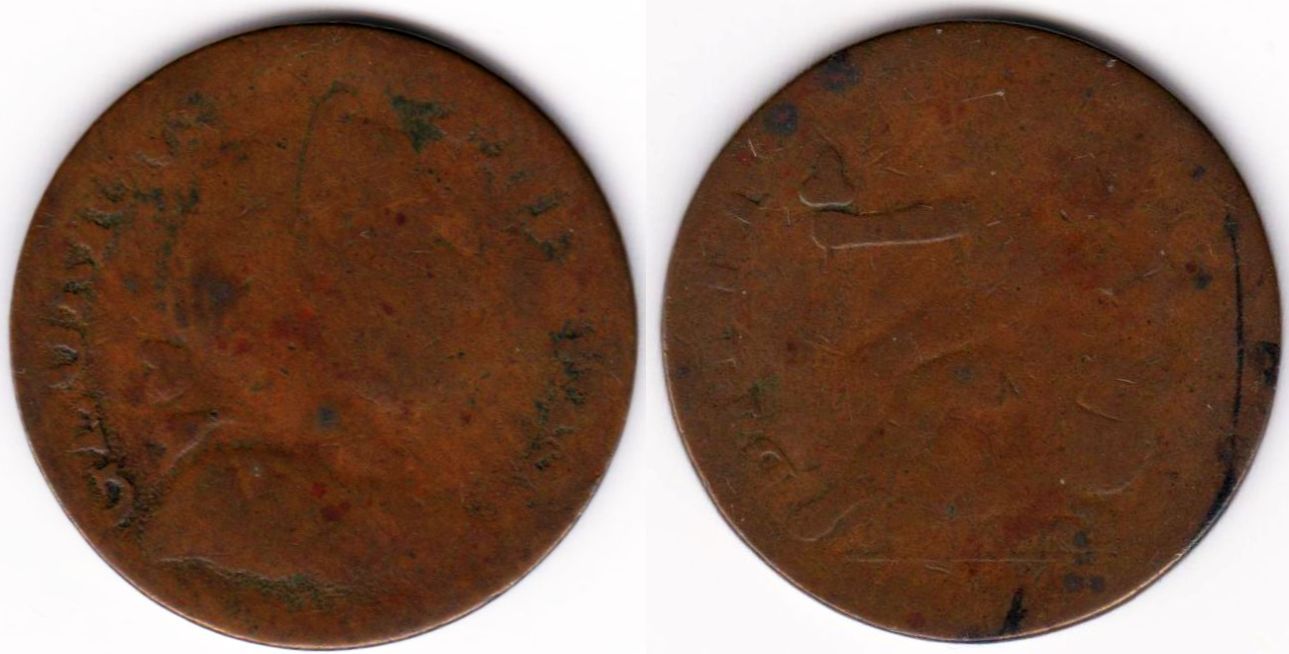
"If everything seems to be under control, you're just not going fast enough."
--- Mario Andretti
|
|
Valued Member
United States
179 Posts |
Quote:
blargish, I'll see your Bitit and raise you one! Even more so, your examples are of both die states! Your second example (the later state) shows prevalent rust around the bust. Furthermore, the reverse of your first example shows the "R" of "BRITI" well (as opposed to BITIT!) I hope to make another post in the future citing other information about these fellas. |
|
Valued Member
Canada
496 Posts |
Wood 23 has many die states .
|
|
Valued Member
United States
179 Posts |
Quote:
Wood 23 has many die states . Yes, I've come across articles stating that there are 8 or so; however, I've not been able to find anything that actually describes each individual die state. And I was referring to Wood 33 in my previous post which, as far as I am aware, has two distinct die states. |
|
Pillar of the Community
Canada
1085 Posts |
How would these coins have been valued and used? I'm assuming they're on the order of penny or half-penny.....
|
|
Pillar of the Community
Canada
1085 Posts |
Would banks have honoured them?
|
|
Pillar of the Community
United States
694 Posts |
They generally traded as halfpennies among the illiterate masses. I do not believe the banks accepted them.
|
|
Valued Member
404 Posts |
@Silver101 these circulated as matter of convenience. People and merchants often knew that they were accepting fake coin, but especially in the Canadas, there simply was not enough small change to do otherwise. Savings and bank deposits were generally made in silver coins of account, as well as banknotes (both governmental and chartered), the latter of which generally traded at generally accepted discounts on face value depending on issuing authority. Interesting note that Mr. Marcus Goldman of Goldman Sachs fame started off trading in paper in NYC, buying discounted notes, and selling them where the discount was lower.
|
|
Pillar of the Community
Canada
1085 Posts |
@norantyki and @1960NYGiants - thanks for this info - really interesting. I find the social context of all of this to be quite fascinating. A world in which most people are only marginally educated and, given a shortage of something as foundational as coins, will simply make little replicas and trade them as though they are real. There's such a range - some of the merchant tokens are actually pretty fine coins - clearly professionally produced - whereas others are decidedly on the crude end of things. The thing I love about this early era is the diversity of it all. There's so much character and the coins are so polyglot - some look English, others look American, still others look French - and then some of them, like the brute beasts in the original post - look they could have been made in a bazaar in ancient Persia!
Then the big transition in the 1850s and 1860s as Federally approved coins start to appeal - all with a strong, heavily empire-oriented structure and propaganda role to play. These in turn would help bind a new country together in some sense and also bind that new country to England. What an amazing world.
|
| |
Replies: 18 / Views: 4,698 |




 Posted 08/10/2020 06:17 am





