Thank you all for the feedback.
John Hyrcanus (original post) had five sons, Judah Aristobulus, Antigonus, Alexander Jannaeus, Absalom, and one son whose name was not recorded.
John decreed that on his death his wife would take over as ruler, and his eldest son Aristobulus was to receive the high priesthood only. However, when John died, Aristobulus imprisoned his mother till she died of starvation, and declared himself king. To secure his position he imprisoned his brothers, apart from Antigonus, with whom he had a particularly close relationship. Aristobulus was not only the first king from the Hasmonean lineage, but the first of any Hebrew king to claim both the high priesthood and kingship title. He was said to be the first Jew in "four hundred and eighty three years and three months" to have established a monarchy since the return from the Babylonian Captivity.
The reign of Aristobulus was a short one, from 104 to 103 BC. Not long after proclaimiing himself king, he was stricken with abdominal pains, causing his health to gradually deteriorate. When Antigonus returned from a campaign to Jerusalem to celebrate the festival of Sukkot at the Temple, the queen plotted against him. Afraid that if Antigonus took the throne she would be tortured and killed, she told Aristobulus that his brother intended to seize the throne.
Aristobulus had Antigonus put to death, and immediately regretted his action. Aristobulus's health then drastically declined until his death shortly after.
Queen Salome Alexandra then released Aristobulus's brothers from prison, selecting Alexander Jannaeus as the next king.
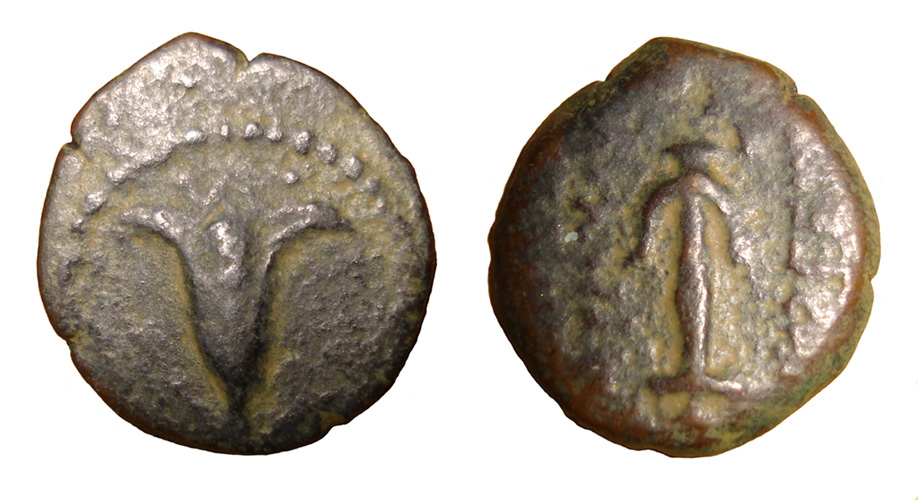
Which brings us to the next coin, a Prutah of Alexander Jannaeus. Though it is not in very good condition I bought it for two reasons; it is connected to the original post, and it has the Seleucid anchor.
Alexander Jannaeus (also known as Alexander Jannai/Yannai#8206;, born Jonathan Alexander) was the second king of the Hasmonean dynasty, who ruled over an expanding kingdom of Judea from 103 to 76 BCE. He was the third son of John Hyrcanus by his second wife.
After the death of Aristobulus, Alexander, as the oldest living brother, had the right not only to the throne, but also to Salome, the widow of his deceased brother, who had died childless, and although she was thirteen years older than him, he married her in accordance with Jewish law. By her he had two sons: the eldest, Hyrcanus II, became high-priest in 62 BCE, and Aristobulus II, who was high-priest from 66 - 62 BCE and started a bloody civil war with his brother, ending in his capture by Pompey the Great.
From his conquests to expand the kingdom, to a bloody civil war, Alexander's reign has been generalised as cruel and oppressive with never-ending conflict.
The major historical sources of Alexander's life are Josephus's Antiquities of the Jews and The Jewish War.
Like his brother, Alexander also served as the high priest. This raised the ire of the religious authorities who insisted that the two offices should not be combined.
According to the Talmud, Yannai was a questionable desecrated priest (rumour had it that his mother was captured in Modiin and violated) and, in the opinion of the Pharisees, was not allowed to serve in the temple. This infuriated the king and he sided with the Sadducees who defended him. This incident led the king to turn against the Pharisees and he persecute them until his death.
During his last years, Alexander continued campaigning in the east. The Nabataean king Aretas III managed to defeat Alexander in battle, however, Alexander continued expanding the Hasmonean kingdom into Transjordan. In Gaulanitis, he captured the cities of Gaulana, Seleucia, Gamala and Hippos; in Galaaditis, the cities of Pella, Dium, and Gerasa. Alexander had Pella destroyed for refusing to Judaize. Alexander captured all these cities in a period of three years (83-80 BCE). Three years later, Alexander had succumbed to an illness during the siege of Ragaba, and having reigned for 27 years, died at the age of forty-nine.
Full text and article:
https://en.wikipedia.org/wiki/Alexander_Jannaeus
Alexander Jannaeus, Prutah, Judaea. 103-76 BC.
Obverse: ΒΑΣΙΛΕΩΣ ΑΛΕΞΑΝΔΡΟΥ around Seleucid anchor. Reverse: Wheel with 8 ray-like spokes. Bronze. Diameter: 15 mm. Weight: 2.6 gr.
Reference: Hendin 467-472, Meshorer 8-9.








 Posted 08/12/2020 10:10 pm





