| Author |
 Replies: 8 / Views: 1,324 Replies: 8 / Views: 1,324 |
|
|
New Member
United States
3 Posts |
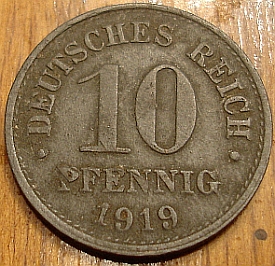
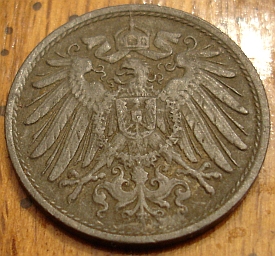
I was roll searching Jefferson nickels from my local WF branch today and came across the 1919 10-pfennig coin in the photos below. I do not see a mint mark of any kind on it. Is there any value in this coin over and above its conversational worth? Thanks in advance! Image:  10PfennigObverse.jpg 10PfennigObverse.jpg98.28 KB Image: 10PfennigReverse.jpg89.9 KB |
|
|
|
Moderator
 Australia
16994 Posts |
This is the zinc 10 pfennig, KM# 26 in the Krause catalogues, and they didn't have mintmarks; one of the few German coin types not to feature them. These were issued with dates ranging from 1917 to 1922; it looks to be in better condition than the typical zinc coins you'd see in a dealer's 3-for-$1 scratchtray, but all these dates are quite common.
Don't say "infinitely" when you mean "very"; otherwise, you'll have no word left when you want to talk about something really infinite. - C. S. Lewis
|
|
Pillar of the Community
United States
3098 Posts |
Well, this was before hyperinflation kicked in hard, so I guess you can make a conversation about it like
"Back in 1919, 10p could have gotten a loaf of bread. In 1925, it cost 1000000000000...0000 marks!"
|
|
Pillar of the Community
Spain
1361 Posts |
value is definetely worth more than a nickel
|
|
Pillar of the Community
Poland
3201 Posts |
The 1919 is a bit harder to find than the 1920-22, though the key date is 1917. Quote:
"In 1925, it cost 1000000000000...0000 marks!" Wouldn't that be 1924? |
|
Pillar of the Community
Germany
1238 Posts |
Actually 1923. (Hyperinflation in the Weimar Republic came to an end with the introduction of the Rentenmark in November '23.) Kind of odd that even in 1921/22 they still made coins featuring that imperial eagle which, in the CoA, had been replaced by a different eagle in 1919 ...
Christian
|
|
Pillar of the Community
Poland
3201 Posts |
So why did they print billion-mark notes dated early 1924?
|
|
Pillar of the Community
Germany
1238 Posts |
Depends on what one wants to emphasize. The introduction of the Rentenmark, at a rate of 1 Billion (1,000,000,000,000) Mark = 1 RentM, brought an end to inflation in mid-November 1923. The Rentenmark was not legal tender but people accepted and used this new money. Legally the "old" Mark was not replaced by the Reichsmark (same rate) until the end of August 1924; that is why notes with lots of zeros were still printed in 1924 ...
Christian
|
|
Pillar of the Community
Poland
3201 Posts |
Thanks for the explanation!  |
| |
Replies: 8 / Views: 1,324 |
|










 10PfennigObverse.jpg
 10PfennigReverse.jpg


 Posted 11/23/2008 03:10 am


