| Author |
 Replies: 8 / Views: 1,648 Replies: 8 / Views: 1,648 |
|
|
Pillar of the Community
United States
616 Posts |
`I moved into ancients 6 1/2 years ago, and for some reason found myself drawn towards the deification issues. It started with the coin I'm using as my avatar, the deification issue of Antonin Pius showing his funeral pyre topped with a quadriga - although it looks like a wedding cake with 4 candles on it. I read a good treatise written a century ago about the state religion of Rome, and started collecting the coins of deified emperors and their families.
Like all good topics, the more I learned the more I realized there was to learn. After those years of collecting I thought I had exhausted the deification issues, usually marked with "CONSECRATIO" on the reverse. A few weeks ago I learned that Constantine the Great, who died a Christian, had one issued in his name by the Senate. After I picked that one up, I found another that I missed. And another. Then I realized Trajan Decius had issued an entire set of 11 to celebrate Rome's heritage (and his connection to it).
The more I dug, the more of them I found. So I thought I'd better start a list. Please suggest those that I missed, and provide links to any write-ups on the coin if found.
Julius Caesar authorized by Octavian.
Augustus authorized by Tiberius.
Augustus authorized by Titus.
Augustus authorized by Trajan Decius.
Vespasian authorized by Titus.
Vespasian authorized by Trajan Decius.
Titus authorized by Trajan Decius.
Nerva authorized by Trajan Decius.
Marciana authorized by Trajan.
Trajan authorized by Trajan Decius.
Sabina authorized by Hadrian.
Hadrian authorized by Trajan Decius.
Faustina I authorized by Pius.
Pius authorized by Marcus Aurelius.
Pius authorized by Trajan Decius.
Lucius Verus authorized by Marcus Aurelius.
Faustina II authorized by Marcus Aurelius.
Marcus Aurelius authorized by Commodus.
Marcus Aurelius authorized by Trajan Decius.
Commodus authorized by Septimius Severus.
Commodus authorized by Trajan Decius.
Pertinax authorized by Septimius Severus.
Septimius Severus authorized by Caracalla.
Septimius Severus authorized by Trajan Decius.
Caracalla authorized by Elagabalus.
Julia Domna authorized by Severus Alexander.
Julia Maesa authorized by Severus Alexander.
Paulina authorized by Maximinus Thrax.
Severus Alexander authorized by Trajan Decius.
Mariniana authorized by Valerian.
Valerian II authorized by Gallienus.
Carus authorized by Carinus.
Constantine I authorized by Senate.
What I find particularly interesting is that the leadership of many ancient cultures often claimed descent from the gods. In Japan the emperor once claimed descent from the sun goddess Amaterasu. I'm also curious if the ancient Roman practice lives on today in the Roman Catholic Church's canonization of saints - but I'll leave that topic for another day.
Edited by jskirwin
10/25/2020 9:24 pm
|
|
|
|
Pillar of the Community
United States
1549 Posts |
There is a very rare CONSECRATIO coin for Commodus issued by the Alexandria mint using the same obverse dies as the non-consecration issues (also rare). I do not have one yet but Ars Clasica sold this one: https://www.acsearch.info/search.html?id=2664067My favorite guess is that Commodus planned a visit to the city that never happened and the eagle type was pushed into limited release during the time that it was unclear who was in charge in early 193. That is just a guess. There are those who prefer just to call them errors. This listing dates the coin to Septimius' period in 195 when he was 'reverse adopting' himself into the family of Marcus. Edited by dougsmit
10/25/2020 7:38 pm
|
|
Pillar of the Community
 United States
616 Posts |
|
|
Pillar of the Community
 United States
8056 Posts |
Nice to hae such a focused hit list! Quote:
I'm also curious if the ancient Roman practice lives on today in the Roman Catholic Church's canonization of saints - but I'll leave that topic for another day I think the short answer is no. In the monotheistic Judeo-Christian tradition, the first commandment prohibits deification of anyone other than the single (Jewish) or triplicate (Christianity) supreme being (or at least that is one interpretation). In contrast to polytheistic religions like Rome or Japan. That said, saints were treated as very special human beings more akin to local heroes with special powers in the afterlife, long before there was a canonization process. And it is definitely true that the dedication of churches to saints follows in the Roman tradition. The reference I like on the cult of Christian saints is, "Why Can the Dead do Such Great Things," Robert Bartlett, 2013 Princeton University Press. As for the numismatic manifestations of the cults of saints, you can take a look here: http://goccf.com/t/367831. Again, a tradition that clearly follows the Roman model. While I am totally unschooled in deification of ROman Emperors it seems the "divine right of kings" might be the later analog that was acceptable in the monotheistic CHristian culture? i.e. the king is not a god, but his or her authority has been granted by god.  And the practice of canonizing Christian kings in medieval times (Henry of Germany, Louis of France, etc.) might also cause confusion, though that was always done posthumously. Edited by tdziemia
10/26/2020 12:12 pm
|
|
Pillar of the Community
United States
6130 Posts |
I actually had just revisited my checklist a few weeks ago; there are a few that you are missing, but mostly ones that are far outside of either of our reach!
- Julius Caesar by Nerva
- Augustus by Nerva
- Livia by Claudius and Galba (reverses only)
- Claudius by Nero
- Poppaea and Claudia by Nero
- Domitilla I by Vespasian
- Domitilla II by Domitian
- Titus by Domitian
- Unnamed infant by Domitian
- Julia Titi by Domitian
- Trajan Pater by Trajan
- Nerva by Trajan (reverse only)
- Matidia by Hadrian
- Hadrian by Pius
- Quintus Julius Gallienus by Gallienus (purported)
- Victorinus by Tetricus
- Claudius II by Quintillus or Aurelian
- Claudius II by Constantine
- Nigrinian by Carinus
- Numerian by Carinus
- Constantius by Maxentius and Constantine (pre-reform)
- Constantius by Constantine (later)
- Maximian by Maxentius
- Maximian by Constantine (later)
- Galerius by Maximinus II
And there are also posthumous coins that don't specifically refer to deification:
- Most coinage of Agrippa
- All coinage of Nero Claudius Drusus
- Most coinage of Germanicus
- All coinage of Antonia
- All coinage of Agrippina I
- Most coinage of Nero + Drusus Caesar
- Tiberius by Nero
E: forgot:
- Helena (AE4-sized)
- Theodora
There is a rare series of provincial tetradrachms of Elagabalus that make outlandish and nonsensical claims that he is the child of Caracalla and Plautilla, and honors them and Septimius Severus
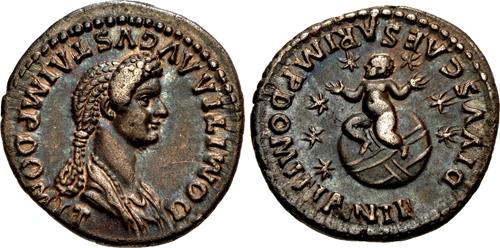
I recently won a coin of "ΘEAN" Octavia, indicating divinity, despite the fact that Nero had her killed!
Probably some more that I'm missing, too.
Edited by Finn235
10/27/2020 11:04 am
|
|
Pillar of the Community
United States
616 Posts |
Thanks Finn.
Unnamed infant by Domitian.
Wow.
|
|
Pillar of the Community
United States
1554 Posts |
This thread prompted me to do some reading online. What I found in academic sources was that divus was indeed occasionally used to refer to saints but mostly around the Renaissance, a millennium on from the last deified emperor. Earlier Latin sources were seemingly careful to use sanctus in order to avoid this particular issue.
As an aside, it's interesting to me that while Latin has divus distinct from deus, Greek makes no such distinction. Therefore while Augustus styled himself divi filius ("son of a god") on the Latin coinage, the equivalent on Greek language coins is θεου υιος ("son of God"), precisely the title given to Jesus Christ in the Gospels.
Edited by Kushanshah
10/26/2020 11:14 pm
|
|
Pillar of the Community
United States
6130 Posts |
Edited by Finn235
10/27/2020 1:37 pm
|
|
Pillar of the Community
United States
616 Posts |
Finn
That is an amazing coin - unusual and beautifully struck. Nice patina too.
And the selling prices isn't insane - though still a divorce-risker.
tdziemia and Kushanshah
Thanks for the comments. As I read up on the religion myself (I'm re-reading "The Religion of Ancient Rome" by Cyril Bailey) I've just wondered whether the deification process had seeped into the Catholicism just as many other Roman cultural elements have.
|
| |
Replies: 8 / Views: 1,648 |
|







 Posted 10/25/2020 7:54 pm