PCGS - One of the defining moments of the Civil Rights Era in the United States during the mid-20th century occurred when Central High School in the southern city of Little Rock, Arkansas, was formally integrated. While the event was an isolated chapter in history, it certainly wasn't because the act of racial integration was unique to that particular high school in Arkansas.
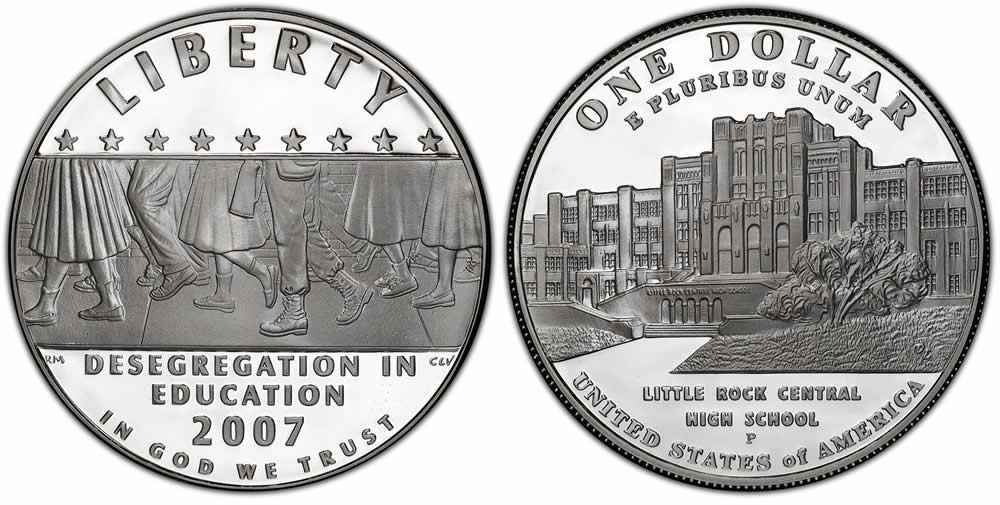
2007-P $1 Desegregation, DCAM, PCGS PR70DCAMIn fact, the United States Supreme Court ruling that served as the catalyst for integration in public school systems across the United States had been ceremoniously handed down three years earlier in 1954. That was when the justices decided the landmark case Brown v. Board of Education, in which the court's nine justices unanimously declared segregation in the public school system under the "separate but equal" clause unconstitutional. If integration was to become the national standard, then why was the individual desegregation of Central High School in Little Rock, Arkansas, in 1957 an event noteworthy enough for recognition on a commemorative coin?
A National CrisisThe desegregation of Central High School in Little Rock should have been little more than an uneventful adherence to law, as determined by the findings of Brown v. Board of Educationthree years earlier. However, sociopolitical leanings and cultural resistance against racial integration in the South during the late 1950s meant desegregating would prove challenging at the least. That was certainly the situation during integration efforts at Little Rock's Central High, which became a flashpoint for violence when the school's first nine black students enrolled and began attending classes there.
The nine black students soon to be known as "The Little Rock Nine" made their way toward Central High School on the morning of September 4, 1957, the willing subjects of a racial experiment unfolding across the South during the late Jim Crow era - full-scale racial integration. The nine students, escorted onto school grounds by police, were spat upon and assaulted by flying objects thrown from the throngs of angry bystanders and even fellow students. They only got so far as the front door. That is where stood Arkansas Governor Orval Faubus, who deployed the Arkansas National Guard to physically block the students from entering in objection of the federal desegregation ruling.
Read the Entire Article 



 Posted 11/19/2020 01:58 am





