| Author |
 Replies: 10 / Views: 2,933 Replies: 10 / Views: 2,933 |
|
|
Pillar of the Community
United States
3848 Posts |
I found this 1946 S Wheat cent when pulling out steel cents from a large bag of wheat cents. It has a very strong attraction to a magnet, almost like a steel cent. This cent appears to be the correct copper alloy. The entire coin isn't attracted to the magnet, just one spot on the coin. That leads me to think that there is some sort of shrapnel or iron impurity in the cent. It weighs 3.19 grams, so it is overweight. I went to two coin shops to see their opinion. The first said to get it certified with NGC, while the other said to come to a forum. Both have never seen anything like it, and clearly showing interest. I want to get more opinions before I pour some money into it. I believe this is legitimate, not a fake or homemade coin. It has standard detail for a 1946 S, and has common wear throughout. It can't be post-mint, that's why I think I have something better than the normal Wheat cent. Thanks in advance, and feel free to post thoughts and opinions. 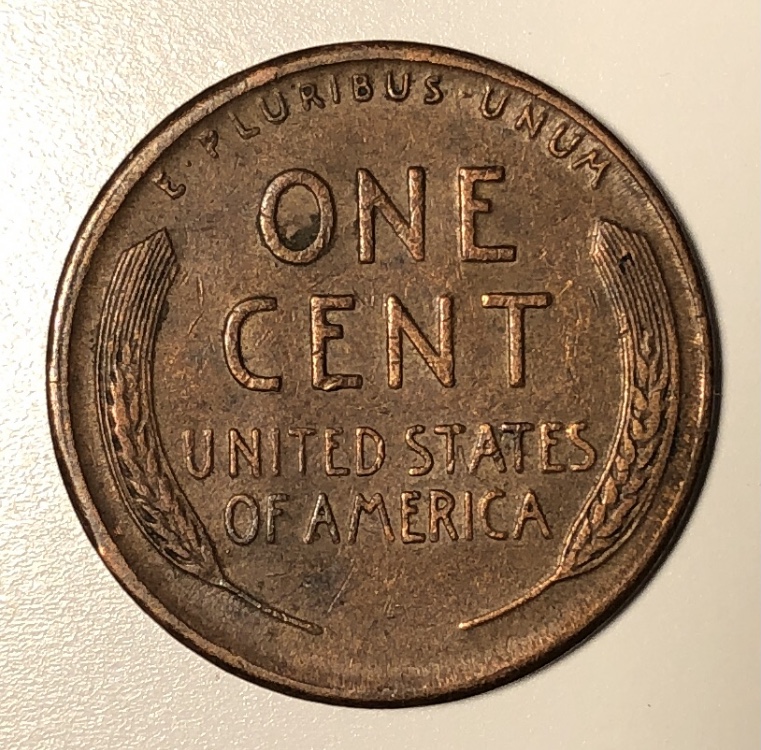 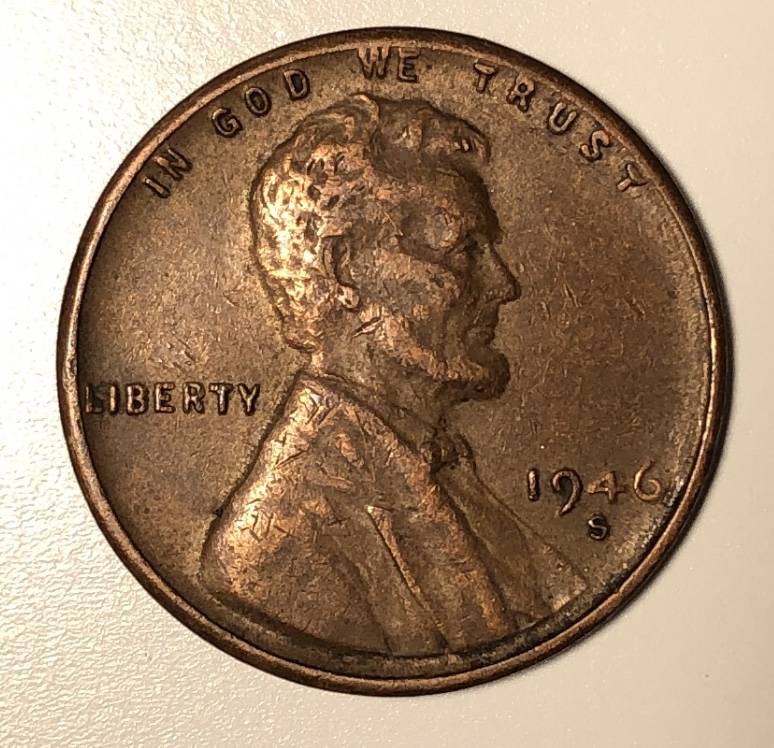 Suffering from bust half fever. Want to learn how to attribute early half dollars by die variety? Click Here: http://goccf.com/t/434955Shoot me a PM if you are looking to sell bust halves. |
|
|
|
Rest in Peace
United States
18456 Posts |
Can you show us or tell us exactly where the magnetic spot is on the coin ?
|
|
Pillar of the Community
United States
5825 Posts |
I look at the date and think that something is wrong with the "4".
|
|
Bedrock of the Community
United States
94367 Posts |
Yes, where is the hot spot?  to the CCF! |
|
Bedrock of the Community
United States
62064 Posts |
I was wondering if it was on the 'O' on ONE? Some steel may have been struck on to the coin where is chip is starting. (thus the over weight and no evidence of plating)
There is also something on the right wheat lines that maybe a small piece of wire?
|
|
Pillar of the Community
 United States
3848 Posts |
Thank you for all of the replies! The magnetic spot is more like a strand. Regarding the obverse, it starts at the date and continues through LIBERTY. Regarding the reverse, the magnet is attracted to the E in ONE and hooks around and ends at C in CENT. I believe the dates appearance is entirely normal as the 1946 S Wheat cent seems to have a lot of grease strikes. I've seen a lot where you can barely see the date. Suffering from bust half fever. Want to learn how to attribute early half dollars by die variety? Click Here: http://goccf.com/t/434955Shoot me a PM if you are looking to sell bust halves. |
|
Pillar of the Community
United States
3848 Posts |
There is no visible foreign objects that can be seen in person. The object could indeed be a piece of wire, but I don't know how a piece of wire could get stuck in the alloy during the minting process. That's where I am stumped. Any ideas what I should do with it?
Suffering from bust half fever. Want to learn how to attribute early half dollars by die variety? Click Here: http://goccf.com/t/434955Shoot me a PM if you are looking to sell bust halves. |
|
Moderator
 United States
196778 Posts |
to the Community! |
|
Bedrock of the Community
Australia
21794 Posts |
With all metal on metal plated objects, there can be some atomic interchange at the plating interface.
That would make it easier to examine the outer surface layer using XRF, looking particularly for nickel or iron.
0.08 of a gram too much. Is that still within tolerance?
With a mintage of nearly 200 million, what is the possibility that a few slightly overweight examples may have escaped the mint without checking?
It is obvious to make the assumption that it could be copper plated steel, but I think perhaps that may be just tooooo tempting.
|
|
Bedrock of the Community
United States
17884 Posts |
Carefully check the edges of the coin along the line that you indicate is magnetic. There is a magic trick that uses a concealed magnet to make a coin "disappear". To make the trick work a coin is altered by drilling in from the edge and inserting an iron or steel pin.
|
|
Pillar of the Community
United States
3848 Posts |
The magnetism is comparable to a steel cent. A fancy X-Ray machine, I believe would reveal a piece of contaminant inside the planchet. Unfortunately I don't have one around the house to confirm that theory. 0.08 grams difference is definitely within tolerance of a common mistake at the mint.
The edges are normal. Great thought Conder101, as that would be a logical explanation for the magnetism. I was expecting a tampered edge, because that would explain exactly what the problem is. It is like there is a steel pin inside the penny, but no sign of any post-mint damage.
For there to be a pin or wire-like object inside the cent, it would seem that there would be some sort of view of the object from one side or the other. There is no wire peeking out, or pin poking out of the side. That increases the odds of a foreign object being in there, especially having it perfectly seated, undetected from any view. It is entirely possible though since that seems like the best possible explanation.
Suffering from bust half fever. Want to learn how to attribute early half dollars by die variety? Click Here: http://goccf.com/t/434955Shoot me a PM if you are looking to sell bust halves. |
| |
Replies: 10 / Views: 2,933 |
|




 Posted 11/14/2020 08:48 am





