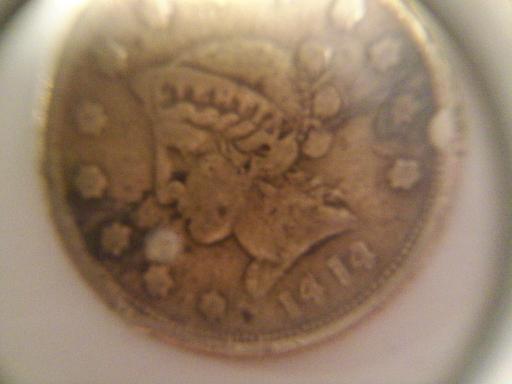
Clearly it's meant to imitate the US gold coin pictured by bman above. It's equally clear that the manufacturer either had no knowledge of the English language, or deliberately mangled the legend. I would posit two scenarios:
1. It's an "evasion" - a fake coin with a design similar to a real coin, but with clear differences in minor details, such as the date and lettering. It would be intended to fool someone who only took a quick glance at the coin, or was illiterate. If the counterfeiter got caught, his defence would be that he was just making medals and there were sufficient differences between them and the real things; it wasn't his fault that other people were using them as fake coins. Such a coin would have been made in the mid-1800's, when the real things were in circulation.
2. It's a fake coin made outside the US, in a non-English speaking country. Such a coin may be a contemporary counterfeit like number 1, or it may have been made more recently, in China for example; I'm reminded of the Chinese fakes that read "Maxxico" instead of Mexico.
Don't say "infinitely" when you mean "very"; otherwise, you'll have no word left when you want to talk about something really infinite. - C. S. Lewis









 Posted 12/06/2008 10:36 pm


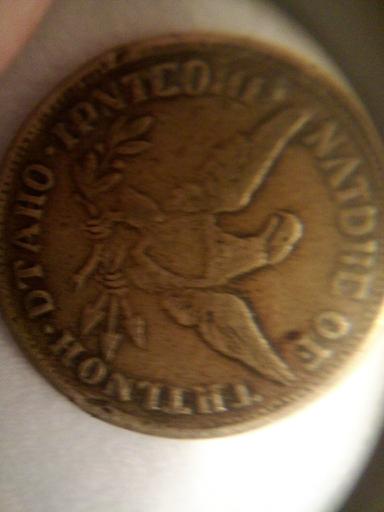
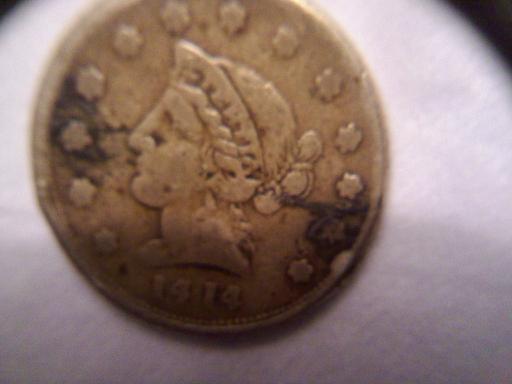


 think it is a token. There isn't any monetary value on the coin.


