All ancient authors appear to agree in representing Catania as a Greek colony named Katane, of Chalcidic origin, but founded immediately from the neighbouring city of Naxos, under the guidance of a leader named Euarchos (Euarchus). The exact date of its foundation is not recorded, but it appears from Thucydides to have followed shortly after that of Leontini (modern Lentini ), which he places in the fifth year after Syracuse, or 730 BC. After Hieron of Syracuse captured Katane in 476 BC, the name was changed to Aitna, and he repeopled the city with a new body of colonists, amounting, it is said, to not less than 10,000 in number, and consisting partly of Syracusans, partly of Peloponnesians. Fifteen years later the new colonists were expelled and the city reverted to it's original name. When the city was taken by Dionysios of Syracuse in 404 BC he sold the population into slavery. During the First Punic War Katane submitted to Rome.
These are two bronzes I obtained recently, both from Katane (Catania), but two centuries apart.
The first has the head of Amenanos, represented as a young male head with small horns, who was the river god associated with the city. Interestingly, the most popular representation of a river god is the "man faced" bull. There is a school of thought however, that believes the "man faced" bull always represents Achelous and not a local river god. The reverse features a very ornate thunderbolt with spread wings.
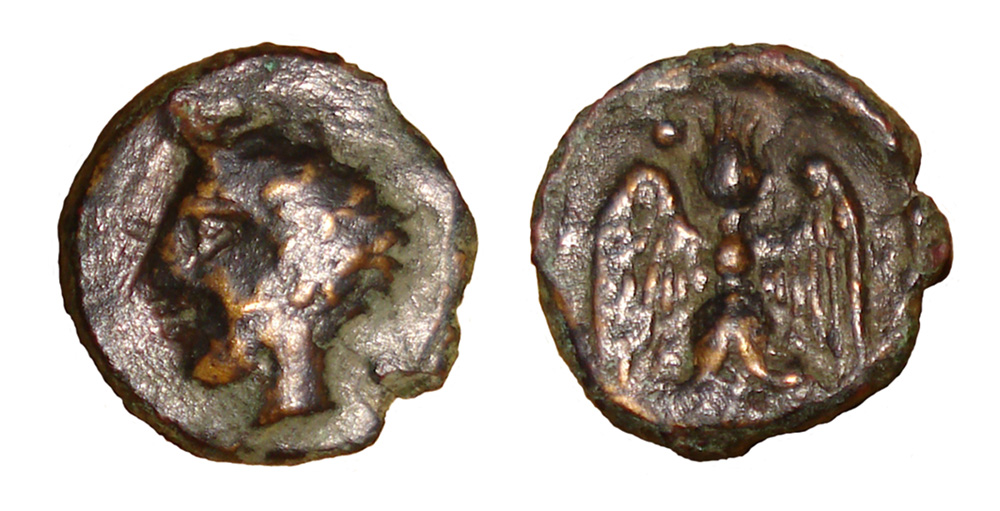
Sicily, Katane, Onkia, 413 - 404 BC.
Obverse: Head of young river god Amenanos left, with short horns; pellet right. Reverse: Winged thunderbolt with spread wings; pellet above. Bronze. Diameter: 10 mm. Weight: 0.9 gr.
Cf. Sear 1067.
Next, when I was in Sicily many years ago I heard the story of Amphinomos and Anapias, but till now had not seen an ancient coin with the brothers depicted on it.
The story goes; During a fearful eruption of Aetna in the 5th century, the stream of lava was descending on Katane. Everyone was desperately trying to save their treasures, but the brothers Amphinomos and Anapias went back to try and save their aged parents. In legend, the brothers carried off their mother and father on their shoulders, but the lava overtook them. Heavily laden as they were, their doom seemed inevitable. The gods, looking down, saw their devotion to their parents and parted the fiery stream, letting them pass unscathed. The brothers were later held up as icons of filial piety, and received divine honours.
The story is told by numerous authors. Lykurgos of Athens speaks of only one young man, while other writers such as Seneca, Pausanias, and Claudian, mention the brothers. The deed was also depicted on Katanic and Roman Republican coins, and statues of Amphinomos and Anapias were erected in their honour.
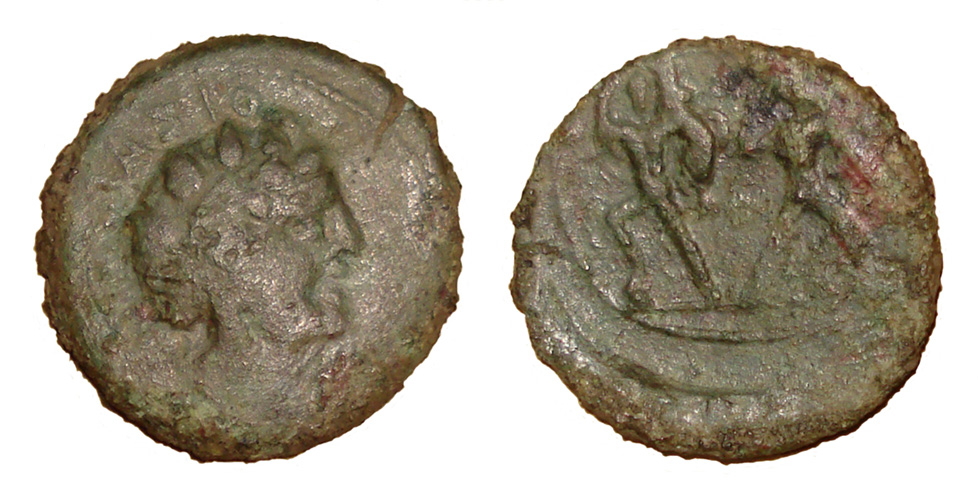
Sicily, Katane, 186 - 170 BC.
Obverse: ΛΑΣΙΟ. Head of young Dionysos right, wreathed with ivy. Reverse: ΚΑΤΑΝΑΙΩΝ. The Katanean brothers, Amphinomos and Anapias, advancing left and right, bearing their parents on their shoulders. Bronze. Diameter: 21 mm. Weight: 4.2 gr.
Sear 1078.










 Posted 12/11/2020 3:11 pm


