Having done some research on this note, I thought I should share my findings with the community. I am sure a number of you have this note, but perhaps not all of you have complete information about it and its background.
Strictly speaking, it is
not a banknote. It is a
railway bond but, as I will explain later, one that was
used as currency, so I think it fits just as well in this forum as in the Checks, Stocks, and Bonds Forum.
Below, I will go through what kind of note this is, what the text says, why it was emitted and how it was used. I will also give a short but useful background of the political landscape of North Caucasus after the Russian revolution. For those of you interested in railways, I will say a few words about that and the locomotive that is depicted on the front. Plus bits and pieces of other information that I have dug out. At the end, you find the Notes which I refer to in the text.
It is such a beautiful note, here it is:


When I saw this note the first time here in a CCF post, it immediately caught my attention. Besides having an interest in banknotes, I am also interested in railways and trains and maps. With the small but detailed and (as I soon found out) accurate depiction of an actual steam locomotive, and of course the beautiful and very detailed map, this one scored high on my interest meter

. That I also have a general interest in the time around WW1, didn't hurt either. But, I collect primarily
French coins, and although I do have a tiny collection of French banknotes and even a couple of French war bonds,
Russian bonds are definitely outside my area of collection. So, now began a mental battle between the somewhat more sensible part of my brain, saying "you collect French coins, remember?
That's where your money should go, not into buying Russian bonds" and the more aesthetic part, arguing "but this is a such a beauty, and it has a train, and a map, and it is just such a fantastic piece of paper! Want to have, please!"
Of course the aesthetic part won in the end.

Once in my possession, like with everything I else I collect, I want to know everything there is to know about it. What is it really, why was it emitted, why does it look the way it does - basically, what is the history behind this note? (Yes, I have a general interest in history too ...) The first thing was of course to find out what all the text said. That it was some sort of interest bearing paper rather than an ordinary banknote was clear from start - the "5,4 %" at the center of the obverse pointed to that - but not knowing Russian, the rest of the text was unreadable to me. However, an online Cyrillic keyboard and Google translate soon helped to decipher the text (Note 1). (The full translated text is given a little bit further down in this post.)
Finding out more about the Vladikavkaz Railway, the steam engine depicted, and Northern Caucasus around 1918 is not too difficult. There is plenty of information in English around the Internet. About the bond itself, however, English sources are scarce, and here I had to go to Russian sources to find detailed information. Figuring out proper Russian keywords, searching for Russian web pages and making use of Google's automatic translation of those took time but gave a lot of useful information (Note 2). There is contradictory information in places, but I have tried to iron out those by cross-checking sources and checking against a timeline of events during the tumultous years in North Caucasus following WW1 and the Russian revolution.
The text on the noteLet's start with what all the text on the bond says. Front side first:
Around the coat of arms at the top:
Rostov-Vladikavkaz RailwayOn both sides above the oval with the train:
100 rublesCenter piece:
Loan ticket
of the Vladikavkaz Railway Company
Issued at 5.4% for two years
of hundred rubles
1 September year 1918Serial number:
B34787Signatures:
Chairman of the Board Krieger-Voinovsky
Head of General Accounting BertholdBottom:
Counterfeiting of tickets is prohibited by the lawLeft side, vertical text:
Emission of tickets is controlled by the governmentMonogram to the right:
(shorthand for Vladikavkaz Railway)
Reverse side:
Loan tickets are secured with all income and property of the Vladikavkaz Railway Company.
Tickets are accepted for payments and fees by the cash offices of the North Caucasus railways, state savings banks at the stations of the aforementioned railways, institutions of the State Bank and Treasury.
Loan tickets are valued at the value of the ticket with an addition of 1½ kopeks per hundred rubles per day from 1 September year 1918, counting every month as 30 days.
Interest ends on 1 September year 1920, after which this ticket is accepted for 10 years at a value of 110 rubles 80 kopeks.Monogram behind the text:
(shorthand for Vladikavkaz Railway)
North Caucasus 1918-1921After the Russian revolution in 1917, North Caucasus fell under the newly formed Russian Soviet Federative Socialist Republic (RSFSR), but more or less immediately seceded as the Mountainous Republic of the Northern Caucasus. During the Russian Civil War, that followed on the revolution and lasted 1917-1923, the area became a war zone with several local armies fighting over the region: The Voluntary Army, the Don cosacks, the Kuban cosacks, and of course the Russian Red Army. The Red Army successively defeated the others and took control beginning 1920 and in 1921 the Mountain Autonomous Soviet Socialist Republic was proclaimed.
Today the area is divided among several republics in the Russian Federation.
The Vladikavkaz RailwayThe Vladikavkaz Railway opened in 1873. It was a private railway with administrative head quarters in Rostov-on-Don. Vladikavkaz (the name means ruler of the Caucasus) was one of the endpoints of the railway and an important city (it is found near the center of the map on the note). The gauge was 1,524 mm/5 ft, like in the rest of the Russian Empire. It became an important railway, second only to the Transsiberian Railway according to some. The company did well, it also owned oil fields, oil refineries, and other industrial plants. In 1913, the railway had 2,511 km/1,560 mi of tracks, 795 locomotives, 827 passenger cars, and 19,525 freight cars. The gross income was more than 56 million rubles and the number of transported passengers over 8.3 million.
Like for many other railways all over the world, issuing of bonds was done quite regularly as a means of financing expansions. The high profitability also attracted foreign capital, and in particular British banks and industrialists became large share holders of the railway and other industries in the region.
The railway continued to operate during the Russian Civil War, carefully balancing between and gaining the support of the different armies in the region. After the take over of North Caucasus by the Red Army in 1920, however, it was nationalized in Jan/Feb, becoming the North Caucasian Railway under the control of the People's Commissariat of Railways of the RSFSR (Note 3).
The bondWith the backgrounds on North Caucasus and the Vladikavkaz Railway in place, we can turn our attention to the main subject of this post, the bond itself.
The civil war in the North Caucasus region undermined the finances of the railway and in 1918 it was decided to issue a loan amounting to 60 million rubles in the form of bonds. These would run for two years at a yearly interest of 5.4 %. At this time, the North Caucasus was occupied by the Volunteer Army and the Don and Kuban cossack armies, and the railway board had to seek permission from the commands for these armies. All three armies, each controlling part of the territory where the railway was located, granted permission. A special committe was formed with representatives from the railway, the state bank, the finance department and the three army commands, to implement and oversee the issuance of the bonds.
From start,
the intention was to let the bonds circulate as currency and (as stated on the bonds) allow them to be used as payment for tickets at the railway but also for payments to governmental institutions. The background to this was that the war situation made the status and trustworthiness of the regular ruble banknotes uncertain, while the Vladikavkaz Railway was considered financally stable (and as also stated on the notes, their value was backed by the assets of the railway). The presence of a substantial foreign stake in the ownership of the railway also played a role (it was thought that "the British will pay"). For this reason, the bonds became popular among the public and were used as a means of payment in general, not just for the purposes stated on the notes. The value of a bond at each time was its nominal value plus the interest up until that time. The bonds also circulated outside North Caucasus, in present day Georgia.
The notes were issued Sept 1, 1918, in nominal values of 50, 100, 500, and 1,000 rubles. The name of the designer was E. N. Shur. Only the 1,000 rubles notes were printed on water marked paper, the lower denominations used regular thick paper. Bonds were printed in the following numbers:
50 rubles: 255,501
100 rubles: 167,265
500 rubles: 41,937
1,000 rubles: 26,814
(This actually adds up to a bit more than 77 million rubles, more than the 60 million allowed. The excess 17 million were therefore destroyed on Oct 5, together with cliches and engravings, in the presence of military controllers.)
The popularity of the notes led to them being sold out during 1919, and a second loan was issued in November that year. It totalled 200 million rubles, and would also run for two years at 5.4 % annual interest. Due to the high inflation, the new loan had denominations of 5,000 and 10,000 rubles. Notes from this 2nd loan are rare.
In January 1920, Rostov-on-Don was taken by the Russian Red Army and not long after the entire North Caucasus fell to the Red Army. The Vladikavkaz Railway was nationalized and in March 1920, all notes issued by the railway (and all other money issued by the previous governments) were declared invalid, without any possibility of redeeming their value.
To summarize, these bonds in effect worked as money in North Caucasus from Sept 1918 - Jan 1920. They were never redeemed. Even if that had been possible, the hyper inflation in Russia during this period might have made that uninteresting. The inflation from Sept 1918 to the redemption date of Sept 1920 was about 10,000 %. A 100 rubles note would effectively have a value of 1 ruble at that time, and the 5.4 % interest, well ...
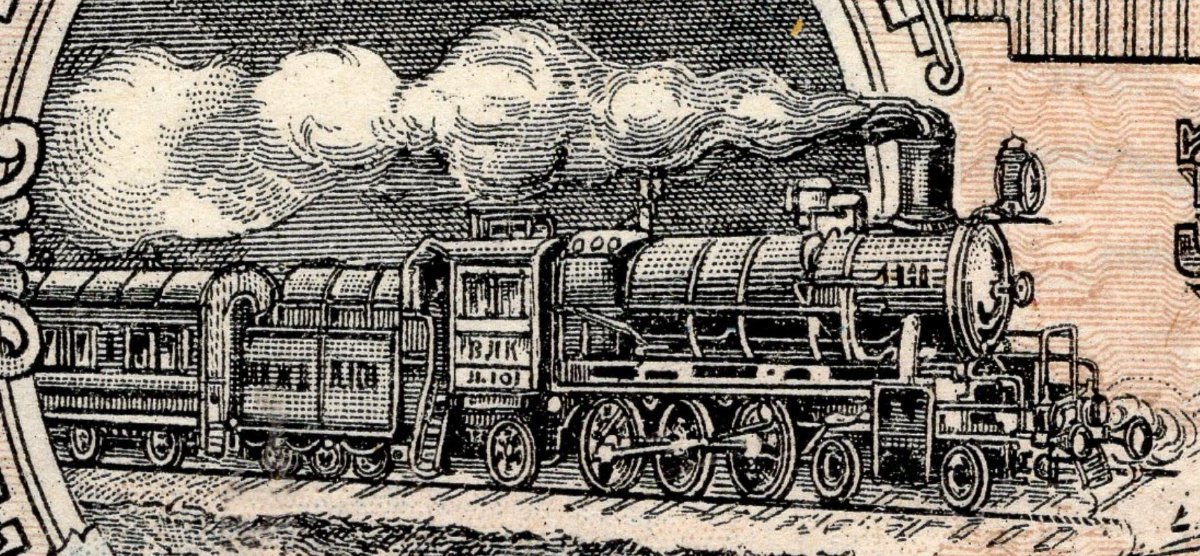
The trainThe train on the front is a quite accurate depiction of an actual train on the Vladikavkaz Railway. It is an express train, pulled by a Class L express passenger locomotive. This is a four cylinder 4-6-2 locomotive, also known as "Pacific" class (Note 4). With a magnifying glass, one can actually read "VLK L.101" on the cabin side of the locomotive and "VLK.Zh.D. L.101" on the tender. VLK and VLK.Zh.D. are Russian shorthands for Vladikavkaz Railway. The serial number 101 of Class L was built in 1915, like the others in the series at the Putilov works in St Petersburg. In all, 18 of these oil fueled steam engines were built before 1918 (additional engines were built in the 1920s, but then coal fueled). The Class L was the most powerful passenger locomotive in the Russian Empire and the Vladikavkaz Railway was the only railway that had them. No wonder it got to adorn the bonds, most likely being the pride of the company.
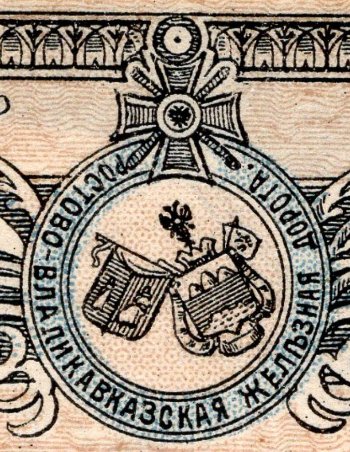
 The coat of arms
The top of the front side of the note displays the coat of arms of the Vladikavkaz Railway. It consists in turn of three elements: To the left in the circle, the arms of Rostov-on-Don. To the right, the arms of Kuban. On top, the Russian double eagle inscribed in a St George's cross. (My information here is a bit sketchy and incomplete, so far.)
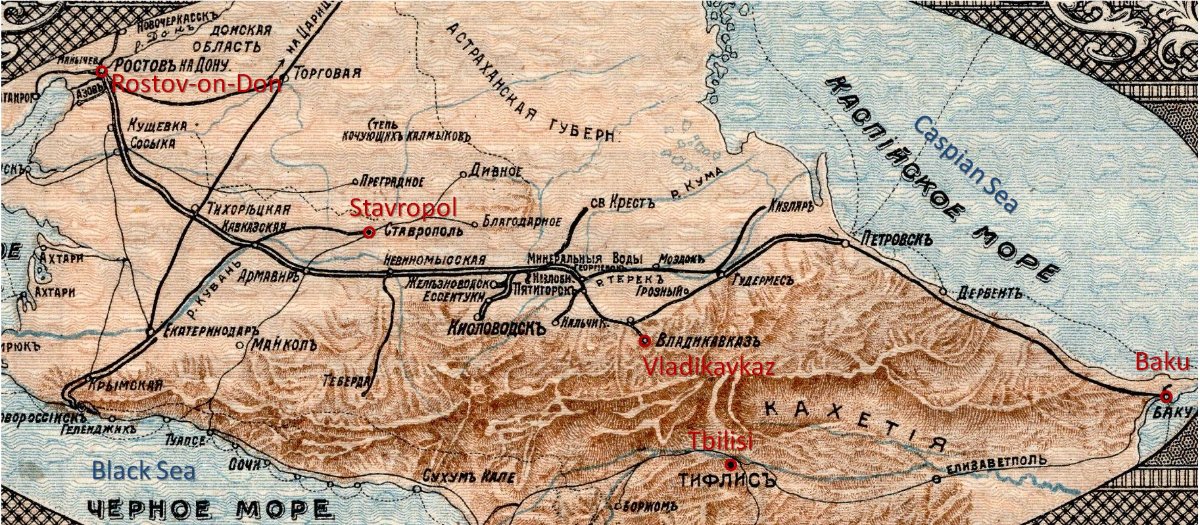
 The map
Well, the map speaks for itself in its beauty. I have just added the Western names of a few key cities (in red).
 Notes:
1. I used Lexilogos multilingual keyboard. Its Russian keyboard also has old Russian characters no longer used today, but used on the note. A couple of places in the text gave confusing results and took some time to figure out.
2. The Russian site with most useful information about this bond is bonist.info.
3. Many sources give the date of the nationalization of the Vladikavkaz Railway as September 1918. This is apparently wrong, since the region was not under the control of Soviet Russia (RSFSR) until 1920. It is correct, however, that nationalization of Russian railways in general began in 1918, with (former tsarist) state railways taken over in April 1918 and private railways in September 1918. Possibly, even likely, was the Vladikavkaz Railway on the list of railways to be nationalized already in Sept 1918, but effectively that did not take place until Jan/Feb 1920.
4. "4-6-2" refers to the wheel arrangement: 4 leading wheels, 6 driving wheels, 2 trailing wheels. "Pacific" is an alternate popular name for this wheel arrangement.








 Posted 12/26/2020 10:15 am


 Very impressed with your tenacity & linguistic/historical/geographical/numismatic sleuth work! This was such an articulate write up that it motivated me to "buck up" on the geography/history of the region. I did not realize that according to Wiki:


