| Author |
 Replies: 9 / Views: 1,948 Replies: 9 / Views: 1,948 |
|
|
New Member
Canada
24 Posts |
Hello, I recently inherited a collection of coins. Unfortunately, the humidity of Southern China was not so kind and left them in a rather green state. Is there anything I can do to at least save a few of them? Most are copper or nickel, with a few brass pieces as well. Thanks in advance. 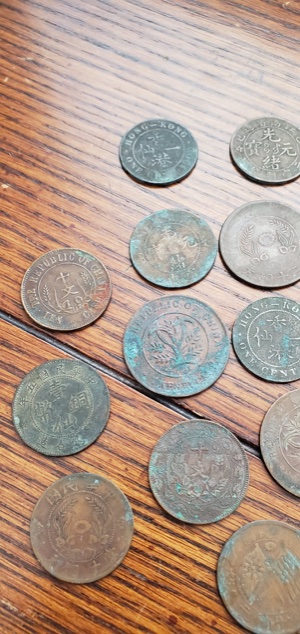 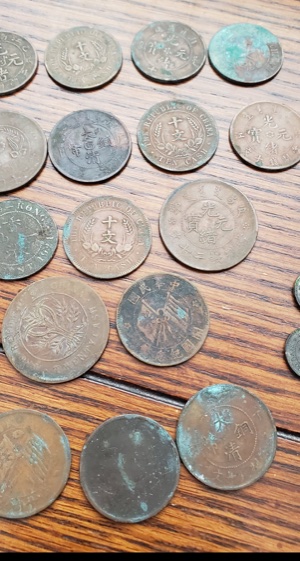 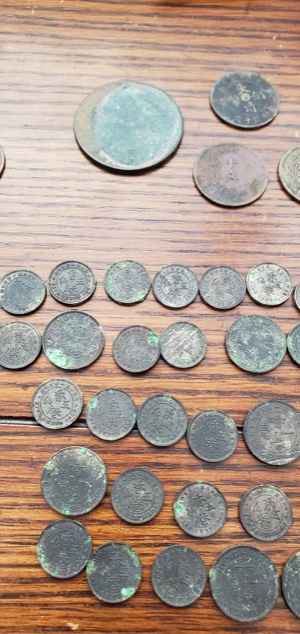 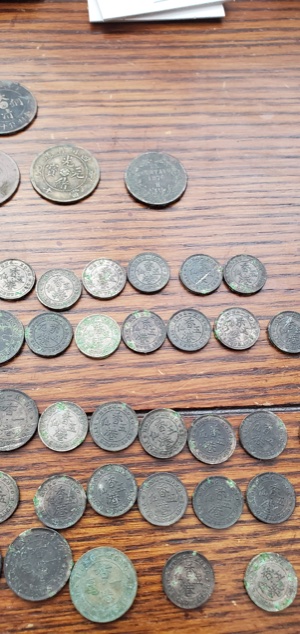 |
|
|
|
Pillar of the Community
 United States
6514 Posts |
There is a product made by a forum member named BadThad. Believe it's called Verdi-Care. It removes the green verdigris while preserving the surface of the coin. From what I understand it is very hard to get ahold of. I guess if he makes a batch it's gone before he finishes.
Edit: Had to look up how to spell verdigris.
Edited by chafemasterj
12/27/2020 12:20 pm
|
|
Pillar of the Community
2145 Posts |
I read a post recently (about a few days ago) in the Ancient coins section about somebody making his own solution from items you have in your household, to help control verdigris. I can't remember more than that. Maybe someone can find it.
EDIT: It wasn't from the guy who does his own electrolysis.
Edited by Rothery
12/27/2020 1:42 pm
|
|
Pillar of the Community
United States
1543 Posts |
Edited by Gincoin43
12/27/2020 2:14 pm
|
|
Pillar of the Community
Canada
5287 Posts |
Most of the pieces you have shown are worth a dollar or two at most, without the verdigris. However, there are a few rarer varieties and it may be worth putting in the effort to determine if you have any. Krause's Standard Catalogue of World Coins does describe them, but not particularly well in my opinion.
|
|
Moderator
 United States
56855 Posts |
 to CCF. John1  |
|
Bedrock of the Community
Australia
21789 Posts |
The problem with making your own solution of Sodium sesquicarbonate is that the common harmless chemicals (washing soda and baking soda), from which it is made, have varying amounts of water of crystallization, and so it is virtually impossible to make a balanced solution necessary for passivation of bronze disease (verdigris).
Better to just buy natural Sodium sesquicarbonate (also harmless), from a chemical supplier.
Just be aware that the unaffected patina on the rest of each coin may? be disturbed as you treat them.
Some museums and ancient coin collectors use Renwax as a sealant to protect the coins after passivation.
|
|
Bedrock of the Community
United States
20753 Posts |
Why not just start with baking soda and distilled water solution. |
|
Pillar of the Community
United States
8031 Posts |
Baking soda has only one of the two ingredients (sodium bicarbonate). If I understand correctly, the idea of the sesquicarbonate is to make a carbonate/bicarbonate buffer system with a specific pH. This can't be achieved with just baking soda.
Two alternative recipes for preparing a 5% solution of sodium sesquicarbonate (I think I have seen this recommended as the concentration to use for coins):
1. To one cup (237 g.) of distilled water, add 12.4 grams of sodium sesquicarbonate purchased from a chemical supply house, as mentioned by @sel
OR
2. To one cup (237 g.) of distilled water, add 5.5 grams of baking soda (sodium bicarbonate), and 18.6 g. of washing soda (sodium carbonate decahydrate). This solution will be slightly below 5%.
Edited by tdziemia
12/28/2020 1:34 pm
|
|
Bedrock of the Community
Australia
21789 Posts |
Litmus paper (cheap enough) testing should give some sort of reasonable estimation of pH**, before the solution mixture can be used. Don't know what the pH should be for verdigris passivation. I would guess pH7, but I stand for correction when it comes to verdigris passivation.
Not a big deal in this case, but just be aware that the areas of patina undisturbed by verdigris on other coins (may? expect?) to be affected. Experiment on the lowest valued coin first.
**pH = the negative index expression of the H3O+ hydroxionim ion (H+) concentration in the range of 0-14.
Water molecules are bipolar, and the H+ ion attaches on the positive pole of the water molecule, to form a positively charged hydroxium molecule in solution.
Ph7 is neutral, because H30+ and (OH)- ions are in equilibrium in the solution.
|
| |
Replies: 9 / Views: 1,948 |
|










 Posted 12/27/2020 1:36 pm


