Thanks again, you people are great.
Found this:
Token gestures
The basic unit in Freemasonry is the lodge, often referred to as the chapter.
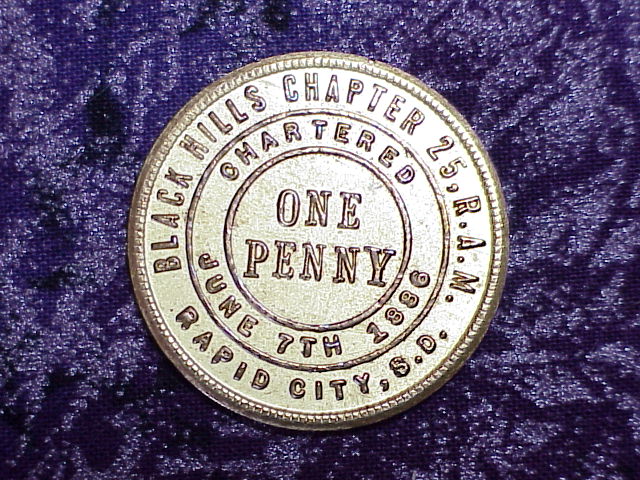
Participation in Freemasonry is indicated by the issuance to members of what is referenced as a Masonic chapter "penny" or "mark" (or mark penny, as the pieces are often called by specialists).
These pieces are considered by collectors to be tokens and are collectible, since at least once side of each chapter penny is unique despite the use, in some instances, of stock dies. Not all lodges have issued chapter pennies, instead preferring to use a token substitute of some sort.
Chapter pennies can often be found among the offerings of token and medal dealers at coin shows, in their fixed-price lists, over online dealer and auction sites, and through the classified advertisements in
Coin World.
E.A. King notes in the 1926 inaugural edition of his reference Masonic Chapter Pennies that the chapter penny represents "a sacred token of the rites of friendship and brotherly love."
King published a second, more comprehensive edition of the book in 1930. Quarterman Publications in Massachusetts published reprints of Masonic Chapter Pennies in 1972 and 1982.
King writes that today's scarcity of Masonic pennies is primarily attributed to members highly valuing them and refusing to part with them during their lifetime.
King based his cataloging primarily on the collection of one Mason, Albert Hanauer, which was donated to the Museum of the House of the Temple, Washington, D.C., in 1925, more than two decades after Hanauer began the collection.
The museum purchased the collections of nine other collectors of Masonic chapter pennies to add to the museum's holdings. Chapters whose pennies or tokens were not yet represented were invited in 1925 to submit examples directly to the museum, according to King.
King's book remains the standard reference and has not been updated in the more than 80 years since the listings were compiled. King accounted for thousands of varieties, including variations in metal composition.
Tradition
The tradition of the mark penny appears to have arisen in the United States circa 1880, according to King.
Benno Loewy, a "worthy brother" in the Masonic order whose collection was one of nine acquired by the Washington, D.C., museum from which King compiled his catalog, wrote in a 1905 monograph, Bibliography of Masonic Medals and Badges: "It is only within a very short time that specially designed mark pennies have come into general use in the Royal Arch Chapters in the United States, elsewhere they are practically unknown."
Most Masonic pennies were copper or copper alloy, about the size of a U.S. large cent, which measures between 28 and 29 millimeters in diameter. Some, however, measure at least 36 millimeters in diameter, according to King.
Some tokens actually are large cents that have been counterstamped, which King acknowledges may have been the result of lodges he visited around the country hastily preparing a makeshift token when no others officially existed.
King also describes and illustrates chapter penny tokens in silver, German silver, aluminum, brass, bronze, white metal and nickel.
Not all the tokens are "pennies," either. King notes that designations of "shekel" or "half shekel" became increasingly popular in the 1920s and 1930s with examples known in the same compositions as the chapter pennies.
Many chapters used stock dies, according to King, who noted "the idea of sameness that runs through the series." In many instances, chapter identification is inscribed around one penny at the center on one side, and on the other side, the letters htwsstks arranged in a circle around a keystone.
"These letters are supposed to represent the 'mark' of our Ancient Grand Master," King writes.
King biblically references a mysterious stone, citing Revelation 2:17, "To him that overcometh will I give to eat of the hidden manna, and will give him a white stone, and in the stone a new name written, which no man knoweth saving he that receiveth it."
Builder's tools, like those used by stone mason, are often incorporated with the design.
The photographic plates in King's reference show that not all the chapter pennies are of this basic design.
Some exhibit portraits of famous Americans or noted structures, including the U.S. Capitol.
Not all of the chapter pennies are round, either. Some examples are in the shape of a keystone or exhibit scalloped edges. Some chapters even opted to use, instead of struck tokens, British pennies and Canadian large cents.
Commonly, a member's initials, his full name, or other mark was chiseled into one side of each of the tokens, regardless of country of origin.
Most chapters include a town name, but some just included the lodge number, according to King's catalog.
Each state of the Union has a Grand Lodge that is in charge of local lodges, since there is no National Grand Lodge, as in some other countries.










 Posted 12/10/2008 11:56 am


 Hopefully this will give you a bit more info to go on and at least a starting point for gathering more info.



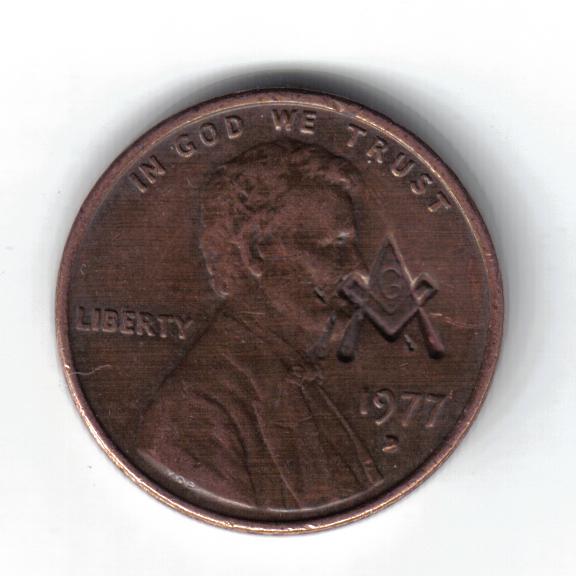 USCent1977DMasonicsymbolobv.jpg


