| Author |
 Replies: 30 / Views: 2,766 Replies: 30 / Views: 2,766 |
|
Pillar of the Community
United States
1429 Posts |
Just purchased these in what I believe is a very good deal based on comparables - $78 for both, including shipping. - your views are welcome.1896-MO AB PCGS AU-58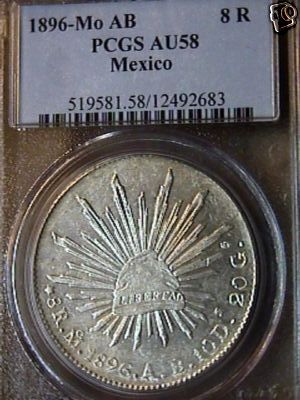 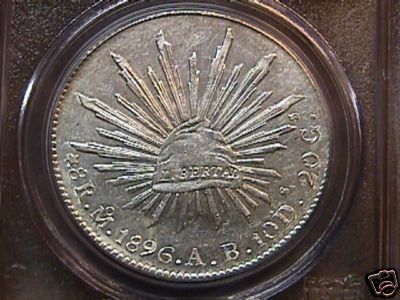 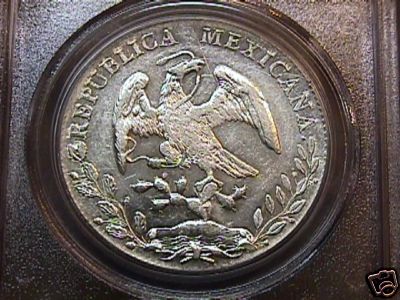 1896-ZS FZ 8 Reales PCGS AU-58 1896-ZS FZ 8 Reales PCGS AU-58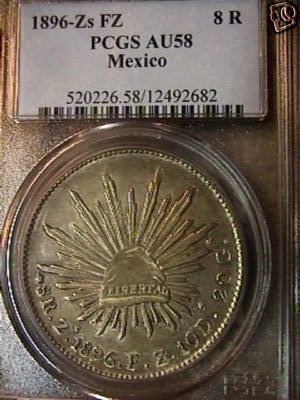 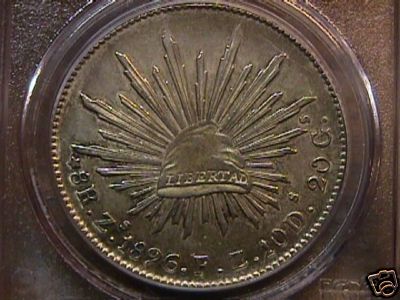 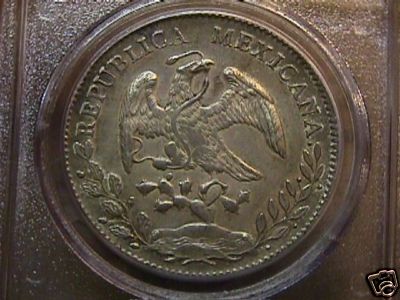
|
|
|
|
Pillar of the Community
United States
3499 Posts |
A very nice pair of coins! Since these both go for about $60 in unc. I think that you got a good deal.
So what has possessed you to venture into cap and rays 8s? Was it just the exposure of Colonial 8s that made you want to further expand your horizons? That is exactly what happened with me. haha
|
|
Pillar of the Community
 United States
1429 Posts |
Impulse purchase (again!). I am offloading many of my other coins on ebay and purchase fewer, higher grade coins. My primary focus is the Taler collection, along with your new influence on my collection appetite. Thanks again. |
|
Pillar of the Community
United States
3499 Posts |
ah, got ya'. Well, I'm just glad to help others appreciate these great coins.
|
|
Pillar of the Community
United States
5362 Posts |
Those are nice. You have two standardized late Republican Trade dollars. Next you need to get some of the early Republican NON standardized die coins. They are even more FUN. |
|
Pillar of the Community
United States
3499 Posts |
swamperbob- Nonstandardized you say? I know that there was some definite variation of the eagles and cap designs. How else were earlier coins not standardized?
|
|
Pillar of the Community
United States
5362 Posts |
Shortly after the 8 Reales coin was re-introduced after the failed attempt at issuing decimal Pesos, the Mexican Government decided to STANDARDIZE the designs used on the 8R. By 1887 all branch mints were using essentially identical dies hubbed from masters produced at the Mexico City mint facility. These late Republican 8Rs were really trade coins meant for overseas export. The Chinese merchants did not like the Pesos. That is what doomed the balance scale series - they were simply unpopular like the US Trade dollars. So in order to get the revenue generated by overseas sale of silver bullion, Mexico went back to the old accepted design. Part of the fun of collecting coins is to learn about the historical causes that produced them. There are periods of silver shortage caused by economic difficulties - these resulted in alternative coinage - tokens and counterfeits. When there is a glut of coinage - counterfeiting slowed. The silver bullion produced by the Mexican mines was a blessing and a curse at the beginning. Shipment of bullion was difficult so Mexico came up with a novel solution - Private mine branch mints. many were run by the local state governments which is why there is no consistency. But others were in private (including American) hands. These earlier mints used dies often of their own design. The central government required the use of the Aztec (Eagle holding snake) design but exactly what that design looked like was up to the operator. That is part of what makes the series so darned interesting. Mints were LEASED to private corporations or operators. These private entities made their own dies. Sometimes like during the 1830s in Durango the dies were shipped in. The hubs for Durango starting in 1832 were made in FRANCE. The eagle is very distinct in design in that case, never adopted by any other mint. Each mint had it's own eagle design at the outset. If you know your eagles you do not have to look for a mint mark. Here are a few of the early eagles used by mints operating in the 1830s. There are MANY more but this is a start. Image:  DO1832to1842.jpg DO1832to1842.jpg33.98 KB Image: GA1825to1845.jpg38.46 KB Image: GO1830to1843.jpg41.35 KB Image: MO1824to1847.jpg41.62 KB Image: PI1827to1839.jpg47.01 KB Image: ZS1825to1842.jpg46.04 KB |
|
Pillar of the Community
United States
3363 Posts |
All (but especially Swamperbob): I just finished rereading Stegner's "Angle of Repose", a fictionalized story which is mostly about mining. You might enjoy it for its settings and history. Reading this string brought to mind an account on an attempt to reopen the Michoacan mine in the late 19th century. The principal character is always a little late for the main strikes, whether in Mexico, New Almaden, Colorado or Grass Valley. A sad, reflective story of life just after the Gold Rush, told through the eyes of the grandson.
"Two minutes ago I would have sold my chances for a tired dime." Fred Astaire
|
|
Pillar of the Community
United States
3499 Posts |
swamperbob- Very interesting! Thanks! That would explain the variation in the eagles. Was it not also the case that there was variation in the Cap and Rays design, such as how the word "Libertad" appeared?
|
|
Pillar of the Community
United States
5362 Posts |
The word LIBERTAD was totally different on the Profile eagle series and it was written in script across the central part of the cap. There were varieties based on size and slope of the word. However, it wore off very quickly and on weaker strikes did not appear even on MS coins. So it was relocated to the lower cap margin at the start of the facing eagle series 1824. They adopted a simple all capital font which was used on all of the 8Rs after 1824. The variation in the shape of the caps and the word LIBERTAD after that point are far more subtle. The one exception would be the Sonora Cap but that one is rare. There are flat bottom caps, small and large opening caps and curly caps but all of the variation really falls into the "minor" category.
There are far more variations in the Ray psoitioning. In the early days before they introduced King die punches with the complete Cap and Rays - you find far more variation. In fact, I have a very early dated 8R original with the incorrect number of rays. That is a rare one die error. The number of rays was a specified part of the overall matrix and normally does NOT vary.
On the early dies, say before 1830 to 1832 (prior to the eagles I used for my examples,) you have dies at all mints on which each element is punched more or less individually. You can find an astounding number of varieties. In fact, no one has ever catelogued the variations. Each die was unique. The ray tips change direction - the number of lines per ray varies. The length of the side bars on the rays vary and of course the angle of individual rays changes.
Some of my favorite varieties involve recut rays - especially when they are cut out of alignment.
I will post a picture of one spectacular variety later if I can locate it.
|
|
Pillar of the Community
United States
3499 Posts |
swamperbob- great info! I would love to see the picture of the variety.
|
|
Pillar of the Community
United States
1429 Posts |
Gents - now you really got me in trouble :) I have subscribed to this link and await some more insights. Thanks,
|
|
Pillar of the Community
United States
1429 Posts |
What would be a fair price for the below?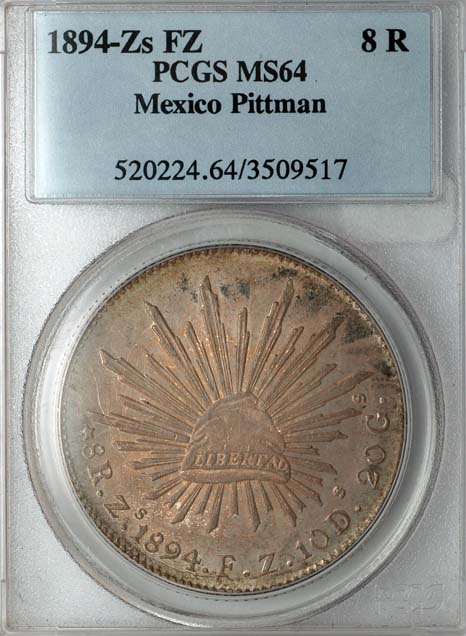 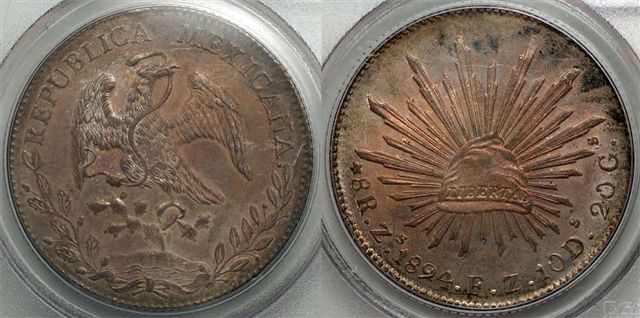
|
|
Pillar of the Community
United States
3499 Posts |
Zohar444-hmm I'm kind of surprised that a coin with that much toning and the dark spots on the Cap and Rays side would get a 64 by a company as strict as PCGS. But it certainly is Uncirculated. I would say that a fair price would be around $60-70, but since this coin is rather well struck, it may go for a few dollars more.
|
|
Pillar of the Community
United States
1429 Posts |
|
|
Pillar of the Community
United States
3499 Posts |
Zohar444- well, the 1868 in the auction is actually a better date than the 1894. In all honesty, most dates from the 1880s and 1890s do not go for very high prices since they had high mintages and many seem to still be in better grades. In fact, I remember about 5 years ago picking up a few common dates from the 1880s and 1890s in EF and AU for $10-12. I actually picked up an 1896 M in AU (but a bit of a weak strike) for $15 last spring. Since the 1894 books for around $60-65 in unc, I guess the value may be more around $70-75 for a well struck example.
|
| |
Replies: 30 / Views: 2,766 |








 Posted 12/10/2008 11:43 pm


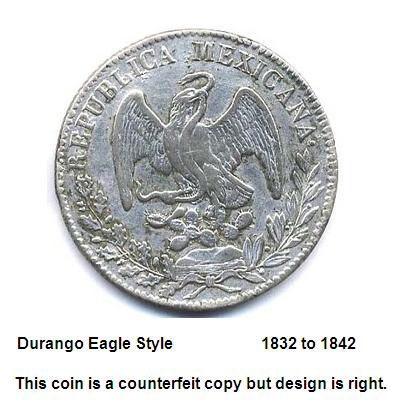 DO1832to1842.jpg
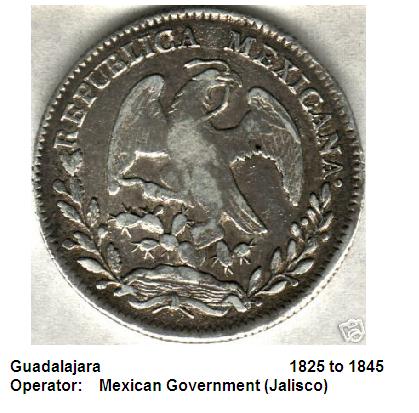 GA1825to1845.jpg
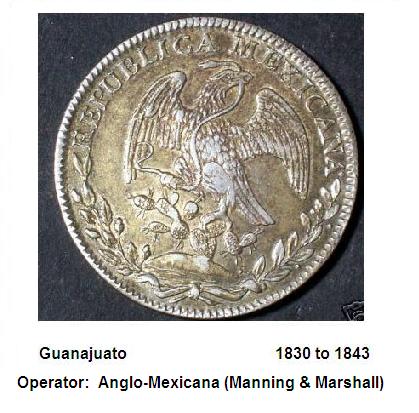 GO1830to1843.jpg
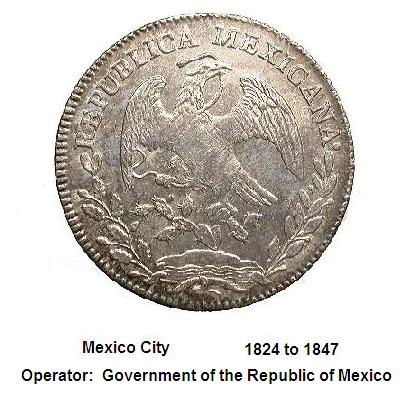 MO1824to1847.jpg
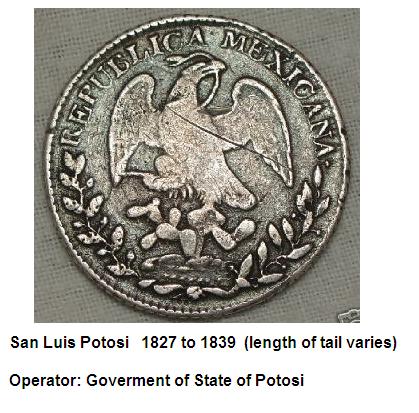 PI1827to1839.jpg
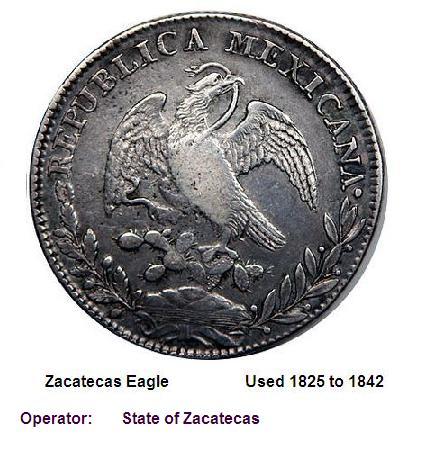 ZS1825to1842.jpg


