| Author |
 Replies: 10 / Views: 3,323 Replies: 10 / Views: 3,323 |
|
|
New Member
Canada
1 Posts |
|
|
|
|
Moderator
 United States
56855 Posts |
|
|
Pillar of the Community
 Canada
9902 Posts |
The second image is upside down.
If someone can translate the inscription below the Canada Pavilion you may find the source of this medallion.
For items like this rarity is not necessarily connected to value, as with all numismatic items value is a function of supply and demand.
"Dipping" is not considered cleaning...
-from PCGS website
|
|
Pillar of the Community
United States
6514 Posts |
Welcome to the Forum. You've come to a phenomenal place to share and learn. Enjoy!
|
|
Moderator
United States
194816 Posts |
 to the Community! |
|
Valued Member
Canada
113 Posts |
The text under the pavilion appears to be Katakana (Japanese).
The second line (in the brackets) reads: ka-na-da (Canada).
The first line is too hard to read due to the poor scan, but appears to be: mo-n-to-ri-?-?-ru (Montreal?).
Jan
|
|
CCF Master Historian of Commemorative Coins
United States
12511 Posts |
I "needed" to see the piece in the correct orientation! 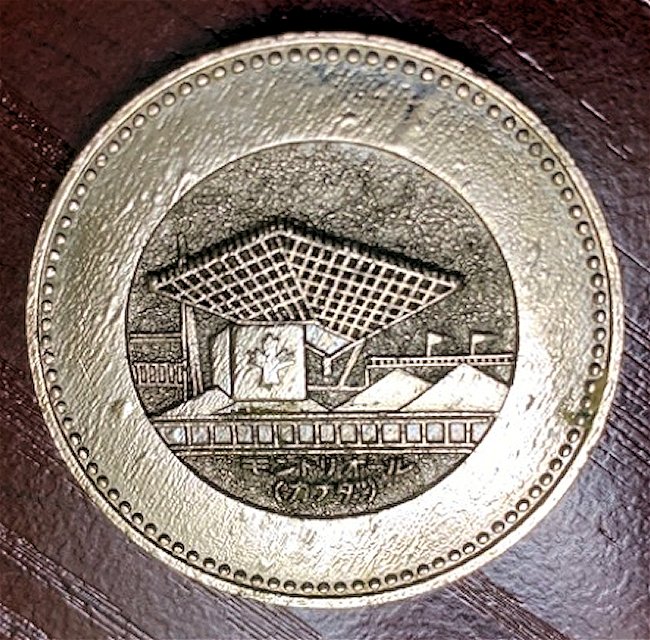 From what I can tell, the medal depicts the Canadian Pavilion at Expo 67. Collecting history one coin or medal at a time! (c) commems. All rights reserved.
|
|
Pillar of the Community
United States
4431 Posts |
to the CCF The word "rare" is a vague adjective that's far too often used to exaggerate financial value. One might better ask if anyone's seen a specimen, knows the mintage, has seen one sell, can find any history on the item .... specifics. IMHO, it's always best for a collector to see what can be learned about a piece, first. Then, pass along the knowledge when ready to part with it and let the marketplace gauge its worth in dollars and cents. As to the subject piece, I've not before seen one; this, in my sixty years of collecting. Then too, I'm stateside and don't collect this genre. Chances are, there's a CCF member who can provide some research insight. With coins, financial values tend to be far more stabilized than with exonumia, tokens and medals, etc. In my area of interest, 19th century American merchant tokens, I've witnessed pieces sell for $700 at auction that I'd not pay $50 for. If two people want a "rare" (not easily found) item, the sky's the limit when it comes down to cost. I recently bought a damaged (counterstamped) Indian cent for 300 times what the average coin dealer would pay. In other words, intrinsic or extrinsic value evolves from knowledge and desirability which can vary greatly from one person to another.  Edited by ExoGuy
01/11/2021 10:07 am
|
|
New Member
United States
1 Posts |
Sorry I'm late to the discussion here, I just saw this article and can shed some light on the medal in discussion for the OP and for future readers looking for information on the medal.
I acquired mine in a set of 5 medallions inside a plastic case with foam I believe behind them some 20 years ago. It came directly from China off some website that I ran down a rabbit hole and found this set. It was priced more than I thought it was worth considering the quality isn't flattering by any means.
One other piece in the set had a Expo 70 medal in it and a few other unknown medals that I couldn't read the writing what they said.
It is not a common medallion by any means. Having been collecting Expo 67 and Canada's Centennial exonumia since 1992, this is the 2nd piece that I have seen.
Great find!
|
|
Moderator
United States
194816 Posts |
to the Community, CCCC67! |
|
Bedrock of the Community
Canada
24885 Posts |
To the Forum. |
| |
Replies: 10 / Views: 3,323 |
|










 Posted 01/07/2021 3:18 pm


