Coin Community Family of Web Sites Join Thousands of Coin, Bullion, & Money Collectors
Specializing in Modern Numismatics Join Thousands of Coin, Bullion, & Money Collectors Coin, Banknote and Medal Collectors's Online Mall Shop for APMEX Bullion on eBay!Royal Canadian Mint products, Canadian, Polish, American, and world coins and banknotes. Vancouvers #1 Coin and Paper Money Dealer 300,000 items to help build your collection!


Username:
Password:
Save Password
Forgot your Password?


This page may contain links that result in small commissions to keep this free site up and running.

Welcome Guest! Registering and/or logging in will remove the anchor (bottom) ads. It's Free!

Troas, Birytis - Kabeiros And Club

To participate in the forum you must log in or register.
Author Previous TopicReplies: 5 / Views: 2,676Next Topic  
Pillar of the Community
Learn More...
Novicius's Avatar
United Kingdom
1168 Posts
 Posted 02/08/2021  1:14 pm Show Profile   Bookmark this topic Add Novicius to your friends list Get a Link to this Message Number of Subscribers
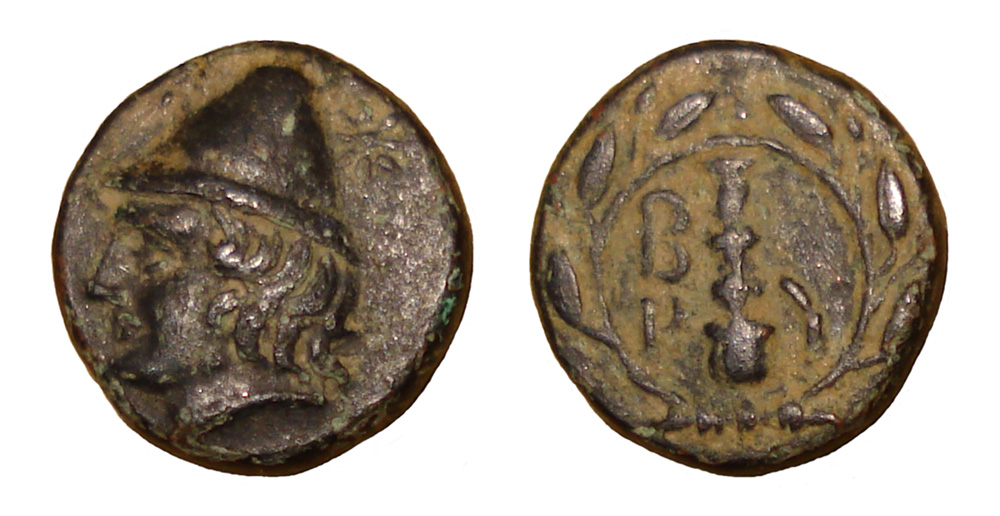
I found this coin with the head of Kabeiros wearing a conical pilos (pileus) to be of interest, as he was a protector of sailors. The pilos was a brimless, felt cap worn by sailors in ancient Greece, and later copied by ancient Rome. The cap became emblematic of liberty and freedom from bondage. During the classic revival of the 18th and 19th centuries it was widely confused with the Phrygian cap, which appeared frequently on statuary and heraldic devices as a "liberty cap."

The coin is full of mystery, from the history of Birytis, to the cult of the Cabeiri. In Greek mythology, the Cabeiri, were a group of enigmatic chthonic deities. They were worshipped in a mystery cult closely associated with that of Hephaestus. The Cabeiri were given a mythic genealogy as sons of Hephaestus.
Troas,-Birytis---Kabeiros-And-Club
I could find very little information about Birytis apart from the text below, and the site is tentatively located near Mersinoba, Asiatic Turkey.

From "The Hellenistic Settlements in Europe, the Islands, and Asia Minor" By Getzel M. Cohen:

The discovery and identification of the Cal Dag as the site of Kebren was made by F. Calvert, who published his findings in Arch. Journal 22 (1865). According to Calvert, of seventy-one coins found at the site and immediate vicinity, twenty-five were of Kebren.

Imhoof-Blumer suggested that Kebren was renamed Antioch, and noting the appearance of the letters B and K on the reverse of some coins, Robert hypothesized that they referred to Birytis and Kebren. The conclusion being that Kebren and Birytis were united in a sympoliteia or synoecism, and together were included in the new Antioch.

Cook noted that Strabo explicitly only mentions Kebren and Skepsis in the original synecism of Antigonei, but suggested that some of Strabo's discussions implied that other towns were also included in Antigoneia. Since Strabo explictely lists Skepsis as one of the towns involved, and since it was still independent in 311/0 BC, Antigoneia could not have been founded before that date. Although there is no supporting evidence, Robert suggests that Birytis was also included in the synoecism. Cook on the basis of the evidence of bronze coins of Birytis, which were probably minted after the end of the fourth century, ie., after the synoecism, rejected this view.

As for the location of Antioch, Cook surmised it was a settlement of exiles at a distance from their old home. He noted the absence of Antioch coins from the Cal Dag and in fact from the Troad. Cook suggested that a dedication of Roman date from the vicinity of Kyzikos to Dionysos Kebrenios might "offer a clue" to the location of Antioch. I. Robert, BCH 106 (1892) suggested that Antioch may have been centred at Birytis rather than at Kebren, however the location of Birytis is not secure. I. Robert has argued it was close to Kebren, but Cook would look for it "in the northwest Troad in the close vicinity of Ilion." (Ilion being the Archaic name for the pre-classical city of Troy, hence the title of Homer's Iliad.)

From "An Inventory Of Archaic And Classical Poleis." Edited by Mogens Herman Hansen and Thomas Heine Nielsen.:

Birytis is shown on Map 56 of the Barrington Atlas, but this location, at Mersinoba (Cook 1973), is not beyond doubt. The city is recorded in the Athenian tribute lists, but late 4th century coins have the form ΒΙΡΥ. No Archaic or Classical source calls Berytis a polis, and the retrospective mentions in Steph. Byz. do not indicate a source. However, the community issued its own coinage in the late 4th century BC. The external collective city-ethnic is recorded in the Athenian tribute lists, and the internal by coins of the 4th and 3rd centuries BC.

Birytis was a member of the Delian League. It presumably belonged to the Hellespontine district, and is recorded from 454/3 to 446/5 BC a total of six times, once completely restored, paying a phoros of 1,000dr. It was assessed for tribute in 425/4 BC. However, it is not completely certain that the Berysioi are to be identified as the inhabitants of the polis mentioned by Steph. Byz.

Birytis struck coins of silver and bronze in the late 4th century to the early 3rd century. Silver:obv. head of Herakles; rev. head of beardless Kabeiros wearing pilos between two stars. Bronze:obv. head of beardless Kabeiros wearing pilos; rev. club, or triskeles; legend: ΒΙΡΥ; L. Robert (1951) 25-31, SNG Cop. Troas 247-53).

Wildwinds only shows seven varieties of bronze coins, and one of silver.
Troas,-Birytis---Kabeiros-And-Club
Troas - Birytis. c. 300 BC.
Obverse: Head of Kabeiros left, wearing pileus. Reverse: Club, B-I / P-Y, all enclosed in wreath. Bronze. Diameter: 11 mm. Weight: 1.2 gr.
Reference: BMC 7-8; SNG Copenhagen 250

Moderator
Learn More...
echizento's Avatar
United States
23731 Posts
 Posted 02/08/2021  2:44 pm  Show Profile   Bookmark this reply Add echizento to your friends list Get a Link to this Reply
Interesting coin and excellent writeup.
Pillar of the Community
Kamnaskires's Avatar
United States
7066 Posts
 Posted 02/08/2021  5:30 pm  Show Profile   Bookmark this reply Add Kamnaskires to your friends list Get a Link to this Reply
The original coneheads. Great post and coin. Thanks for sharing.
Pillar of the Community
Learn More...
Novicius's Avatar
United Kingdom
1168 Posts
 Posted 02/09/2021  1:03 pm  Show Profile   Bookmark this reply Add Novicius to your friends list Get a Link to this Reply
Thanks for the comments, guys.

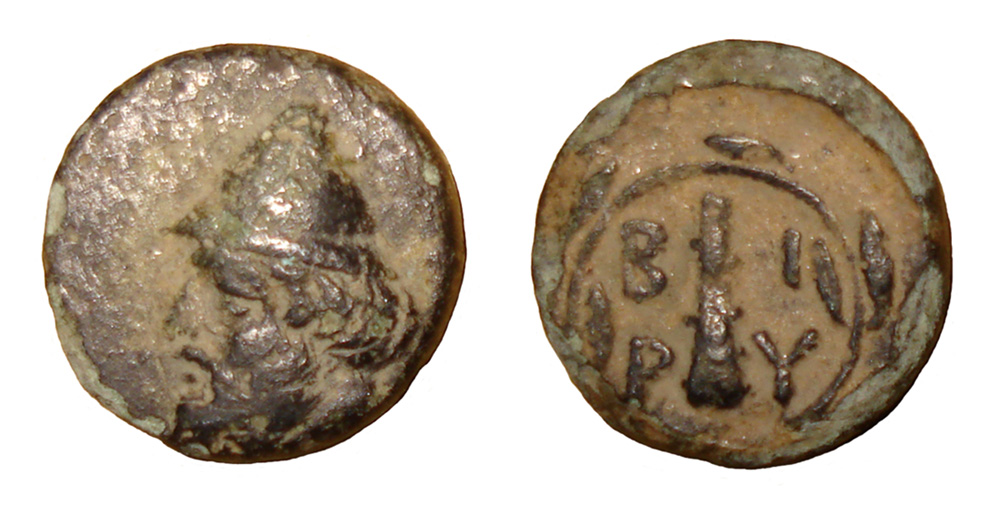
The original coin posted is the one without stars, so here is the version with stars.

The worship of the Cabeiri was centred in the north Aegean islands of Lemnos and possibly Samothrace, at the Samothrace temple complex, and at Thebes. In their origins the Cabeiri and the Samothracian gods may include pre-Greek Hittite, Thracian, proto-Etruscan, or Phrygian elements. The Lemnian cult was always local to Lemnos, but the Samothracian mystery cult spread rapidly throughout the Greek world during the Hellenistic period, eventually into Roman belief.

Robert Beekes believes that they are of non-Indo-European, pre-Greek origin. The Cabeiri were possibly originally Phrygian deities.

Ancient sources disagreed about whether the deities of Samothrace were Cabeiri or not, and the two cults do differ in detail. The two islands are close to each other though at the northern end of the Aegean, and the cults are at least similar, and neither fits easily into the Olympic pantheon. The accounts of the Samothracian gods, whose names were secret, vary in the number and sexes of the gods, but usually between two and four, some of either sex. The number of Cabeiri also varied, with some accounts citing four of them (often a pair of males and a pair of females), and some even more, such as a tribe or whole race of Cabeiri, often presented as all male. The Cabeiri were also worshipped at other sites in the vicinity, including Seuthopolis in Thrace, and various sites in Asia Minor .
Troas,-Birytis---Kabeiros-And-Club
Troas, Birytis. c. 300 BC
Obverse: Head of Kabeiros left, wearing pileus, no beard, stars to left and right. Reverse: Club, B-I / P-Y, all enclosed in wreath. Bronze. Diameter: 11 mm. Weight: 1.5 gr
SNG Copenhagen 247-249; Sear #: 4057
Valued Member
micha's Avatar
Cyprus
385 Posts
 Posted 02/09/2021  4:26 pm  Show Profile   Bookmark this reply Add micha to your friends list Get a Link to this Reply
Great article!
Kabiria (Καβε#943;ρια) mysteries was a great part of the lost knowledge of the mysteries of the ancient world.
There is another interesting coin from Birytis, Kabeiros and Triskeles.
Well done Novicius!
Pillar of the Community
Learn More...
Novicius's Avatar
United Kingdom
1168 Posts
 Posted 02/09/2021  7:31 pm  Show Profile   Bookmark this reply Add Novicius to your friends list Get a Link to this Reply

Quote:
There is another interesting coin from Birytis, Kabeiros and Triskeles.

Thanks Micha. I'd like to add one with the Triskeles to the collection, but haven't seen one recently, at least one I could afford.
  Previous TopicReplies: 5 / Views: 2,676Next Topic  

To participate in the forum you must log in or register.


Disclaimer: While a tremendous amount of effort goes into ensuring the accuracy of the information contained in this site, Coin Community assumes no liability for errors. Copyright 2005 - 2026 Coin Community Family- all rights reserved worldwide. Use of any images or content on this website without prior written permission of Coin Community or the original lender is strictly prohibited.
Contact Us  |  Advertise Here  |  Privacy Policy / Terms of Use

Coin Community Forum © 2005 - 2026 Coin Community Forums
It took 0.24 seconds to rattle this change. Forums