There are only five coins from Astyra listed in Wildwinds, with four being struck under satrap Tissaphernes, ca. 400-395 BC. The location of Astyra is a different matter though. One reference states that Astyra, also known as Astyrum or Astyron, perhaps also Andeira, was a small town of ancient Aeolis and of Mysia, in the Plain of Thebe, between Antandrus and Adramyttium. In "A Classical Dictionary, Containing a Copious Account of All the Proper Names", by John Lemprière, it merely states; Astyra or Astyrum is a city of Mysia near Troas.
Strabo calls it a hamlet, near which is a grove of Diana, thence named Astyrena, but another reference says Astyra had a temple of Artemis, of which the Antandrii had the superintendence. Artemis had hence the name of Astyrene or Astirene. There was a lake Sapra near Astyra, which communicated with the sea. Pausanias, from his own observations, describes a spring of black water at Astyra and that the water was hot, but he places Astyra in the territory of Atarneus. There was, then, either a place in Atarneus called Astyra, with warm springs, or Pausanias has made some mistake; for there is no doubt about the position of the Astyra of Strabo and Pomponius Mela. Astyra was a deserted place, according to Plinys authorities and he calls it Astyre.
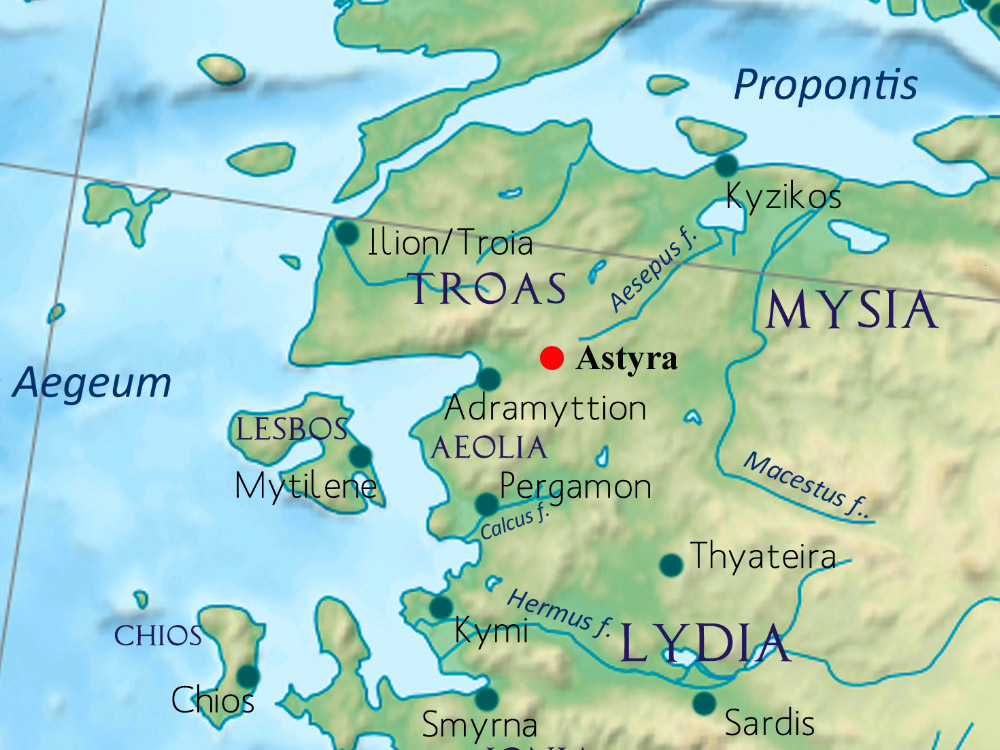
It's site is tentatively located near Buyuk Çal Tepe, Asiatic Turkey. Initial Provenance: Barrington Atlas: BAtlas 56 E2 Astyra?/Andeira?
TissaphernesHis father's name has not been recorded, but Tissaphernes' grandfather was the Hydarnes who had commanded the elite corps of the Immortals during Xerxes' ill-fated campaign against Greece. Hydarnes' father, who was also called Hydarnes, had been one of the seven conspirators who killed the usurper Gaumâta and helped Darius the Great become king in 522 BC. Tissaphernes belonged, therefore, to the highest Persian nobility.
Lydia and Caria were in a state of turmoil due to the revolt by the former satrap, Pissuthnes, against king Darius II Nothus. Tissaphernes incited a rebellion among Pissuthnes' Greek mercenaries and managed to have him arrested. As a reward, Tissaphernes was made satrap c. 415 BC. During the Peloponnesian War (427-404 BC) Tissaphernes strategy was to keep the two warring Greek states in balance. After agreeing to to send the Persian-Phoenician navy to assist the Spartans, Tissaphernes later refused, thus making Sparta an enemy. This strategy was not appreciated by King Darius and Queen Parysatis, who made their second son Cyrus the Younger, satrap of Lydia and Cappadocia. He was to pursue an unconditional pro-Spartan policy. Tissaphernes remained satrap of Caria.
In April 404 BC King Darius died, and Artaxerxes II Mnemon (404-358 BC) was inaugurated at Pasargadae. Cyrus decided to revolt, and In 401 BC his army was ready. Meanwhile, Tissaphernes had joined his king. During the battle at Cunaxa (north of Babylon), he played an important role and although Cyrus' Greek mercenaries were victorious, the usurper was killed. As a reward for saving Artaxerxes' throne, Tissaphernes was allowed to marry the king's daughter and reappointed as satrap of Lydia in 400 BC. During the next years, Tissaphernes was occupied with a war against the Spartans, who had invaded Asia to liberate the Greek towns that they had once negotiated away. The first of their attacks was commanded by Thibron, who marched along the coast until he reached Ephesus (399 BC). The aim of this campaign was to force Tissaphernes to open negotiations. He refused, and Thibron was recalled and replaced by Dercylidas. Tissaphernes then united with the satrap of Hellespontine Phrygia, Pharnabazus, and they concluded a truce with the Spartan army in 397 BC. However, the Persian king double-crossed the peace talks, and the Spartan King Agesilaus, decisively beat Tissaphernes in the neighborhood of Sardes in 395 BC.
Tissaphernes received an invitation from a courtier named Tithraustes, who asked him to come to a town named Colossae. Here, Tissaphernes was killed. It may have been that king Artaxerxes had wanted to pardon him, but queen-mother Parysatis had persuaded him to execute the man who had destroyed her son Cyrus.
Tissaphernes was one of the most loyal servants of the Persian king, a true nobleman. However, during his service, he made two enemies: Sparta and Parysatis. Ultimately, they overcame him and the king did nothing to protect the man to whom he owed his throne.
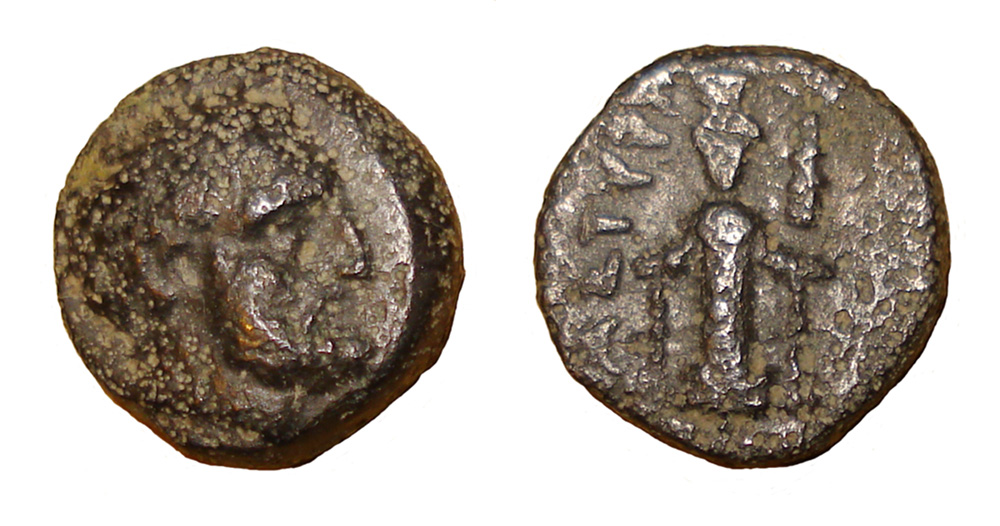
Mysia, Astyra, Tissaphernes, 400 - 395 BC.
obverse: Head of Tissaphernes right. Obverse: ΑΣΤΥΡΗ. Cultus statue of Artemis Astyra facing; club to upper right. Bronze. Diameter 11 mm. Weight: 2.0 gr.
Klein 253.
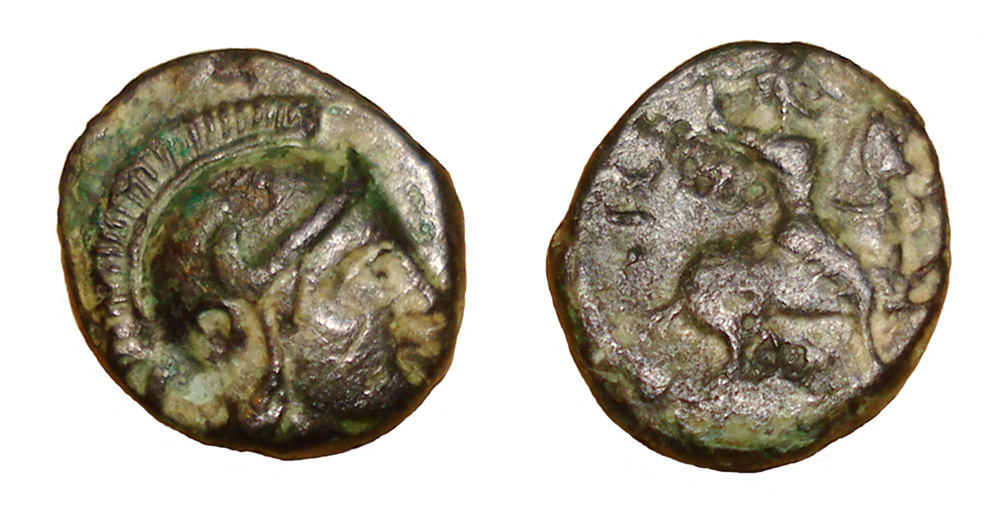
MYSIA, Astyra, Tissaphernes, 400 - 395 BC.
Obverse: Helmeted head of Athena right. Reverse: ΤΙΣΣΑ. Tissaphernes on horseback right. Bronze. Diameter: 10 mm. Weight: 1.0 gr.
Klein 255. Rare.










 Posted 03/09/2021 8:54 pm


