



Coin Community Family of Web Sites Join Thousands of Coin, Bullion, & Money Collectors
Coin, Banknote and Medal Collectors's Online Mall Shop for APMEX Bullion on eBay!Vancouvers #1 Coin and Paper Money Dealer Royal Canadian Mint products, Canadian, Polish, American, and world coins and banknotes. Specializing in Modern Numismatics 300,000 items to help build your collection! Join Thousands of Coin, Bullion, & Money Collectors


Username:
Password:
Save Password
Forgot your Password?


This page may contain links that result in small commissions to keep this free site up and running.

Welcome Guest! Registering and/or logging in will remove the anchor (bottom) ads. It's Free!

Breton 1005, And Other Possible Upper Canadian Colonial Issues

To participate in the forum you must log in or register.
Author Previous TopicReplies: 4 / Views: 2,381Next Topic  
Valued Member
blargish's Avatar
United States
178 Posts
 Posted 03/12/2021  12:53 pm Show Profile   Bookmark this topic Add blargish to your friends list Get a Link to this Message Number of Subscribers
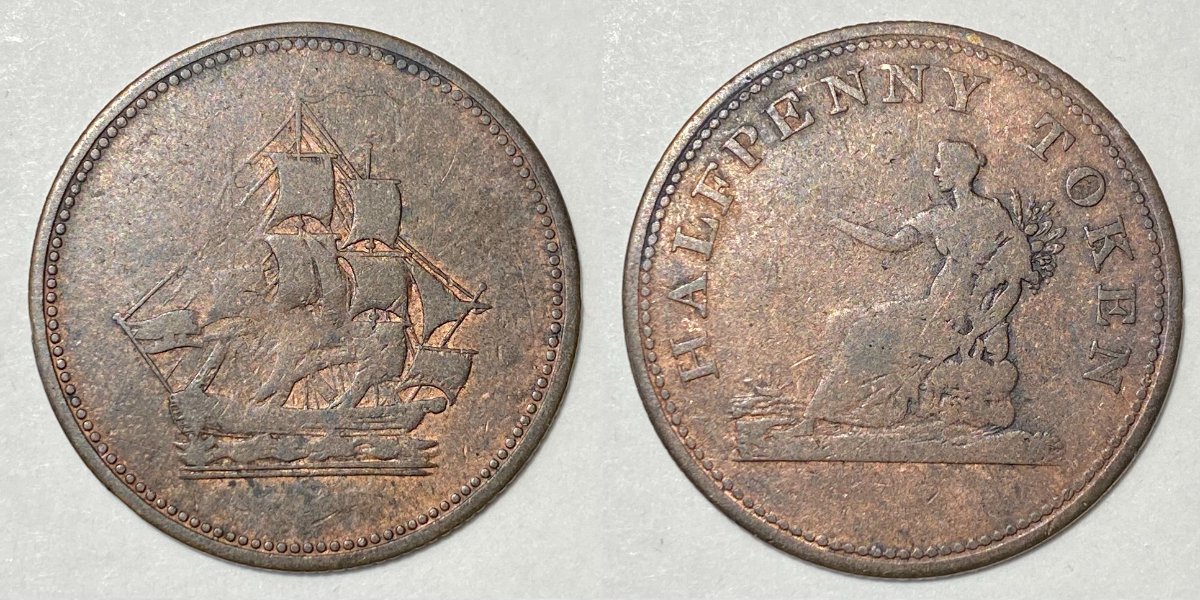
I was recently able to pick up an example of the enigmatic and undated Breton 1005. Unfortunately, it has been cleaned but hopefully it will retone with time. It is classified as Lower Canadian by Charlton, but I hope to share some interesting information about this token and others that appear to have been imported to Kingston, Ontario ca. 1816.

Br 1005. LC-56C1.
Breton-1005,-And-Other-Possible-Upper-Canadian-Colonial-Issues

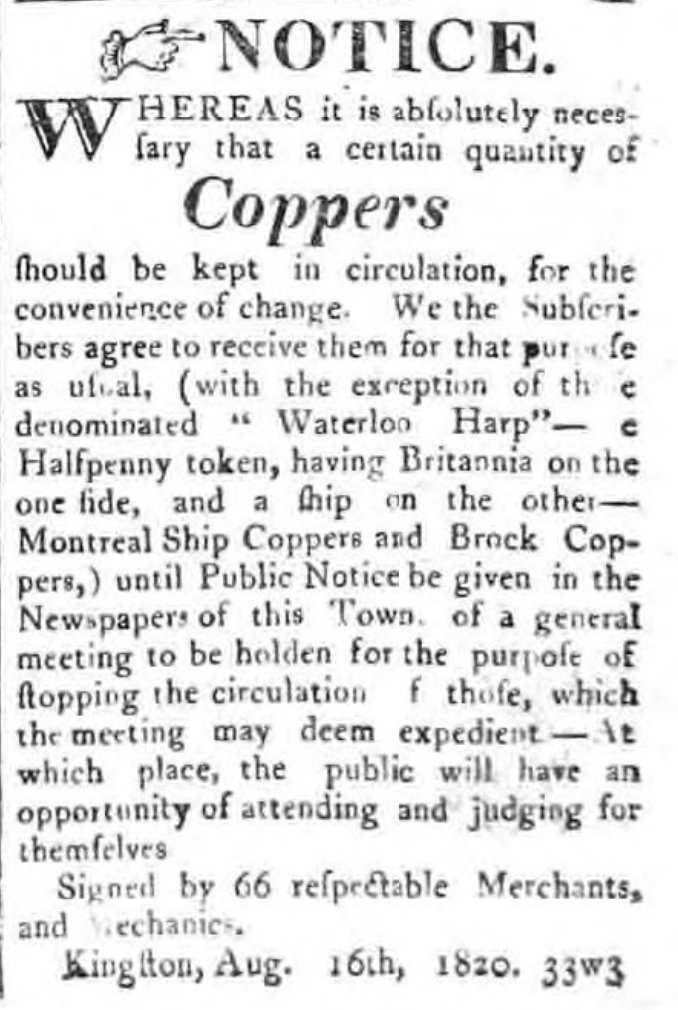
Below is a notice in the Kingston Chronicle from August 18 1820 that references Br 1005 ("a Halfpenny token, having Britannia on the one side and a ship on the other") along with other coppers that are to be barred from circulation on account of their light weight. These others comprise the well-known Upper Canadian Brock tokens, but also the "Waterloo Harp" (Breton 981, the Illustrious Wellington WE-10) and "Montreal Ship" (Breton 531, LC-12) tokens, which are not traditionally viewed as Upper Canadian issues. This newspaper notice was brought to light in Christopher Faulkner's Coins are Like Songs (2016).
Breton-1005,-And-Other-Possible-Upper-Canadian-Colonial-Issues

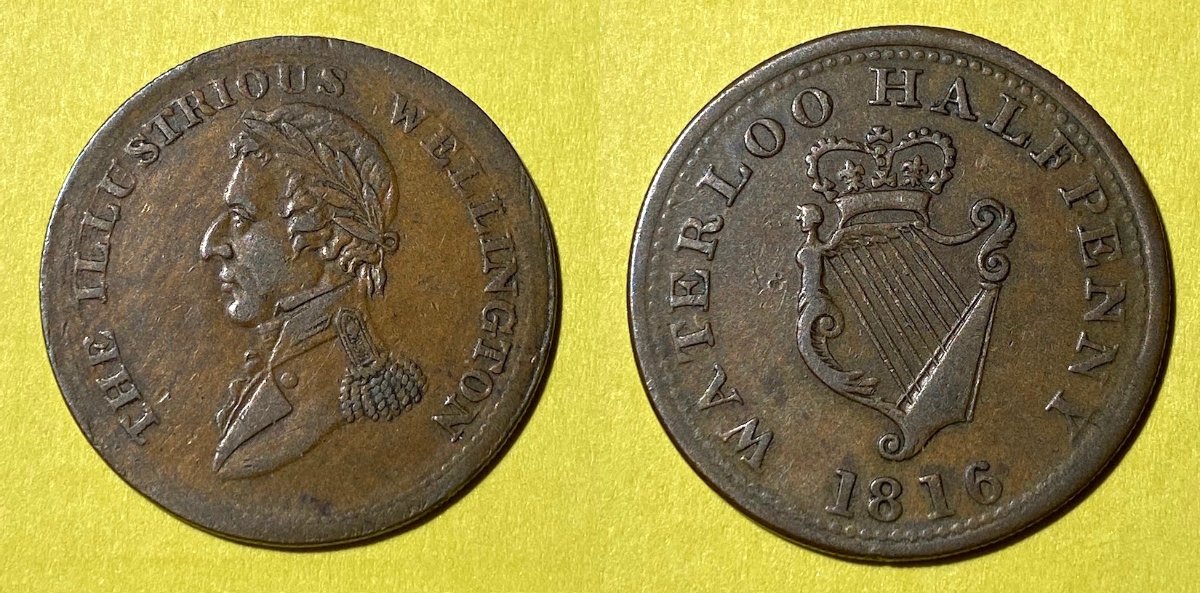
I have further noticed that, although struck on a smaller flan, the letter punches of Br 1005 match with those of the Illustrious Wellington token, Br 981 (notably the letter "H"), suggesting a common origin of manufacture. Although I do not own an example of Br 531 I believe this to be the case for that token as well. A notice in the July 15 1817 issue of the Kingston Gazette (also brought up in Coins are Like Songs) indicates an importation of "Waterloo" (ie. Br 981, WE-10) coppers from Sackets Harbour NY, indicating an American origin for all of these pieces. Furthermore, these issues (excepting Br 1005) are all dated 1816, and production may extend beyond Upper Canada, for example, the 1816-dated Nova Scotia pieces of W.A.S Black.

Br 981, WE-10A2
Breton-1005,-And-Other-Possible-Upper-Canadian-Colonial-Issues

What American-based mint may have been responsible I cannot say, but some these are some interesting and relatively recent insights into the colonial series that I am fascinated by and wanted to share.

Cheers!
Pillar of the Community
1960NYGiants's Avatar
United States
666 Posts
 Posted 03/12/2021  1:18 pm  Show Profile   Check 1960NYGiants's eBay Listings Bookmark this reply Add 1960NYGiants to your friends list Get a Link to this Reply
Nice write up. I think the 1816 dated pieces were antedated to avoid the 1820 law prohibiting issuance of the tokens.
LM of RCNA
Member of CATC
Valued Member
blargish's Avatar
United States
178 Posts
 Posted 03/12/2021  2:08 pm  Show Profile   Bookmark this reply Add blargish to your friends list Get a Link to this Reply
Thanks 1960NYGiants!

Regarding the "1820 Law", that cannot be the case for these issues (ie. the Wellington, Brocks, and Montreal token) as there are numerous articles in the Kingston Gazette referencing their abundant circulation as early as 1817!

Additionally, Faulkner notes that there does not appear to be any such 1820 law, at least nothing that has been found in legal records to date. This 1820 law has been referenced consistently in passing since the early 20th century. I believe it was invoked speculatively (by McLachlan?) to explain why the Bust and Harp tokens are antedated to this date from 1825. However, no other reference to the existence of this law has ever been brought forward since!

It really calls into question the timing of other series that are commonly believed to be antedated, such as the Sloops.
Pillar of the Community
Canada
1505 Posts
 Posted 03/12/2021  10:45 pm  Show Profile   Bookmark this reply Add purelywasted to your friends list Get a Link to this Reply
This might be of some interest

https://www.oldbaileyonline.org/static/Coinage.jsp

"Following the legal prohibition of most forms of trade tokens in 1817, and the collapse of many small provincial banks in the financial crisis of 1825 and 1826 (which helped to eliminate a wide range of competing forms of paper currency), British cash became more stable from the early 1830s."

There was a coinage act in 1816 in the UK. Maybe took a few years to hit the colonies?


This may be part of the mysterious source
https://archives.gnb.ca/exhibits/fo...ulture=en-CA

An Act, passed 29th March, 1820, appears to have established different values for some foreign coins, as indicated by another Act, passed in 1826, which repealed it. Unfortunately, the text of the 1820 Act is not available, and there is no further mention in the Acts of the General Assembly concerning currency, foreign or British, until 1835, when an Act was passed setting the value of "Spanish milled dollars, Mexican dollars, Peruvian dollars, Chilian dollars and the dollars of Central America," at 5 shillings each, and making them legal tender in the Province.
Edited by purelywasted
03/12/2021 10:48 pm
Valued Member
blargish's Avatar
United States
178 Posts
 Posted 03/16/2021  12:16 pm  Show Profile   Bookmark this reply Add blargish to your friends list Get a Link to this Reply
Thank you for those links purelywasted. I have not come across those before and they had some great information.

It appears that the latter Act is referring to an increase in the value of certain foreign coins rather than a ban on the importation of tokens. As for the former, I believe it wouldn't affect the importation of tokens into Canada, whether that be from the United States or Great Britain.
  Previous TopicReplies: 4 / Views: 2,381Next Topic  

To participate in the forum you must log in or register.


Disclaimer: While a tremendous amount of effort goes into ensuring the accuracy of the information contained in this site, Coin Community assumes no liability for errors. Copyright 2005 - 2026 Coin Community Family- all rights reserved worldwide. Use of any images or content on this website without prior written permission of Coin Community or the original lender is strictly prohibited.
Contact Us  |  Advertise Here  |  Privacy Policy / Terms of Use

Coin Community Forum © 2005 - 2026 Coin Community Forums
It took 0.26 seconds to rattle this change. Forums