Specific gravity is not all that hard. I learned how to do it as a Junior in High School. That was 47 years ago and I still remember how. Most decent mechanical scales can be adapted easily.
Digital scales are nice but NOT accurate enough. You can get by with a triple beam balance that weighs accurately to 1/100th of a gram but a Four Beam balance scale that weighs to 1/1000th of a gram is much better.
First you weigh the coin accurately to at least a 1/100 gram. That weight call W.
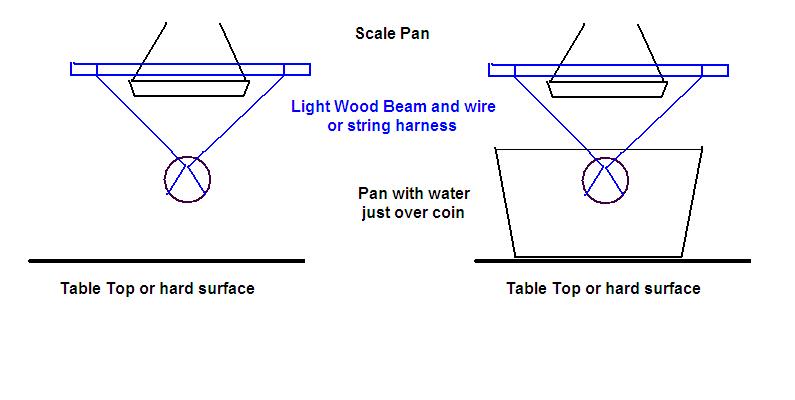
Next fashion a harness to hold the coin using a piece of wood or anything handy and wire or string. Position the scale on a box or anything handy so that the coin dangles freely from the harness. Then weigh the coin plus the harness in air. Call that W2.
Then take a pan of water (room temperature tap water is ok, distilled demineralized is better but not everyone has that ability). Add a drop or two of household detergent to the water to break surface tension. Then immerse the coin completely in the water. Take the weight now. That is W3.
The math is easy - the displacement of the coin is W2 minus W3. Water weighs 1 gram per cubic centimeter. So if the assembly is 2 grams lighter in water - the coin is 2 cubic centimeters.
The Specific Gravity is W divided by the displacement. W / (W2-W3)
There are refinements of course. If you use a wire basket you want to weigh that in water and air to correct for the effect. But to check to see if a coin is silver or copper that is ALL you need to do. Copper has an SG near 9 while coin silver is 10.3.
Now if the coin has no ring - you could have a lead based alloy with zinc which could be as dense as silver but for coins that ring SG is best.
Don't be put off by this test it is simple and it just requires practice.
Here is a sketch I made - hope it helps.
Image:  SpecificGravity.jpg
31.38 KB







 c6a7_1.jpg
 c819_1.jpg


 Posted 12/23/2008 9:34 pm




 )
) SpecificGravity.jpg


