| Author |
 Replies: 26 / Views: 3,842 Replies: 26 / Views: 3,842 |
|
|
|
Pillar of the Community
United States
4963 Posts |
Quote:it is lousy workmanship and terrible quality by the RCM, Lousy only in the sense that they're plated rather than pure metal. Quote:resulting in the appearance of PMD. This is PMD, not a mint error or sloppy plating. |
|
Pillar of the Community
 Canada
9902 Posts |
It's not a plating issue, it's damage.
I think Numisma explained it quite well.
This is not subjective like grading, opinions don't count.
"Dipping" is not considered cleaning...
-from PCGS website
|
|
Pillar of the Community
Canada
6244 Posts |
@DBM if you has the link of numisma article for this kind I will like to read. Theirs site is so ambiguate and hard to find something except some descriptions of coins. Maybe to big database. Now I will explain why it is PRE Striking default, not error coin or PMD. I open a new roll of 25 cents from mint to verify the reedling. It is convex. The explanation of coin is that the reedling is soft on touch and almost flat. I know the milling to day is double operation of milling and reedling. If the reedling rolls was at the end of life and the operator sleep, was change late. Second: the reedling has Ni on the highest part and no abrasive traces. eliminate the polishing after strike. photo attached: 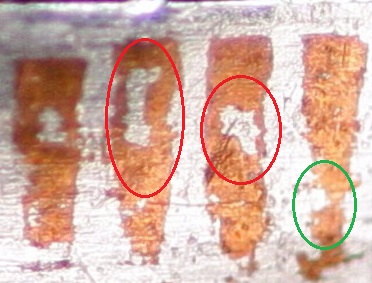 Third Third: The O and R of the coin show missing Ni on the low part of coin not only on the highest past=not happened before strike. Fourth: To take out the Ni you need acid which will attack also the Cu. Here the scientific explanation: Quote:
Nickel metal dissolves slowly in dilute sulphuric acid to form solutions containing the aquated Ni(II) ion together with hydrogen gas.
Copper metal dissolves in hot concentrated sulphuric acid to form solutions containing the aquated Cu(II) ion together with hydrogen gas, H2. ... Copper metal also dissolves in dilute or concentrated nitric acid, HNO3. I look at the default coins for the symptomatic prospectus of metallurgical and chemistry point of view. Grading, value, rarity and collecting desire you guys are the experts not me. If I am wrong with pleasure I will accept the reality. For me is interesting coin from the cheap production and quality control. But accept that is cos 3 or 4 cents to produce and put in the circulation. Edited by silviosi
04/02/2021 12:31 am
|
|
Pillar of the Community
United States
4963 Posts |
Quote:
the reedling has Ni on the highest part and no abrasive traces. eliminate the polishing after strike. I think that's where the copper layer is worn fully through and the inner layer of nickel (or steel- I don't remember whether it's steel-nickel-copper-nickel or just steel-copper-nickel) is showing. Quote:
The O and R of the coin show missing Ni on the low part of coin not only on the highest past I don't think it was abraded by a flat surface, but I'm only seeing the copper on local high points. Quote:
To take out the Ni you need acid which will attack also the Cu. I see no evidence of chemical corrosion, but the fine, parallel scratches indicate abrasion. I bet you could get nearly identical results with 220 grit sandpaper and a few minutes. |
|
Pillar of the Community
Canada
6244 Posts |
@Numisma. I like your point of view.
The coin is core steel-Ni-Cu-Ni. So if abrasive act after strike? why on the reedling parts you has in lower part those line? And how someone will be able to take out the Ni perfect circle near the rim? And how on O and R you has those missing Ni with irregular border. Even if you use 600 grit you will be not able to do those irregular border marks, abrasion leave almost strait marks.. My point of view.
|
|
Valued Member
Canada
127 Posts |
I have a nickel that looks the same as this Quarter.   |
|
Pillar of the Community
Canada
5644 Posts |
Yep, the outer nickel plating is wearing off.
|
|
Pillar of the Community
Canada
1187 Posts |
I have a quarter kind of like this, I assumed it was PMD so I never bothered to post it, but for those who might not know what multi-plated quarters looks like without the nickel layer, here is a good example. This was most likely done out of boredom and curiosity, I'm fairly convinced it never left the mint this way.   Finding and discovering modern Canadian doubled die varieties since 2018. 2023 Recent Publications: Modern Canadian Doubled Die Varieties - First Edition PDF & Paperback https://www.mcddv.ca - (New Site, Second Edition, Registry & Services coming fall 2026) |
|
Pillar of the Community
Canada
6244 Posts |
@John seem to be an acid clean coat of nickel. Probably with sulfuric acid. The cooper must show some very small round holes.
|
|
Pillar of the Community
Canada
1187 Posts |
silviosi, I assume it was dipped in some sort of chemical, I only kept it because I got it back in change and I was always curious to see in hand what a multi-ply coin looked like without the nickel layer.
Finding and discovering modern Canadian doubled die varieties since 2018. 2023 Recent Publications: Modern Canadian Doubled Die Varieties - First Edition PDF & Paperback https://www.mcddv.ca - (New Site, Second Edition, Registry & Services coming fall 2026) |
|
Pillar of the Community
Canada
6244 Posts |
@ John. The multy ply is this:
1. First Nickel 10 microns
2. Second Cooper 15 microns
3. Third Nickel 5 microns.
You are right to keep for knowledge, I have to take out one 10 cent with the partial last ply plated for example purpose and to post. This I have direct from mint when I visit from scrap been plating. No extra value but education tool.
|
| |
Replies: 26 / Views: 3,842 |








 First Page


 Posted 04/01/2021 11:05 pm


