PCGS - On a dreary April morning in 1998 I was blearily wandering through the Van Gogh Museum in Amsterdam. I was just 17 years old at the time, and I was fortunate enough to be part of a high school music trip to Holland. Despite my interest in visual arts and in Van Gogh, I was just too jet-lagged to enjoy the museum. Yet undoubtedly, I saw some of Van Gogh's most famous works, including his prolific studies of sunflowers. Even in his own time, Van Gogh was known as a painter of sunflowers, and at the tragic end of his life his friends brought these flowers to his funeral.
Today, Van Gogh's sunflowers appear on teacups, shoes, tote bags, posters, and countless other items. It's an indelible facet of Dutch culture known around the world.
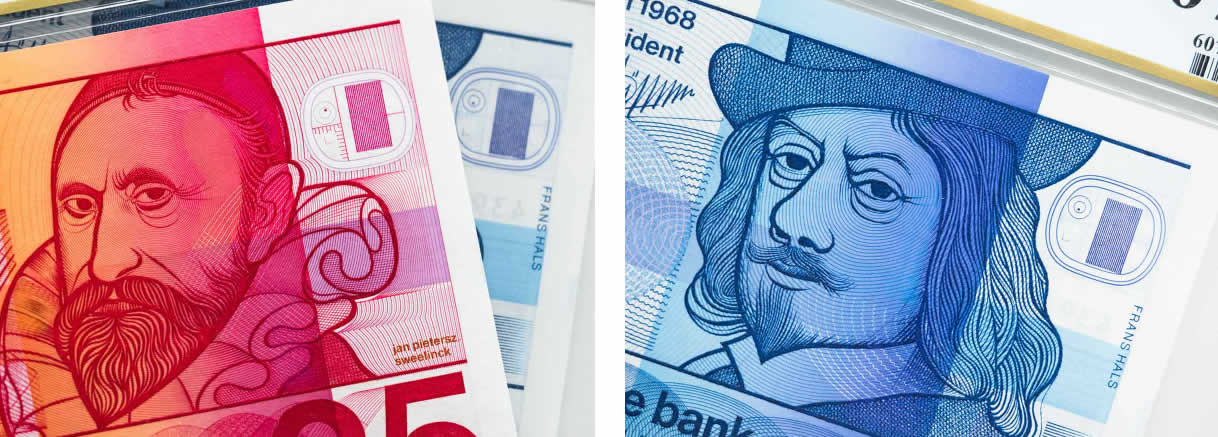
Later that day the clouds had lifted. Following an afternoon of riding trams and exploring kitschy paraphernalia shops that we weren't yet allowed to go into back home, our troupe of Canadian students were loitering outside our hostel near Dam Square. We were examining some of the unusual Dutch banknotes we had gathered. One girl had a note that caught my eye, and I asked her if I could take a closer look. I had never seen anything like it. I was mesmerized by this 50 Guilder work of art. Strikingly bold colors and unabashedly modern, but not in a cold way - in a beautiful and evocative way. The sunflowers on the banknote tapped into that Van Gogh cultural consciousness. Meanwhile, the color orange weaves throughout it - a color linked deeply to Dutch history as much as the colors red, white, and blue are for the United States of America. Without a portrait, and without a specific place or event depicted on the banknote, something special and uniquely Dutch was created.
This is the genius of Robert Deodaat Emile (Ootje) Oxenaar's banknote designs.
"Ah, Mr. Oxenaar, as usual!" Was a phrase that was certainly uttered more than once during Oxenaar's development as a graphic designer. Despite the artist's middle-class upbringing with a businessman father with a long, proud military background, his more free-thinking mother gave Ootje and his brother Ruut the freedom to follow their own unique academic paths in life. Although Ootje had an incomplete secondary education, in part due to the chaos of the Second World War, he nonetheless was accepted into the Hague Art Academy in 1947.
Read the Entire Article 





 Posted 06/03/2021 2:17 pm





