| Author |
 Replies: 7 / Views: 2,648 Replies: 7 / Views: 2,648 |
|
|
Valued Member
United States
271 Posts |
Greetings! Came across a 1986 that seems to have no copper. It does weigh the expected 2.5 grams and has the shape of a true 1986 Canadian cent. I have nothing to measure thickness, but a crude comparison shows similar, if not identical, thickness. Under high magnification I saw no signs of Copper in the creases or edges that might reveal something plated over copper (which might have added weight, too). So, if the weight is correct, might this be a planchet for a nickel? Might it have been plated with tin or zinc when it was not supposed to be in that order or way? Not sure how the wrong metal could be the right size and weigh the correct amount? Lots of interesting striations and swirl-like patterns on both sides in some places. Some of the microscope lines are from being out of sync with the camera... Otherwise there are a couple of long gouges and areas of parallel striations. Not sure, of course, whether these occurred before, during, of after minting. Gouges look after minting to me. Any suggestions would be appreciated. I also assume the value of the error is not worth a Mazzerati, although I am open to a trade.... 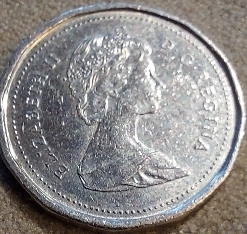 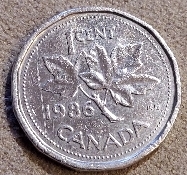 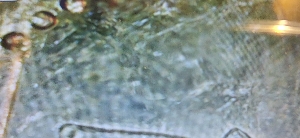 |
|
|
|
Pillar of the Community
Canada
1275 Posts |
Others familiar with off metal strikes will show up shortly but is it attracted to a magnet.
To me it looks like it's coated with something.
Cheers, Bill
|
|
Bedrock of the Community
Canada
21928 Posts |
More than likely a plated cent.
Possibly a high school experiment. I had one that I gave to my granddaughter
|
|
Pillar of the Community
Canada
5297 Posts |
I think it more likely that it was plated afterwards, not by the mint.
|
|
Pillar of the Community
Canada
1634 Posts |
Plated is my guess Can't have been struck on a nickel planchet as the weight is wrong (4.6 g) and the blank planchet (21.2 mm dia) wouldnt have fit in the 1c striking chamber due to the 1c planchet being smaller (19 mm dia). The RCM did mint copper nickel Dominican Republic 10 centavos coins in 1986 that were 2.5 g; however, the planchets were 18 mm dia, so you would expect to see missing devices around the edge. |
|
Moderator
 Canada
10477 Posts |
Full collar, full strike. My bet is that this is nickel-plated, and will be weakly attracted to a rare-earth magnet.
"Discovery follows discovery, each both raising and answering questions, each ending a long search, and each providing the new instruments for a new search." -- J. Robert OppenheimerContent of this post is licensed under a Creative Commons Attribution-NonCommercial 3.0 Unported License. See: http://creativecommons.org/licenses...0/deed.en_USMy eBay store
|
|
Valued Member
 United States
271 Posts |
Thanks for all the input. The coin is not magnetic (at a detectable level for the weak magnet I used).
I guess the Mazzerati trade is out....
|
|
Valued Member
United States
271 Posts |
Yes, JohnnySprawl I agree about the dimensions and weight being a clue, and as a consideration of volume of metal occupied by a planchet. Even if you considered the gram molecular weights of component metals, Nickel and Copper are numerically too different for this error to be a pure 5 cent planchet substitution.
Something like a high school experiment makes a lot of sense.
|
| |
Replies: 7 / Views: 2,648 |
|







 Posted 04/28/2021 7:12 pm





