Four of the five coins struck by the US Mint to help the organizers of the Panama-Pacific International Exposition raise funds include allegorical / mythological elements; the Exposition was held in San Francisco, CA from February 20, 1915 through December 4, 1915. The focus of this post, the Exposition's Quarter Eagle, is one of the four. It features an obverse full of mythological / allegorical elements that either date to the time of ancient Greece or derive inspiration from it.
The two elements that stand out immediately are the hippocampus, an ancient fictitious animal that combines the front quarters of a horse with the body and tail of a fish, and the allegorical figure of
Columbia - a personification of the United States.
Columbia is depicted seated side-saddle on the left-facing hippocampus; she is turned to face to the right. The Phrygian cap she is wearing is meant to symbolize the liberty and freedom enjoyed in the United States. Her left arm is extended and holding a caduceus which is included to represent the medical triumph over yellow fever that enabled the Panama Canal to be built / completed. (More on this below.) The caduceus, however, was not always a symbol of medicine/health (and it has never truly been an appropriate symbol for such).
Originally, in ancient Greek mythology, the caduceus was the wand or staff of the Greek god Hermes (Mercury in Roman mythology). Hermes served many roles for the Greeks, he is described as "not only the Thief, but also the Shepherd, the Craftsman, the Herald [Messenger], the Musician, the Athlete, and the Merchant." (1) In his role as a herald or messenger, Hermes does not actively engage in combat (keep this in mind for later). Also important, none of Hermes' assigned roles in ancient mythology link him to healing.
Hermes' caduceus was a wand with two snakes intertwined around it with their heads meeting at the top; it is often depicted surmounted by wings.
In the decade before the US Civil War, Hospital Stewards of the US Hospital Department began wearing arm chevrons that incorporated the caduceus as a signal of their
non-combatant status; the symbol continued to be used throughout the Civil War by the Stewards. (2)
In 1871, John Maynard Woodworth became the first Supervising Surgeon of the US Marine Hospital Service; the Marine Hospital Service later became the US Public Health Service and the position of Supervising Surgeon later became the now-familiar Surgeon General. Woodworth is credited with creating the organization's flag - he incorporated a caduceus into its design. The emblem on the flag continues to be used to the present; the caduceus is also included on the current emblem of the US Public Health Commissioned Corps (one of the eight Uniformed Services of the US).
The US Army Hospital Corps began using the caduceus unofficially in the 1880s. In 1902, the caduceus was officially adopted by the US Medical Corps, thus establishing a prominent link to medicine / healthcare. The adoption of the symbol, at least in part, came about at the suggestion of US Captain Frederick Reynolds, an Army surgeon. He had been promoting the use of the caduceus as the symbol of the Army's doctors and it was eventually adopted. It is not officially known whether the decision to adopt the caduceus was made because of the Medical Corps' non-combatant role during war or if it was believed it was associated with healing since ancient times.
The potential error in meaning was recognized by 1915 - the year of the coin's release - but, as the Army had already adopted the caduceus symbol, there was no stopping the spread of its use or the general public's association of the caduceus with medicine. For a symbol of healing, the more appropriate and correct symbol to use would have been the staff of Asclepius, a stout club with
one entwined snake. Asclepius was thought to have the power to heal the dead and is considered the god of Medicine.
Though the caduceus as a general symbol of healing was likely a poor choice, the intended symbolism behind its use by
Charles Barber, sixth Chief Engraver of the US Mint and designer/modeler of the coin's obverse, was sound.
Yellow fever was just one of the many obstacles that were faced during the construction of the Panama Canal; it was one of the most significant, however. The virus behind the disease causes high fever, pain, vomiting and, potentially, severe damage to the liver. Untreated, the issues resulting from the liver damage can cause death. Thousands of canal workers died from yellow fever, malaria and other tropical diseases during the time the French worked to construct the canal.
After the US took over construction of the canal, General Walter Reed, a US Army physician, researched how yellow fever was transmitted. Based on research initiated by Carlos Finlay, a Cuban physician, Reed confirmed that yellow fever was transmitted via mosquitoes. As a result, mosquito breeding sites were sought out and destroyed and standing water was drained. These efforts led to the yellow fever epidemic being overcome and the US being able to complete construction of the canal with a workforce that stayed healtheir and able to work on a consistent basis.
It was very fitting, therefore, to have at least one of the coins issued for the Exposition include acknowledgement of the important role medical science played in enabling construction of the canal to be completed - such acknowledgement came via the caduceus in
Columbia's hand. It's unfortunate that the caduceus was used vs. the staff of Asclepius if a symbol of medicine triumphing over disease was the goal!
1915 Panama-Pacific International Exposition Gold Quarter Eagle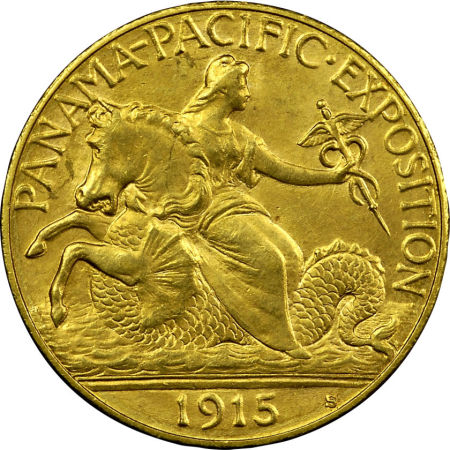
 Note: I do not own this coin yet, so I am presenting images of it courtesy of Heritage Auctions, http://www.ha.com.
For more on the Pan-Pac Quarter Eagle, check out:
-
1915 Pan-Pac International Exposition - Animal Kingdom ThreadFor other of my posts on commemorative coins and medals, see:
Read More: Commems Collection.
For a great background story on the efforts behind wiping out yellow fever in the canal zone, I highly recommend visiting the web site of the Pan-American Health Organization and reading the site's entry on the subject:
Control of Yellow Fever in the Canal Zone.
Sources Cited1. Brown, Norman O.
Hermes the thief; the evolution of a myth. New York (1969, c1947): Vintage Books. p 3.
2. "The Caduceus versus the Rod of Asclepius." National Museum of Civil War Medicine web site. Accessed April 30, 2021.
https://www.civilwarmed.org/caduceus-vs-asclepius/Source Consulted- Web site of the Pan-American Health Organization;
https://www.paho.org.



 Posted 04/30/2021 09:45 am





