PCGS - In 1852, when Commodore Matthew C. Perry sailed a squadron of gun boats into what is today Tokyo Bay, the closed country of Japan was brought to a nautical negotiation with the United States. While the negotiations took years to accomplish, the end result was the Treaty of Amity and Commerce between Japan and the United States, signed 1858, and enacted on July 4, 1859. As part of the treaty foreign coinage was allowed to circulate in Japan giving birth to a short-lived series of Japanese numismatics that ended less than a year later known as the Ansei
Trade dollar or San Bu.
With the opening of Yokohama for trade, merchants who brought with them the most common trade coin of the time, the Mexican 8 Reales, would be able to use such coins for commerce after these coins were stamped at the customs house. These coins were uniformly stamped in the rays above the cap of the Mexico 8 Reales with the characters "#23450;#19977;#20998;#25913;" or "Approval," "3 Bu," and "Exchange." The denomination of San Bu or 3 Bu comes from the Ichibu, the circulating rectangular coin in Japan at the time. It is unknown how many coins were approved for exchange with these countermarks by the government of Japan, but the practice ended May 12, 1860.
While incredibly scarce, these coins were not highly regarded until recently with countermarked coinage from around the world finding new favor with collectors. Researchers such as Kyle Ponterio would go on to explain the importance of these coins and develop a census of dates and mints showing just how scarce and unique these pieces are. Once people started to understand that these coins were only issued under government authority for one year and are Mexican coinage brought in by foreign merchants (including Americans), their importance was easily recognized. This caused demand and prices to increase dramatically as well as counterfeits to be introduced into the market.
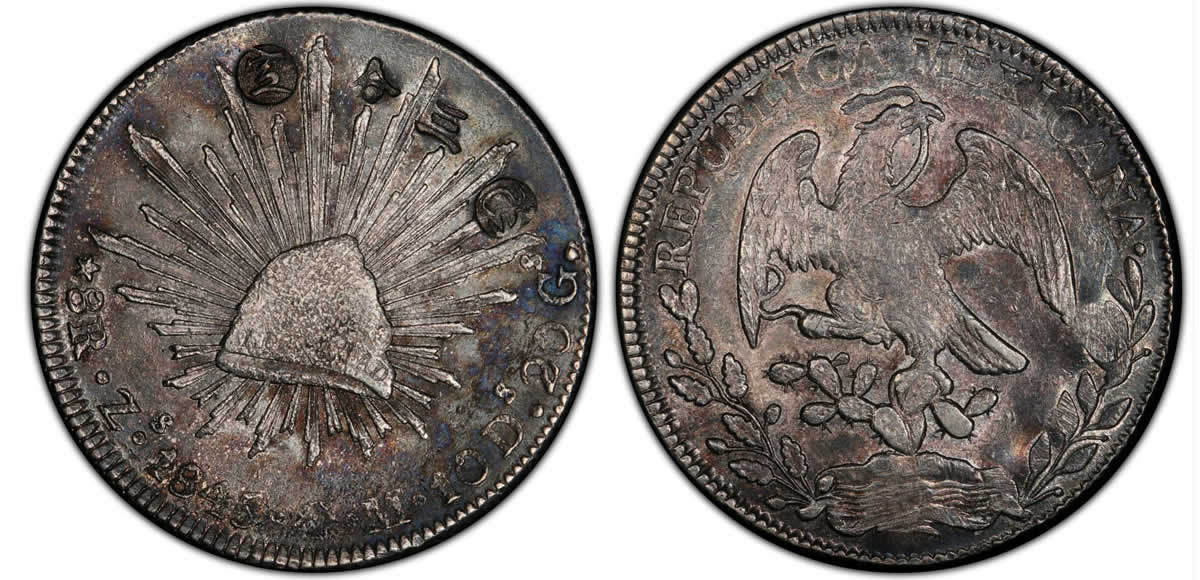 Japan (1859) 3 Bu Countermark on Mexico 1845 Zs OM 8 Reales, PCGS AU58
In a recent submission to the PCGS office in Hong Kong two examples of these rare coins were submitted for certification. One of these examples was a Mexico Zacatecas 1845 8 Reales. Before this piece, the earliest-known date for these issues was an 1849 Guanajuato Mint example. Prior to this example being noted, the earliest Zacatecas Mint example was on an 1856-dated host. The other specimen submitted was a counterstamp on an 1857 Mexico City Mint host, which has two other examples noted in the census from this date and mint. The host from Zacatecas 1845 was graded PCGS AU58. The Mexico City 1857 piece was graded PCGS MS61.
It is unknown what exists and is yet to be found around the world. This submission brought two examples of a coin countermarked for the opening of Japan in 1859, symbolizing the influx of trade that came with it. Well preserved over 160 years later, these important historical pieces have now been certified as genuine and protected by PCGS.










 Posted 10/19/2021 10:42 am


