PCGS - At least three U.S. Mint coins still in use today have seen two significantly different mint mark positions, including the
Roosevelt dime,
Washington quarter, and
Kennedy half dollar - all of which saw mint marks at a certain spot on the reverses of the coins before this tiny feature was moved to their obverses. And as the mint mark (or lack thereof) usually indicates which facility of the United States Mint struck a coin and often denotes a coin to be common or rare, knowing where mint marks are located on any given coin is of great importance to the collector. However, one coin still in use today has seen five distinctly different mint mark locations over the course of its history. This coin is the
Jefferson nickel!
The
Jefferson nickel premiered in 1938 and branch-mint issues saw the inclusion of a mint mark on the reverse just to the right of Monticello, with "D" indicating coins struck in Denver and "S" symbolizing specimens from the San Francisco Mint. Originally,
Jefferson nickels lacking a mint mark signaled coins made at the Philadelphia Mint.
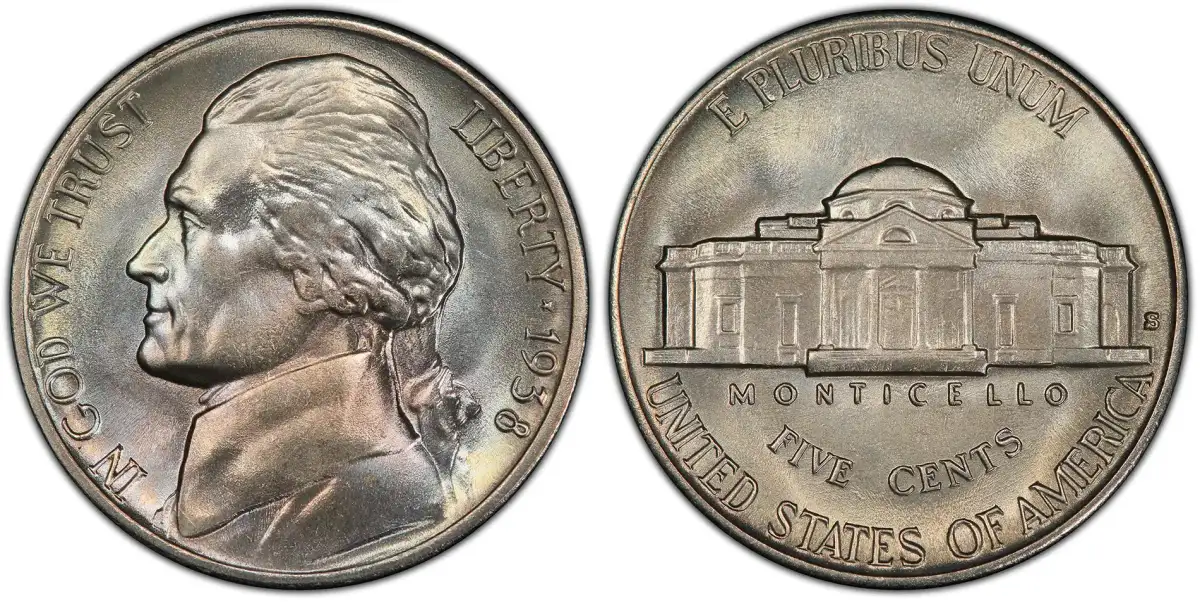 This 1938-S Jefferson nickel shows the "S" mint mark to the right of Monticello, the mint mark location on the coin from 1938 through 1942 and again from 1946 through 1964.
However, things soon changed for the
Jefferson nickel, a coin traditionally consisting of a 75% copper, 25% nickel composition. Emergency materials rations during World War II led to the replacement of the original copper-nickel alloy in favor of one made from 56% copper, 35% silver, and 9% silver beginning in 1942.
 All Jefferson "Nickels" made from 1942 through 1945 with the silver wartime alloy show their mint marks over the dome of Monticello, including a first-ever "P" mint mark denoting coins from Philadelphia.Read the Entire Article






 Posted 11/23/2021 4:00 pm


