


Coin Community Family of Web Sites Join Thousands of Coin, Bullion, & Money Collectors
Vancouvers #1 Coin and Paper Money Dealer 300,000 items to help build your collection! Coin, Banknote and Medal Collectors's Online Mall Shop for APMEX Bullion on eBay!Royal Canadian Mint products, Canadian, Polish, American, and world coins and banknotes. Join Thousands of Coin, Bullion, & Money Collectors Specializing in Modern Numismatics


Username:
Password:
Save Password
Forgot your Password?


This page may contain links that result in small commissions to keep this free site up and running.

Welcome Guest! Registering and/or logging in will remove the anchor (bottom) ads. It's Free!

Extension Expands Import Restrictions On Coins That Circulated In Greece

To participate in the forum you must log in or register.
Author Previous TopicReplies: 4 / Views: 1,016Next Topic  
Press Manager
Learn More...
CCFPress's Avatar
United States
1420 Posts
 Posted 12/05/2021  12:52 pm Show Profile   Bookmark this topic Add CCFPress to your friends list Get a Link to this Message Number of Subscribers
Coin World - When import restrictions on Greek coins were extended with a Nov. 21 notice in the Federal Register, coin collectors received a surprise: the addition of a whole new class of coins falling under the restrictions.

Now, import restrictions apply to coins from the Byzantine and medieval periods that primarily circulated in Greece.

This category includes coin types such as those of the Byzantine and medieval Frankish and Venetian states that circulated primarily in Greece, ranging in date from approximately the third century A.D. to the 15th century A.D.

The expansion of restrictions comes 10 years to the day from when import restrictions on Greek coins were agreed upon in a Nov. 21, 2011, memorandum between the United States and Greece (the rules were implemented Dec. 1, 2011, and have been renewed periodically since then).

Extension-Expands-Import-Restrictions-On-Coins-That-Circulated-In-Greece
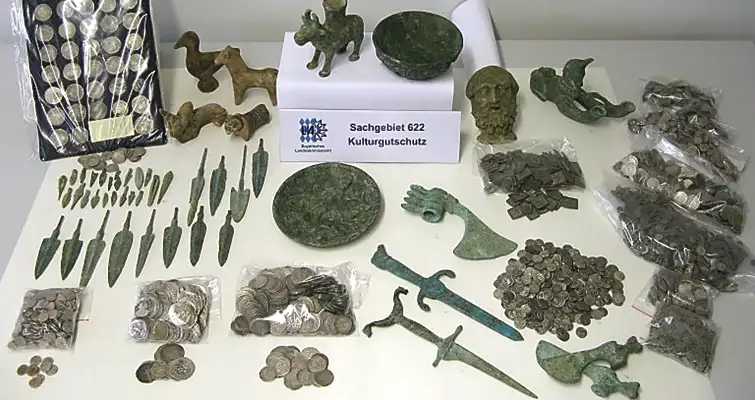
The fight in recent years over how best to respect cultural property is global and wide-ranging, and led to the seizure of objects from a dealer at a German coin show in Munich in 2017, shown here.

Read the Entire Article
Pillar of the Community
United States
2217 Posts
 Posted 12/06/2021  1:45 pm  Show Profile   Bookmark this reply Add livingwater to your friends list Get a Link to this Reply
Wow. They are really expanding the years for restrictions. Sad. I'm concerned such restrictions will continue. In one article I read a while back with photos of items confiscated, some coins/objects I'm pretty sure were fakes. Authorities couldn't tell the difference between genuine or not. IMO this won't do much to stop looting of sites or smuggling. Countries like Greece, Turkey, etc. should pass laws similar to Great Britain where finders are paid for what they discover if the government wants it. This has worked well for properly reporting discoveries.
Edited by livingwater
12/06/2021 2:00 pm
Pillar of the Community
Russian Federation
5172 Posts
 Posted 12/06/2021  2:06 pm  Show Profile   Bookmark this reply Add january1may to your friends list Get a Link to this Reply

Quote:
IMO this won't do much to stop looting of sites or smuggling.
In fact I suspect that for the valuable items it will just make looting/smuggling worse, as the finders would try to cover their tracks, while the common items would either rot in random museum basements or get destroyed, which would just be looting with extra steps.

There are also likely to be knock-on effects on nearby countries, though AFAIK most countries near Greece already have similarly restrictive laws, so there shouldn't be a lot of problems with coins legally found outside Greece being confiscated by Greek authorities - but only because they'd get confiscated earlier in the chain.
Moderator
Learn More...
Sap's Avatar
Australia
16809 Posts
 Posted 12/06/2021  5:35 pm  Show Profile   Bookmark this reply Add Sap to your friends list Get a Link to this Reply

Quote:
Countries like Greece, Turkey, etc. should pass laws similar to Great Britain where finders are paid for what they discover if the government wants it. This has worked well for properly reporting discoveries.

It works well for Britain, because Britain is a rich country that is (comparatively) poor archaeologically. Greece and Turkey are near-bankrupt countries, and are so jam-packed with archaeology that it's difficult to put a shovel in the ground anywhere without digging up something archaeological.

Greece and Turkey simply can't afford to pay all discoverers "fair market value" - it would bankrupt them, and they know it. So they have chosen the path of suppression, simply because it's cheaper. Eminent domain, cultural protectionism and drawing an artificial line through history somewhere (for Greece it's 1826, for Turkey it's halfway through 1876) and declaring that coins on this side of the line are OK for people to collect, but anything on the far side of the line is property of the State and forbidden. The doctrine is also embedded in the education system, where they teach kids that collecting old coins or other antiquities is evil, selfish and unpatriotic.
Don't say "infinitely" when you mean "very"; otherwise, you'll have no word left when you want to talk about something really infinite. - C. S. Lewis
Pillar of the Community
Australia
1610 Posts
 Posted 12/07/2021  4:10 pm  Show Profile   Bookmark this reply Add David Graham to your friends list Get a Link to this Reply
This seems a really complex situation. I agree that restricting the items will only push up prices on the black market which in turn encourages more looting. A similar thing occurs with illegal drugs in Australia. Law enforcement does a pretty good job at apprehending illegal imports but this has had the effect of pushing up prices making Australia very profitable for drug syndicates. When you get party pills manufactured in Europe that are designed for Oz with 'G'day' and kangaroos on them you know the dealers have their eyes on the country.

Agree with Sap regarding these countries being unable to afford a scheme like Britain. Maybe they need to let go of some of the material. If an item is found and temporarily handed over to the authorities then it can be fully documented and studied and a QR code or similar assigned to it. If the item is of high cultural value it can be paid for, if not, the finder can keep it. The info can be uploaded onto the web (similar to PCGS). That way archaeologists etc still have the information. This would also be good for collectors because having your items shown on the webpage is evidence that the goods have been acquired through the right channels.
Edited by David Graham
12/07/2021 4:11 pm
  Previous TopicReplies: 4 / Views: 1,016Next Topic  

To participate in the forum you must log in or register.


Disclaimer: While a tremendous amount of effort goes into ensuring the accuracy of the information contained in this site, Coin Community assumes no liability for errors. Copyright 2005 - 2026 Coin Community Family- all rights reserved worldwide. Use of any images or content on this website without prior written permission of Coin Community or the original lender is strictly prohibited.
Contact Us  |  Advertise Here  |  Privacy Policy / Terms of Use

Coin Community Forum © 2005 - 2026 Coin Community Forums
It took 0.3 seconds to rattle this change. Forums