










 Posted 07/06/2021 6:59 pm


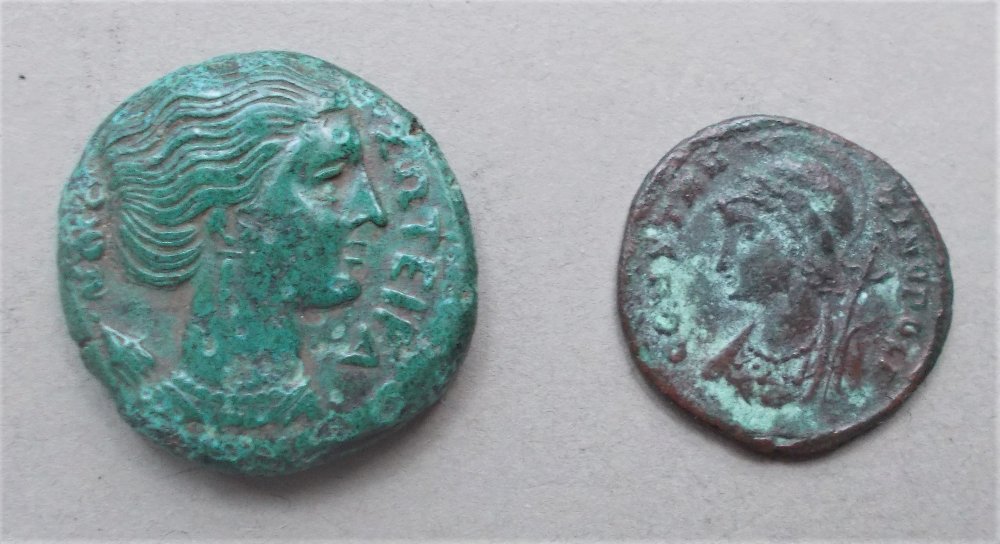
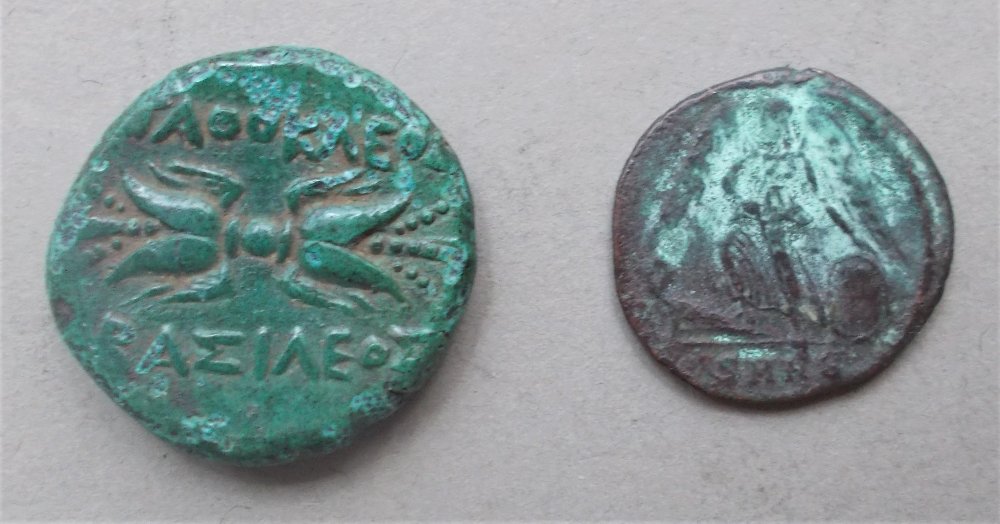
The one on the left is "good green" - ancient bronzes pretty much always look like that in their "natural" state.
The one on the right is "bad green". This pale powdery form of corrosion is "bronze disease". It should be treated, in order to conserve the remainder of the coin as, if left to itself, the green will slowly spread across the rest of the coin.
Back to the first coin, it looks as if it has been treated to remove some bronze disease. See the bright green "craters" across the king's name? I'm a little concerned, given the remaining bits of bright green, that the treatment was ineffective and the bronze disease could continue to spread.
The main problem with bronze disease is that it can go down into the coin, as well as across it; when the bronze disease is removed, it leaves behind "craters" like you see on the first coin.
The one on the right is "bad green". This pale powdery form of corrosion is "bronze disease". It should be treated, in order to conserve the remainder of the coin as, if left to itself, the green will slowly spread across the rest of the coin.
Back to the first coin, it looks as if it has been treated to remove some bronze disease. See the bright green "craters" across the king's name? I'm a little concerned, given the remaining bits of bright green, that the treatment was ineffective and the bronze disease could continue to spread.
The main problem with bronze disease is that it can go down into the coin, as well as across it; when the bronze disease is removed, it leaves behind "craters" like you see on the first coin.
Don't say "infinitely" when you mean "very"; otherwise, you'll have no word left when you want to talk about something really infinite. - C. S. Lewis


