Collectors of the classic US series of commemorative coins are well aware of the 1946 half dollar that commemorates the centennial of Iowa's statehood (1846-1946). Most collectors, however, are not aware that the coin might not have been issued if a proposal for a commemorative half dollar for the centennial of the formation of the Iowa Territory had become law.
The area now referred to as the State of Iowa was initially part of the unorganized territory acquired from France via the Louisiana Purchase (1803), When the present-day area of Louisiana became the Orleans Territory (1804), present-day Iowa's area became part of the large District of Louisiana that encompassed the balance of the Louisiana Purchase territory. The District became the organized Louisiana Territory in 1805 - there was no change in Iowa's status, however.
Louisiana Territory Map Circa 1804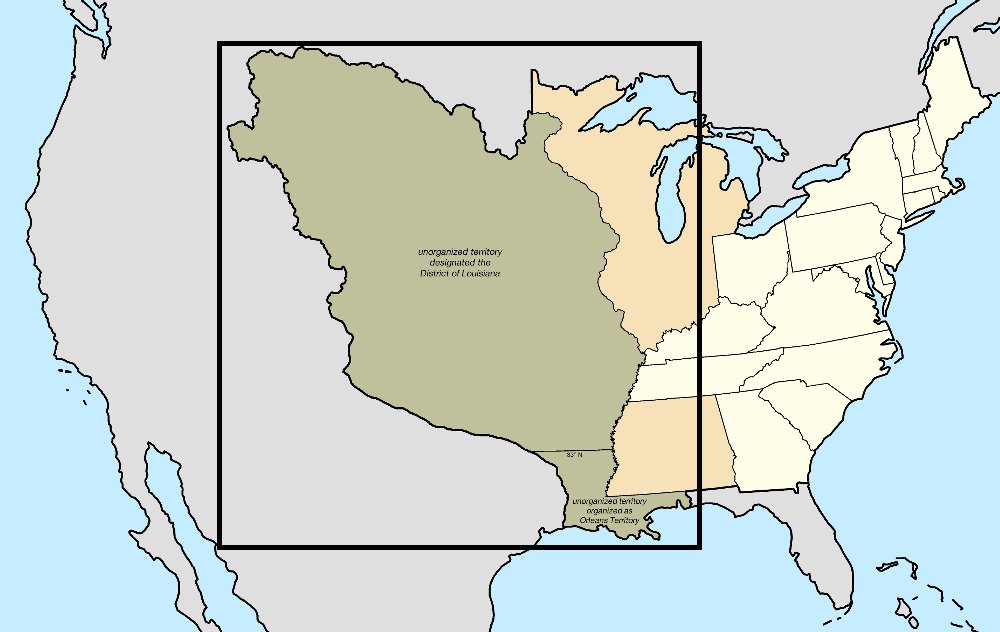 (Image Credit: Golbez, CC BY-SA 4.0 https://creativecommons.org/licenses/by-sa/4.0, via Wikimedia Commons.
The Louisiana Territory was renamed as the Missouri Territory in 1812. A southern segment of the Missouri Territory was cut out to create the Arkansas Territory in 1819; again, no change to Iowa resulted. The southeast corner of the Missouri Territory was carved out to become the State of Missouri in 1821, with the balance of the area returning to "unorganized" status. Part of the unorganized territory, including Iowa's area, was added to the Michigan Territory in 1834. When Michigan moved to become a state, the land area of Iowa became the Iowa District within the Wisconsin Territory (1836). In 1838, Iowa's status officially changed as the US Congress passed legislation that created the Territory of Iowa from the western region of the Wisconsin Territory.
Louisiana Territory Map Circa 1838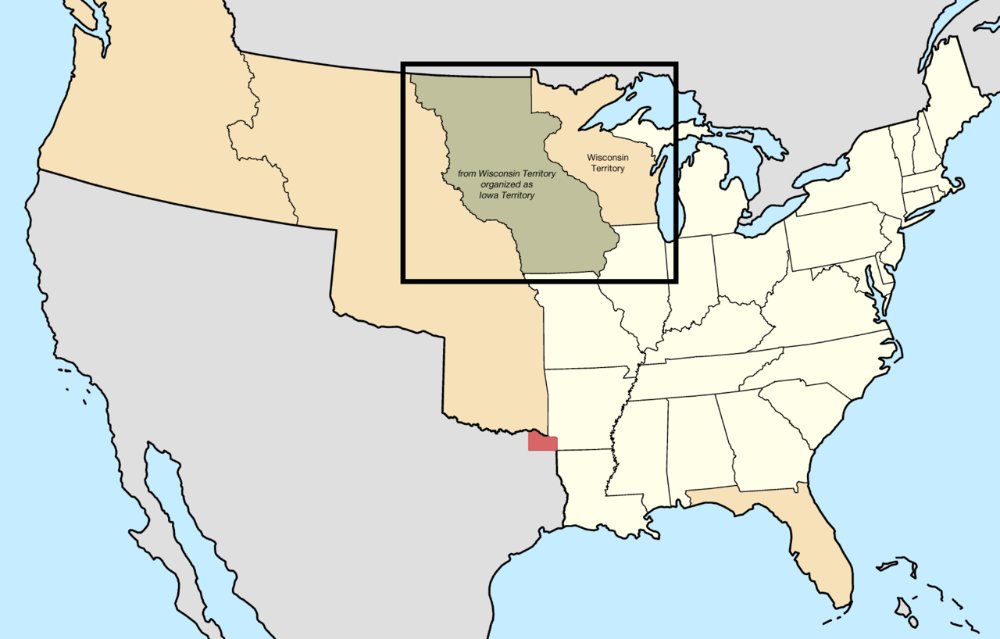 (Image Credit: Golbez, CC BY-SA 4.0 https://creativecommons.org/licenses/by-sa/4.0, via Wikimedia Commons.
The Iowa Territory was much larger than the area that became the State of Iowa, as it included area that stretched north of Iowa's present-day border and included parts of present-day Minnesota and the Dakotas. Iowa took on its current borders in 1846 when it became the 29th State of the Union.
The Iowa Territory coin bill was introduced in the House by Representative Lloyd Thurston (R-IA) in July 1937; it was immediately referred to the House Committee on Coinage, Weights, and Measures. The Committee reviewed the bill and reported on it favorably, in its report it stated, "It was the feeling of the committee that inasmuch as counties, cities and other political subdivisions have been extended a similar privilege, that one of the 48 States of the Union is entitled to this courtesy, especially in view of the importance of the occasion hereinbefore mentioned." Not exactly a ringing endorsement - more like a resigned acceptance of the abuses seen in the US commemorative coin series to my eyes - but it was accompanied by a recommendation for passage.
The bill called for 100,000 silver half dollars of standard specifications for the benefit of the Iowa Centennial Committee. If the coins were sold at a premium by the Committee, it was to use the proceeds to help pay for the statewide celebrations planned for the centennial anniversary. The coins were to be struck at only one Mint facility, to carry only the "1938" date and to only be available for striking by the Mint for a period of one year following the bill's enactment. The bill was never considered by the full House or referred to the Senate for its consideration. As a result, it died a quiet death.
The legislation did not specify a design for the coin, but I can imagine a coin very similar to what was seen in 1946: the Seal of the Territory (vs. State) and appropriate changes to inscriptions on the obverse and the Old Stone Capitol in Iowa City on the reverse. The Old Stone Capitol served as the center of Government for the Territory from 1842 to 1846 and in the first years of the State until 1857; at that point, the Government moved to Des Moines.
Seal of Iowa Territory circa 1838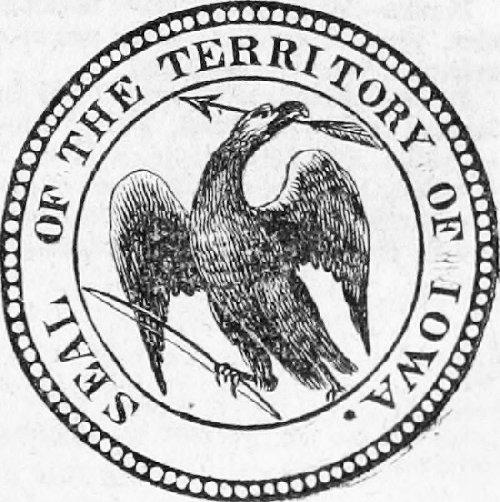 (Image Credit: Willson, Marcious. American History. Cincinnati: WH Moore & Co., 1847.)1946 Iowa Statehood Half Dollar

I'm not aware of a 1938 commemorative medal being struck for the centennial of the Iowa Territory to replace the failed coin, but the Post Office did issue a three-cent stamp for the anniversary.
1938 Iowa Territory Centennial Stamp
If the coin bill had been successful, it is very likely that Congress would
not have approved another coin in 1946 to mark Iowa's Statehood Centennial. Though I'm sure it was disappointing to not get approved for the 1938 Territorial coin, I'm thinking the 1946 Statehood coin more than made up for it!
For more on the Iowa Statehood commemorative half dollar, check out:
-
1946 Iowa Statehood Centennial-
1946 Iowa Statehood Centennial - Redux-
1946 Iowa Statehood Centennial - Coins Depicting Places ThreadFor other of my posts about commemorative coins and medals, plus more What If? stories, have a look at:
Read More: Commems Collection.










 Posted 07/23/2021 5:47 pm


