| Author |
 Replies: 10 / Views: 1,325 Replies: 10 / Views: 1,325 |
|
|
Pillar of the Community
Australia
1617 Posts |
I got hold of 9 old Indian coins for a good price and having only a few later Princely State coins I thought these would be a nice addition. Only problem is, I'm getting nowhere identifying the first few I've looked at so am hoping the learned members of CCF can help out. So first coin off the rank is: 20.0-20.7mm diameter ~4.8mm thick Weight = 12.65g Metal - looks like copper. Was actually taken aback at how chunky some of these coins are. Had no idea until I took them out of the package.  Also, is there a good website on identification of these coins that does not involve spending hours looking at random pictures? I am hoping once I get an ID for each coin that I can learn more about it. I currently have no idea what the writing is. On that note, apologies if the coin orientation in the pics is incorrect. I don't know which way is up or down.  Thanks  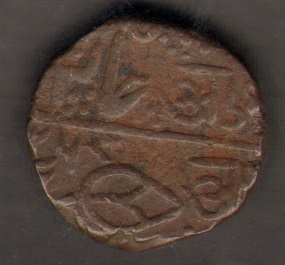 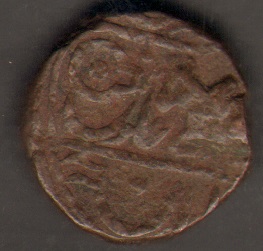 Edited by David Graham
08/10/2021 03:24 am
|
|
|
|
Pillar of the Community
United Kingdom
2490 Posts |
Rightly or wrongly, I usually associate that leaf design with coins issued by the Sikhs.
|
|
Pillar of the Community
United States
7067 Posts |
|
|
Pillar of the Community
United States
636 Posts |
Yes, many Sikh Empire coins show leaves, but this style of leaf (a bilva leaf) is from Indore. For example, not a match to your coin, but showing this type of leaf https://www.zeno.ru/showphoto.php?photo=170370I also notice a lingam on your coin, about 10 o'clock on the second photo, and several Indore coins have lingams. I believe your coin is a half anna from Indore as a British protectorate, in the name of Shah Alam II, period 1759-1806 AD. The weights varied widely, from 12-20 g. I see some related coins with bilva leaves (KM 63.1, 64, 68, 93.2, 93.4) but I didn't notice a match to your coin in Krause or Zeno. Indian numismatics is the most complex in the world. There were over 100 kingdoms with over 1000 rulers, many languages, many denominations, and many dating systems. In general, searching in the Zeno database (search.zeno.ru) using a range around the weight and diameter can help ID Indian coins, but it's still necessary to look through a lot of photos. Edited by Seeker55
08/10/2021 11:14 am
|
|
Pillar of the Community
 Australia
1617 Posts |
Thanks heaps for the responses. Just getting to know some more terms helps a lot. I don't mind looking at photos so long as I'm looking in the right area!  |
|
Pillar of the Community
United Kingdom
1324 Posts |
nobody notice the date?
AH1267 (1850), so this coin is KM#64...
|
|
Pillar of the Community
Australia
1617 Posts |
AndyG - Yes, that's the one. The knowledge of many CCF members is astounding!  I didn't realise how much movement there was. The linga is almost out of view in the sample on the web whereas in my coin the reclining bull is half out of view compared to the sample on the web. Can I please ask where the date is located on the coin and how you decipher it? Thanks  |
|
Pillar of the Community
United Kingdom
1324 Posts |
As ever with Indian coins, not everything makes the flan - the picture in Krause, whilst being an actual coin is not all that helpful as different bits of the design are on that particular specimen. Below the "268" of the 1268. 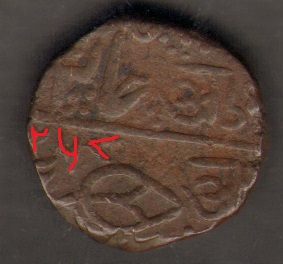 Edited by andyg
08/10/2021 4:31 pm
|
|
Pillar of the Community
Australia
1617 Posts |
Thanks AndyG. What language or script are the numbers in? They look arabic but the 8 is rotated. Ta.
|
|
Pillar of the Community
United Kingdom
1324 Posts |
The numeral chart in Krause (at the start) states it's Hyderabad Arabic.
It's also 1267 - not 1268 :)
|
|
Pillar of the Community
Australia
1617 Posts |
Thanks AndyG. The chart at the start of Krause is indeed handy.
|
| |
Replies: 10 / Views: 1,325 |
|





 Posted 08/10/2021 09:37 am





