| Author |
 Replies: 12 / Views: 1,732 Replies: 12 / Views: 1,732 |
|
|
Valued Member
Georgia
166 Posts |
2.2. g, 24 mm. Any ideas? 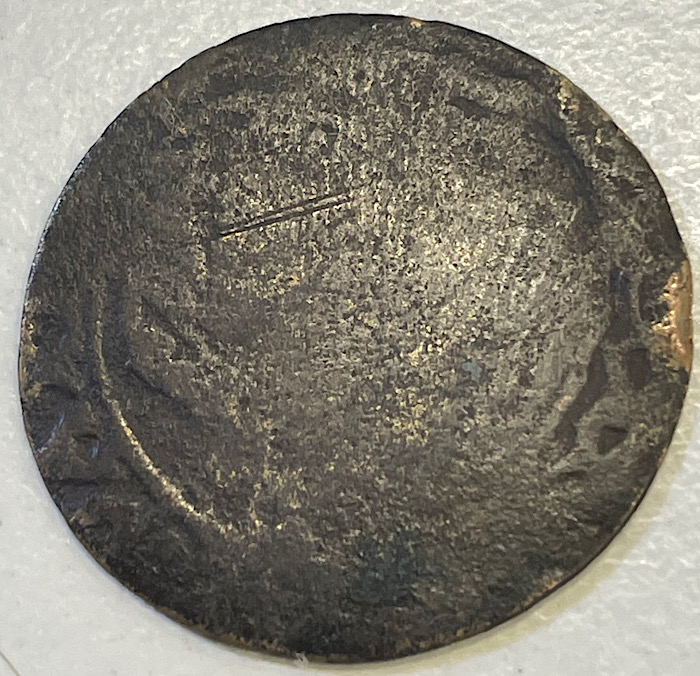 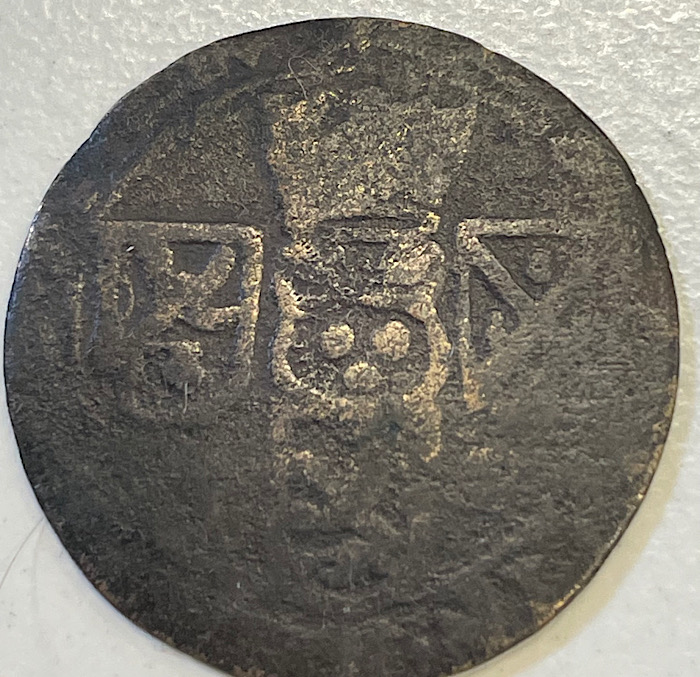 |
|
|
|
Bedrock of the Community
United Kingdom
18619 Posts |
It looks to me like a 17th-century Liard issued by one of the states that now make up Belgium, Luxembourg and the Netherlands. There are lots of different varieties - I am sure someone on the Forum will be able to identify it!
|
|
Pillar of the Community
 United States
8038 Posts |
I agree but could not come up with a match. ANd that weight is a bit light for a liard. The central device between the shields is a briquet for a number of those states, but this does not appear to be one (or is very poorly executed). For Liege that central device is something different, but certainly not a match. Reckheim specialized in making "official" counterfeits that looked like coins of some of these other places, so maybe that's an option?  |
|
Pillar of the Community
United States
8038 Posts |
Some thoughts, but no answer, and maybe this reproduces research you've already done: 1. "Spanish Netherlands" (extending as far south as Tournai) produced liards with this general design (crowned briquet with three shields) 1618-1696, but the shields are not correct for the Burgundian-Hapsburg rulers, which usually have 3:00 Burgundy (diagonal stripes), 6:00 Brabant (rampant lion left), 9:00 Austria (horizontal bar). https://en.numista.com/catalogue/pieces8590.html One exception occurred on some coins minted for Breda in 1620s, which had a shield replacing the central briquet (so, a total of 4 shields: Burgundy (9:00)-AUstria (center)-Brabant(3:00), Breda (6:00). Still not a match https://en.numista.com/catalogue/pieces48253.html Also, the weight of your coin is more consistent with a gigot/duit than with a liard/oord, which weighed 3.8 g. 2. Namur made coins with this design, but only used different shields in 1712, when all three shields had a rampant lion left (still no match): https://en.numista.com/catalogue/pieces44729.html 3. The common 18th century liards of Liege have four shields , so are not a match, but for a short time in the 17th century we find a design with 3 shields. But always for Liege, the city symbol is in the center, and the content of these 3 shields does not match: https://www.acsearch.info/search.html?id=6473197Always, for Spanish Netherlands area, there is a problem of the weight not matching expected values for the two copper coins. So, my thought is maybe this is a token (there were many being made in this part of Europe in the 17th century), or comes from a nearby area that I don't know very well. |
|
Pillar of the Community
Sweden
2124 Posts |
Good research there, @tdziemia. I have been looking for a match too, without success.
What puzzled me from start is the lion rampant facing right (the leftmost shield). That is an unusual figure in heraldry. Almost always does the lion face left (except when there are two lions facing each other, usually holding a shield or something between them). I have found a few small villages in France and some minor noble family that have a lion rampant facing right in their coat of arms, but none seem to have been involved in any minting.
So your theory about it being a token, might be the best so far.
|
|
Pillar of the Community
United States
8038 Posts |
Thanks @erafjel. As you say, the right facing lion is elusive (also leading me to think it is a non-official issue). I think Gueldres/Gelderland pairs right- and left-facing rampant lions, but never the right facing one alone.
|
|
Valued Member
 Georgia
166 Posts |
Thanks, guys, it was very illuminating. Looking at the middle shield - could it be a Courtenay coat of arms (three roundels)?
|
|
Valued Member
Georgia
166 Posts |
Also, given it's apparently an unofficial issue/token, does it have any significant numismatic value?
|
|
Pillar of the Community
Sweden
2124 Posts |
Quote:
Looking at the middle shield - could it be a Courtenay coat of arms (three roundels)? Hard to tell, given that there is an upper part of that shield which I cannot make out. Quote:
does it have any significant numismatic value? I would say no, since it is very worn and cannot be properly attributed. |
|
Valued Member
Georgia
166 Posts |
|
|
Pillar of the Community
Belgium
651 Posts |
This is a coin of the county of Gronsveld, a small county in nowadays Netherlands Limburg. https://en.numista.com/catalogue/pieces61545.htmlThis county, part of the Holy Roman Empire, issued, like its neighbour Reckheim, light-weight coins which looked similar to the coins of neighbouring Liege, Spanish and northern Netherlands. |
|
Pillar of the Community
Sweden
2124 Posts |
Mystery solved, thanks @bart!
In Numista it (and three other coins from Gronsveld) is termed "Gronsveld - Gulden Counterfeit". Should this be interpreted as that counterfeiting (imitating?) neighboring areas money was what Gronsveld was into?
|
|
Pillar of the Community
Belgium
651 Posts |
Quote:
In Numista it (and three other coins from Gronsveld) is termed "Gronsveld - Gulden Counterfeit". Should this be interpreted as that counterfeiting (imitating?) neighboring areas money was what Gronsveld was into? Indeed. As an independent county, member of the Holy roman Empire, Gronsveld and also Reckheim, were entitled to issue their own coins for internal use. Instead they made light weight imitations of the coins of neighbouring countries so those coins could circulate there. In fact this was counterfeiting, but as their coins were not copies, but only look-a-likes, they got away with it. |
| |
Replies: 12 / Views: 1,732 |
|










 Posted 09/07/2021 11:06 pm


